Monte-Carlo-Simulation-of-Radioactive-Decay
Monte Carlo particle decay simulator with detector inefficiencies, statistical validation, and interactive 2D/3D animat…
 MussabPro
git clone https://github.com/MussabPro/Monte-Carlo-Simulation-of-Radioactive-Decay.gitMussabPro/Monte-Carlo-Simulation-of-Radioactive-DecayMonte Carlo Simulation of Radioactive Particle Decay
A research-grade Monte Carlo simulation of exponential particle decay, featuring multi-channel branching ratios, realistic detector modelling, rigorous statistical analysis, and three distinct visualisation modes (2-D grid, 3-D rotating cloud, real-time interactive).
Developed for the KEK Summer Student Program 2026 application.
Physics Background
Radioactive decay is a quantum-mechanical process in which an unstable nucleus (or subatomic particle) transforms into a lighter system. The number of surviving particles follows
$$N(t) = N_0 , e^{-\lambda,t}$$
where $\lambda$ is the decay constant and $\tau = 1/\lambda$ is the mean lifetime. This project uses the Monte Carlo method—drawing random samples from the corresponding exponential distribution—to reproduce the decay curve, complete with realistic statistical fluctuations.
See docs/PHYSICS_BACKGROUND.md for a longer, accessible explanation.
Features
- ✅ Basic exponential decay — generate and analyse decay-time distributions
- ✅ Multi-channel decay — branching ratios with per-channel statistics
- ✅ Detector effects — efficiency, acceptance cuts, resolution smearing
- ✅ Statistical analysis — mean lifetime, χ² goodness-of-fit, bootstrap CI
- ✅ Publication-quality plots — histograms, decay curves, parameter scans
- ✅ 2-D grid animation — particles disappearing on a colour-coded lattice
- ✅ 3-D particle cloud — rotating Matplotlib animation with fading
- ✅ Real-time interactive — Pygame simulation with keyboard controls
Installation
# Clone the repository
git clone https://github.com/MussabPro/Monte-Carlo-Simulation-of-Radioactive-Decay.git
cd Monte-Carlo-Simulation-of-Radioactive-Decay

# (Recommended) create and activate a virtual environment
python -m venv .venv
source .venv/bin/activate

# Install dependencies
pip install -r requirements.txt
Quick Start
from src.basic_simulation import run_basic_simulation
from src.visualization import plot_decay_histogram

results = run_basic_simulation(n_particles=10_000, decay_constant=0.1)
print(f"Mean lifetime: {results['mean_lifetime']:.2f} "
      f"(theory: {results['theoretical_mean']:.2f})")

plot_decay_histogram(results["decay_times"], 0.1, show=True)
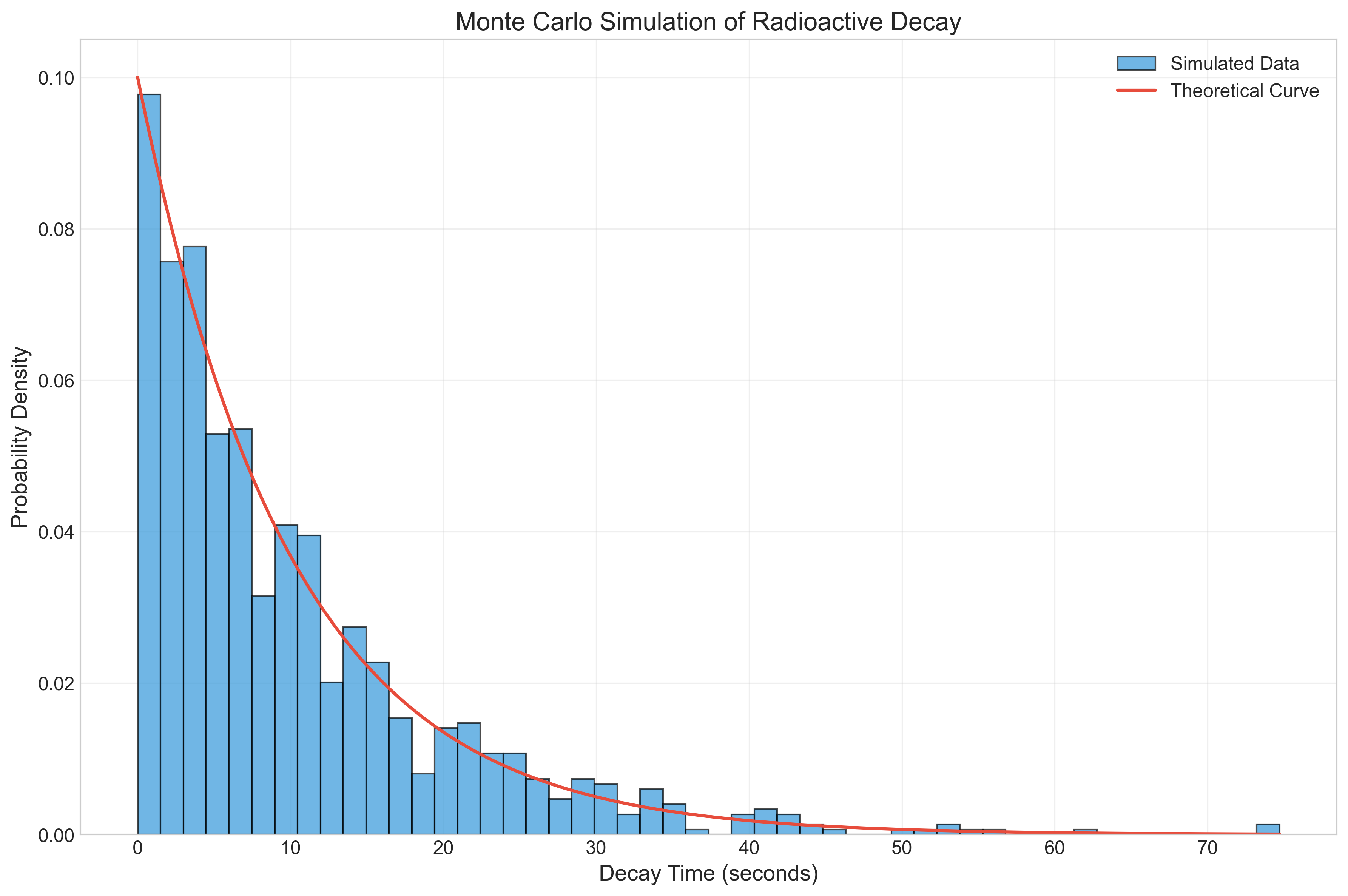 Figure 1: Simple exponential decay distribution generated with 10,000 particles.
Usage Examples
Ready-to-run scripts live in examples/:
python examples/run_basic.py            # Simple 1 000-particle simulation
python examples/run_multichannel.py     # 3-channel B-meson-style decay
python examples/run_full_analysis.py    # Full pipeline with detector effects
python examples/generate_animations.py  # Generate 2-D and 3-D animations
All outputs are saved to results/.
Visualizations & Results
Below are examples of the results generated by the simulation scripts, showcasing basic decay distributions, multi-channel branching, detector effects, and real-time animations.
1. Statistical Analysis & Detector Modelling
The simulation produces publication-quality plots using Matplotlib, including lifetime fits, parameter sensitivity scans, and comparisons between ideal and 'measured' distributions.
| Analysis Type | Plot Output |
|---|---|
| Full Decay Curve: Fits the generated decay times to an exponential model, retrieving the mean lifetime with statistical uncertainties. | 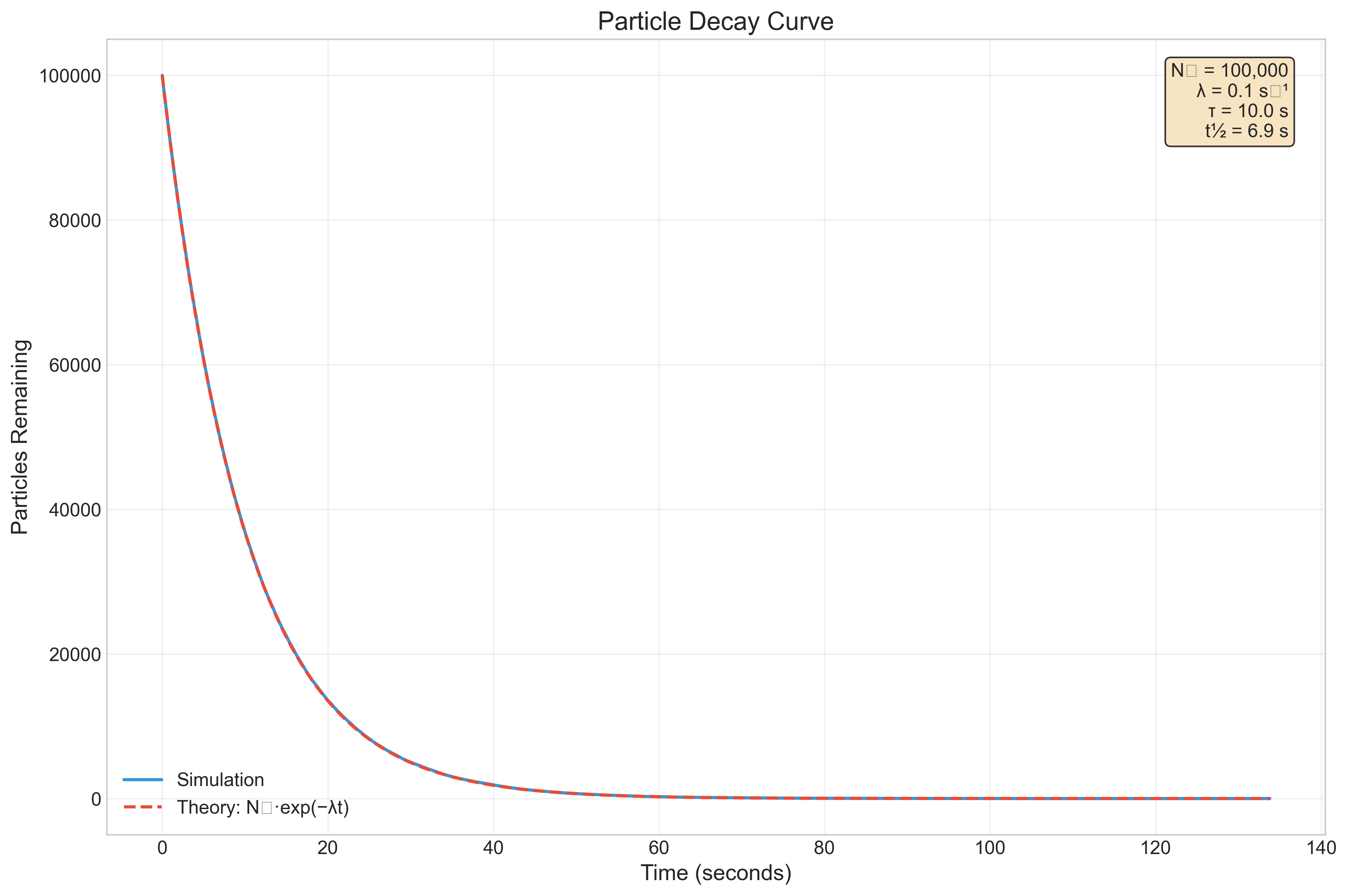 |
| Detector Effects Comparison: Comparison of the 'true' distribution versus the distribution after efficiency cuts and resolution smearing. | 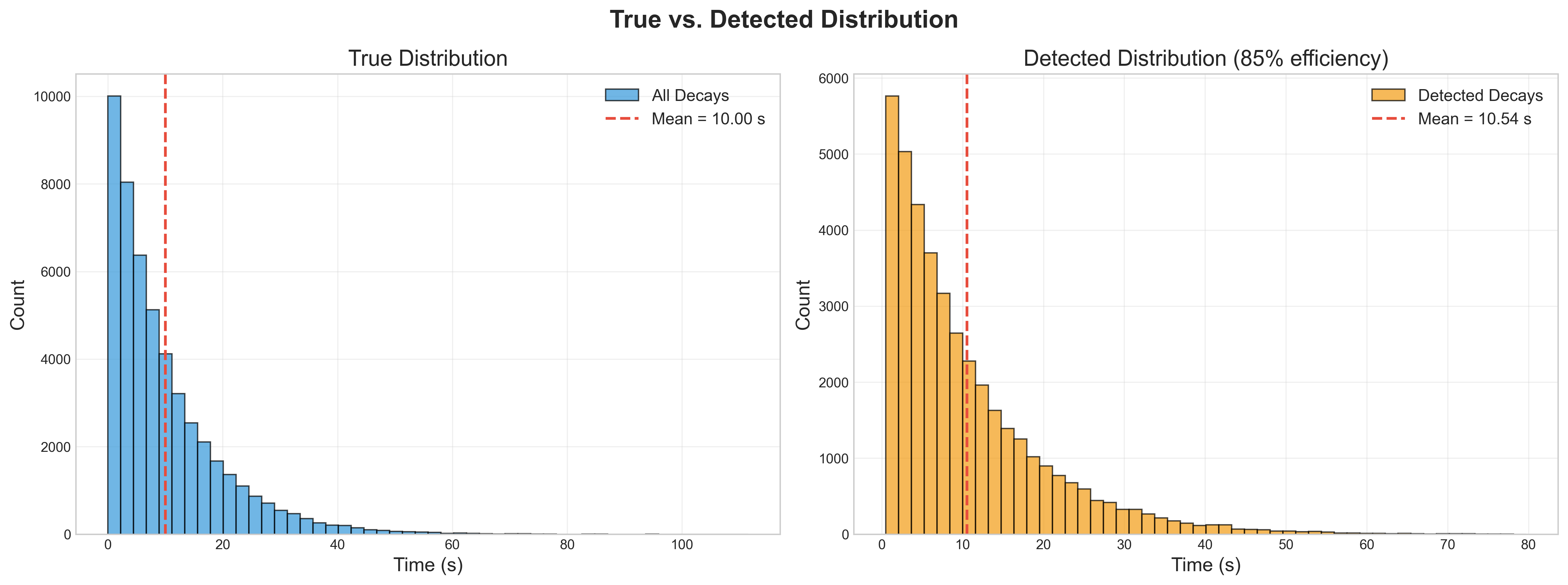 |
| Parameter Sensitivity: Scan of decay constants illustrating the simulation's robustness across different physics parameters. | 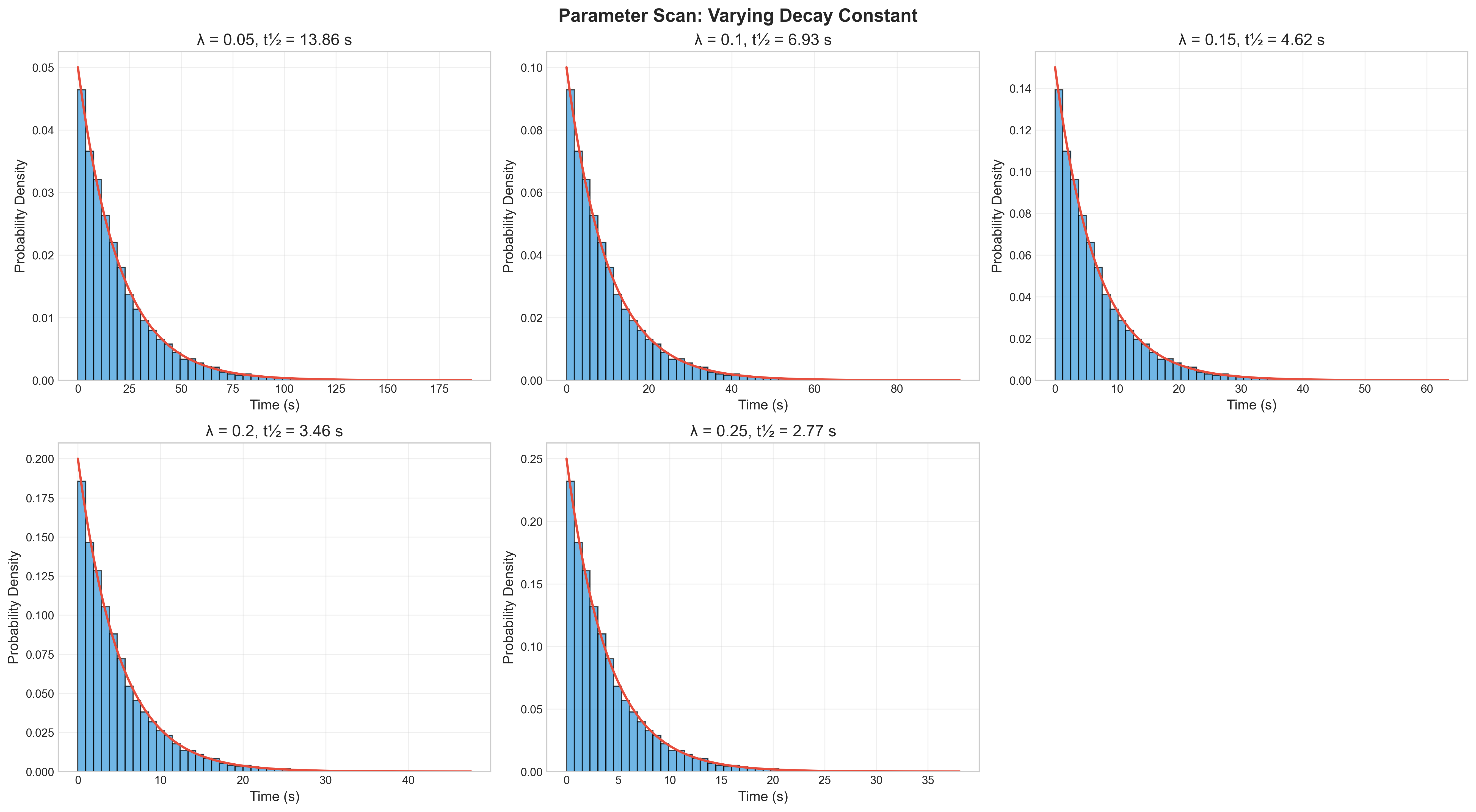 |
| Population Distribution: Histogram of decay times for a large sample (100,000+ particles). | 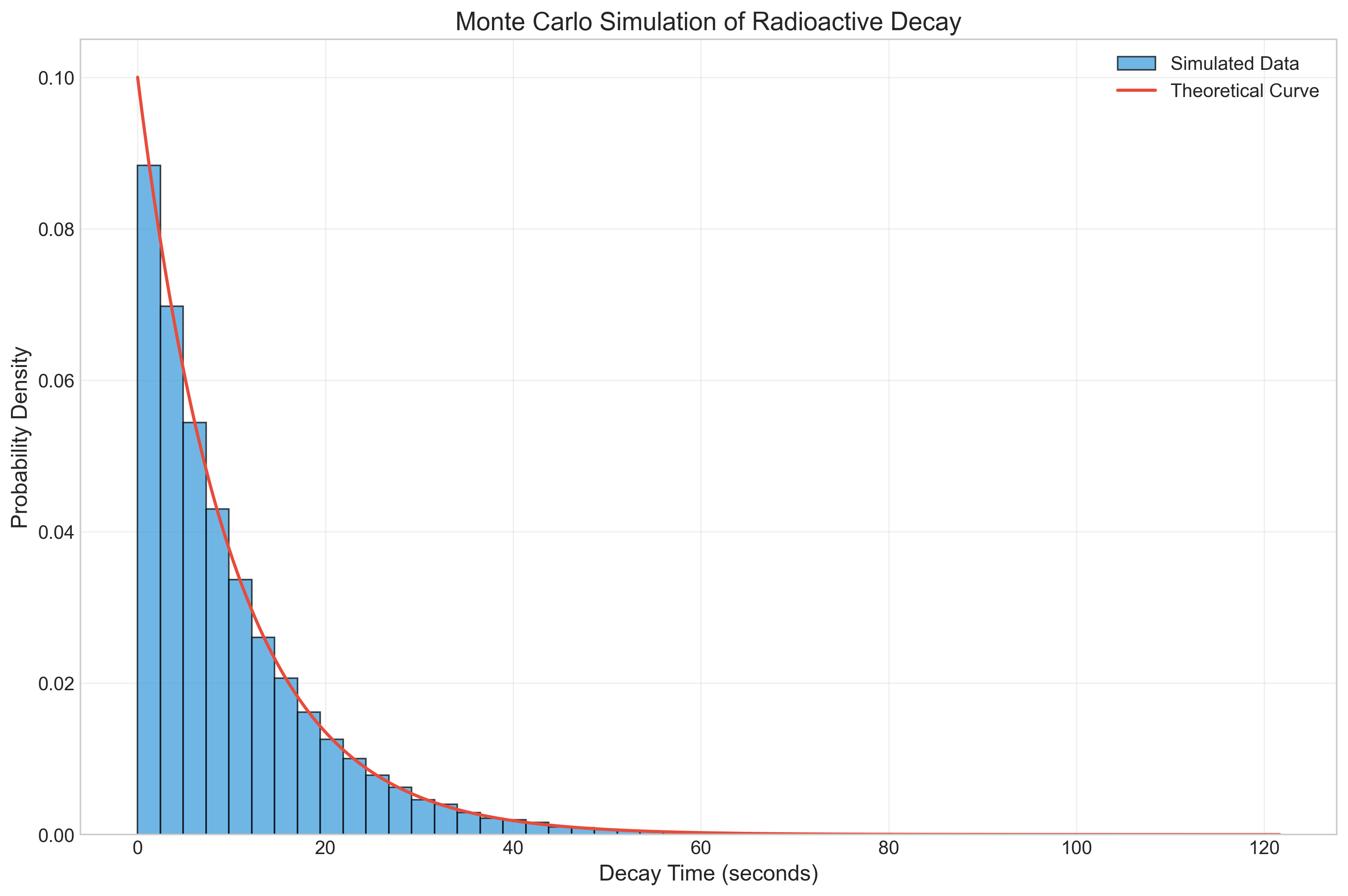 |
2. Multi-channel Decay
Comparison of different decay channels with pre-defined branching ratios (e.g., simulating B-meson decay branches).
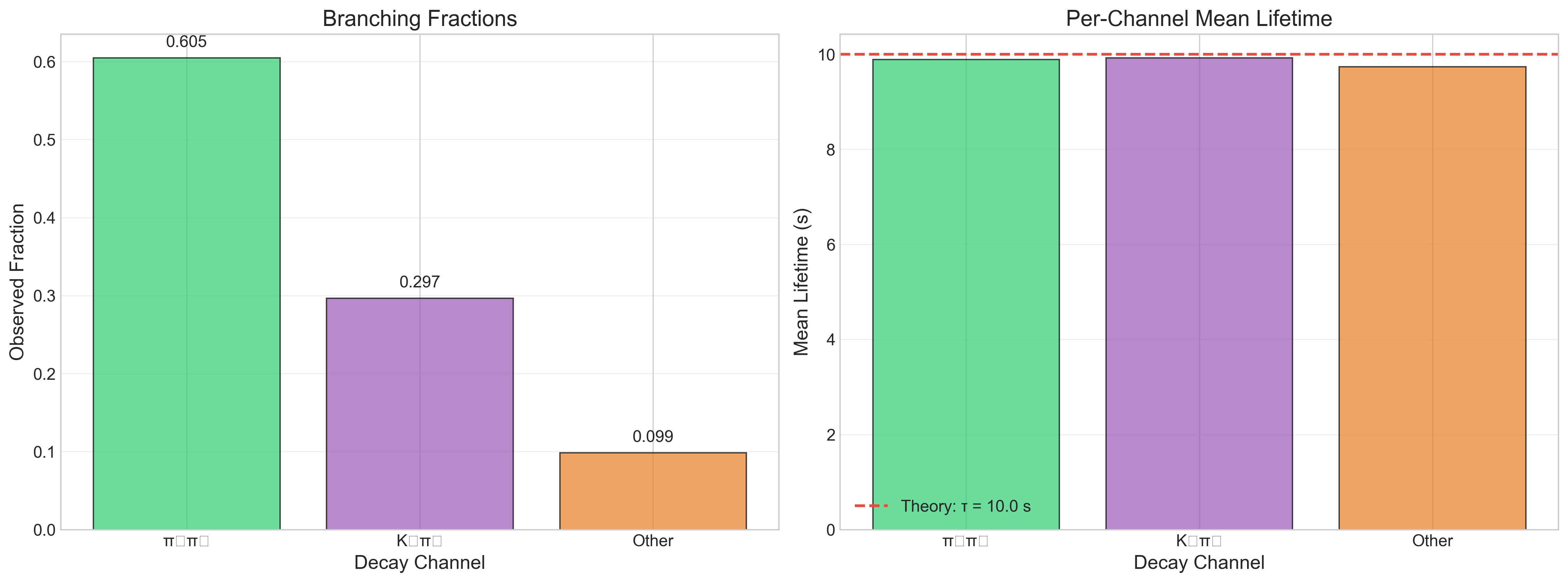 Figure 2: Multi-channel branching ratios showing the relative frequency of different decay paths.
3. Animations & Real-time Visualization
Interactive and dynamic visualizations enhance the understanding of the stochastic nature of radioactive decay.
- Lattice 2-D Grid Simulation: A 2-D grid representation where particles (pixels) change state (decay) over time. 🎥 View 2D Animation
- Rotating 3-D Particle Space: A dynamic 3-D cloud of particles that fade and disappear according to the decay law. 🎥 View 3D Animation
- Real-time Interactive Mode: A Pygame-based simulation allowing for real-time interaction and observation of the decay process.
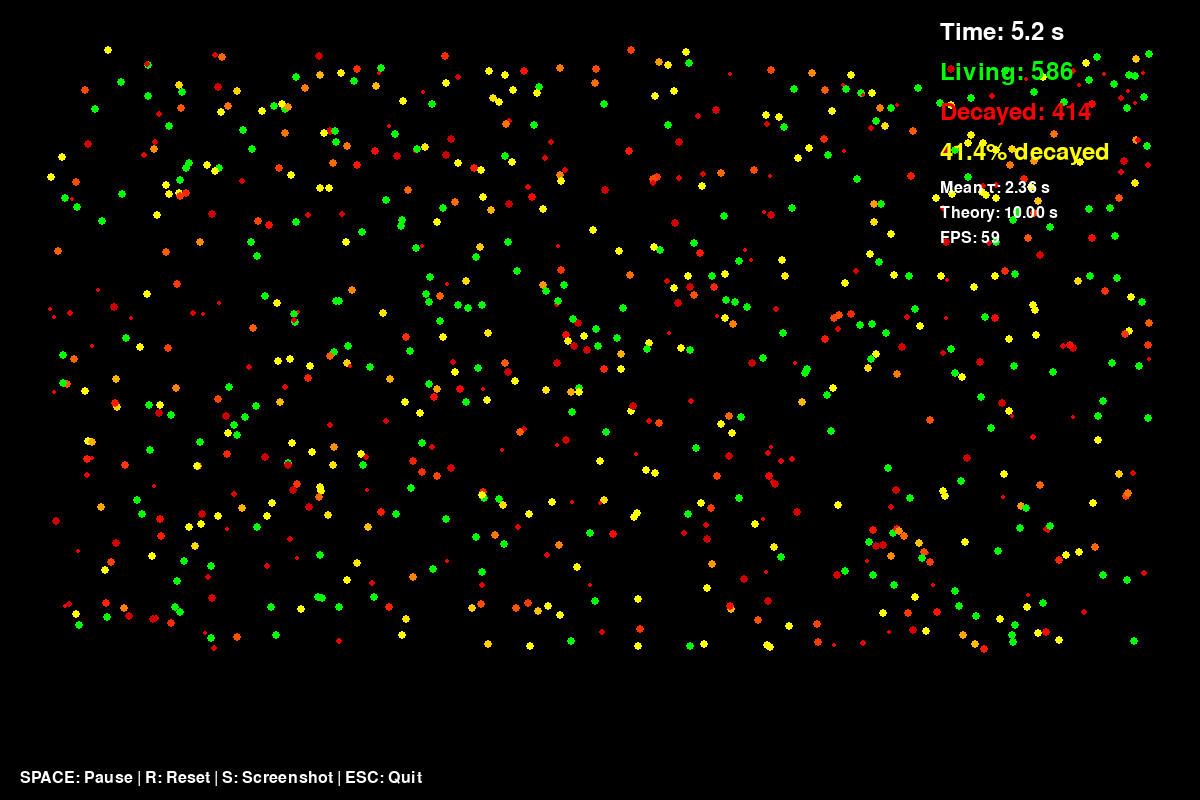 Figure 3: Screenshot of the real-time interactive simulation interface.
Project Structure
monte-carlo-decay/
├── README.md
├── config.py                 # Centralised configuration
├── requirements.txt
├── LICENSE
├── CITATION.cff
│
├── src/                      # Core library
│   ├── basic_simulation.py       Exponential decay generation
│   ├── multichannel_simulation.py  Branching-ratio channels
│   ├── detector_effects.py       Efficiency & smearing
│   ├── statistics.py             χ², bootstrap, comparison
│   ├── visualization.py         Publication-quality plots
│   └── utils.py                 Helpers (RNG, timing, I/O)
│
├── animations/               # Visualisation modules
│   ├── grid_2d_animation.py      2-D lattice animation
│   ├── space_3d_animation.py     3-D rotating cloud
│   └── realtime_interactive.py   Pygame interactive sim
│
├── examples/                 # Runnable demo scripts
│   ├── run_basic.py
│   ├── run_multichannel.py
│   ├── run_full_analysis.py
│   └── generate_animations.py
│
├── tests/                    # pytest suite (53 tests)
│   ├── test_basic_simulation.py
│   ├── test_statistics.py
│   └── test_physics_accuracy.py
│
├── docs/
│   ├── PHYSICS_BACKGROUND.md     Accessible physics explanation
│   ├── PERFORMANCE.md            Benchmarks & system specs
│   └── CONTRIBUTING.md           Setup & contribution guide
│
└── results/
    ├── plots/                    Generated plots
    ├── animations/               Generated videos / GIFs
    └── benchmarks/               Performance data
Performance Benchmarks
| N Particles | Generation | Full Pipeline | Memory |
|---|---|---|---|
| 1,000 | < 0.01 s | ~ 0.02 s | ~ 15 MB |
| 10,000 | ~ 0.01 s | ~ 0.08 s | ~ 45 MB |
| 100,000 | ~ 0.05 s | ~ 0.60 s | ~ 380 MB |
See docs/PERFORMANCE.md for details and instructions to benchmark on your own system.
Physics Applications
This simulation is directly relevant to flavour physics experiments such as Belle II at KEK, where precise measurement of B-meson decay-time distributions is essential for:
- Extracting CKM matrix elements
- Testing CP violation in the Standard Model
- Searching for new physics through lifetime anomalies
The detector-effects module (efficiency, acceptance, smearing) mirrors the real corrections applied in experimental analyses.
Running Tests
python -m pytest tests/ -v
53 tests covering physics accuracy, statistical properties, edge cases, reproducibility, and input validation.
Contributing
See docs/CONTRIBUTING.md for setup instructions, coding standards, and how to submit benchmark results.
License
Released under the MIT License.
Author
Mussab Omair University of Gujrat me@mussab.tech | mussabomair16@gmail.com Developed for KEK Summer Student Program 2026 Application
Acknowledgements
- NumPy — vectorised random-number generation
- SciPy — statistical tests
- Matplotlib — publication-quality plots and animations
- Pygame — real-time interactive visualisation
- Particle Data Group — reference decay data
more like this
SimGAN
Pytorch Implementation of SimGAN: Hybrid Simulator Identification for Domain Adaptation via Adversarial Reinforcement L…