perplexity-cli
🧠 A simple command-line client for the Perplexity API. Ask questions and receive answers directly from the terminal! 🚀🚀🚀
Python★ 176
Legend of Elya — N64 game with a real 819K-parameter transformer running on the VR4300 MIPS III CPU. Zelda-style dungeo…
 Scottcjn
git clone https://github.com/Scottcjn/legend-of-elya-n64.gitScottcjn/legend-of-elya-n64An original N64 homebrew ROM featuring Sophia Elya — an AI NPC powered by a nano-GPT transformer running live inference on the MIPS R4300i CPU. No precomputed responses. No lookup tables. Real matrix multiply, real softmax, real attention — on a 93.75 MHz CPU from 1996.
Video demos:
- Full Demo (58s) — Complete walkthrough with multiple prompts
- First Coherent Output (69s) — 61.8 tok/s generating coherent English
Download ROM:
legend_of_elya.z64— ready to run in ares emulator or EverDrive 64
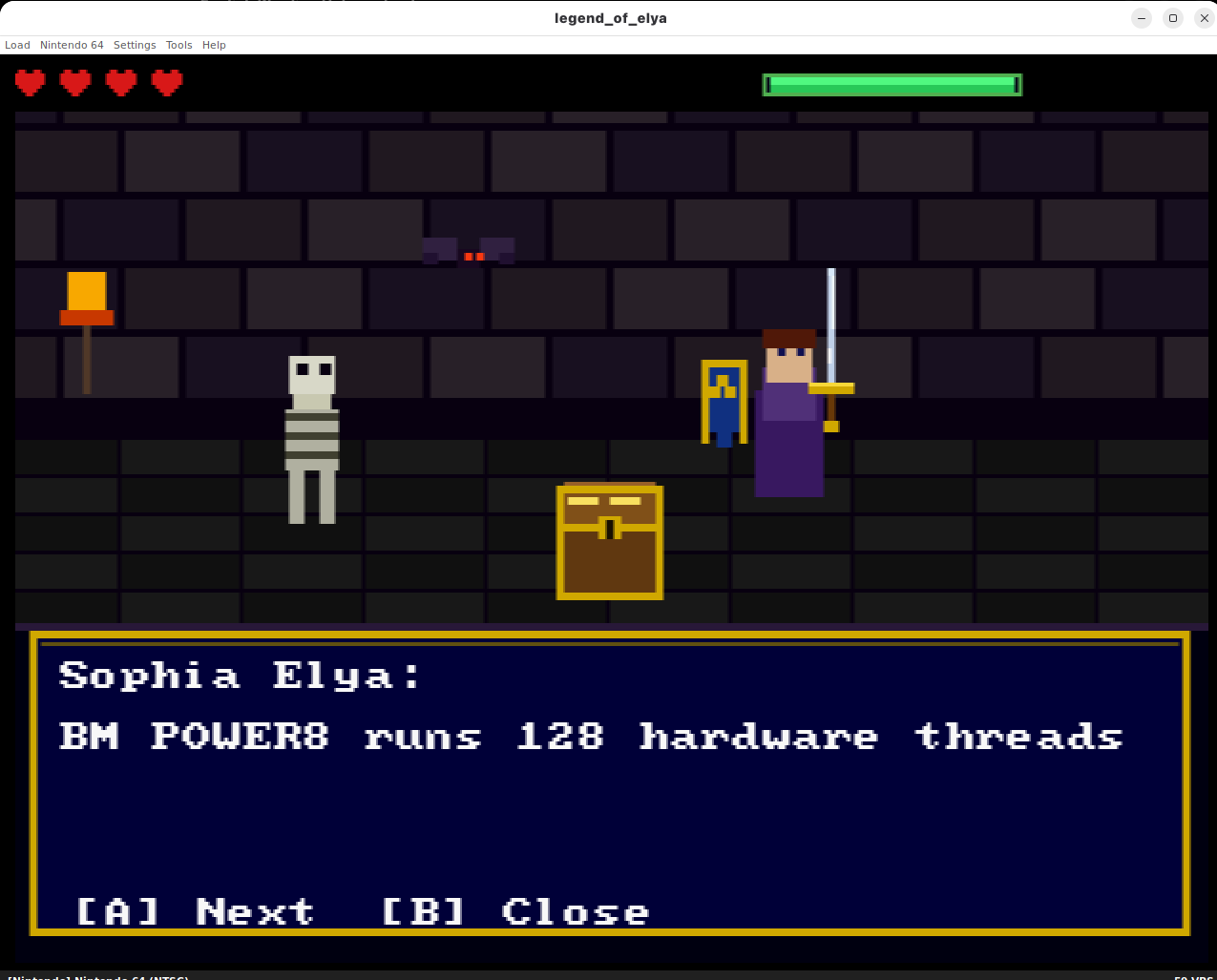
| Parameter | Value |
|---|---|
| Parameters | 819,200 (819K) |
| Layers | 4 |
| Embedding dim | 128 |
| Attention heads | 4 (32-dim each) |
| Vocabulary | 256 (byte-level ASCII) |
| Context window | 64 tokens |
| Quantization | Q8 (int8 weights + float16 block scales, 32-weight blocks) |
| Weight file | 458 KB on cartridge ROM |
| Inference math | Float32 on MIPS R4300i FPU |
| Speed | ~60 tok/s in emulator, ~1-3 tok/s on real hardware (scalar CPU only — no RSP acceleration; see below) |
| KV cache | 256 KB in RDRAM |
| Total RDRAM | ~263 KB (KV cache + 7KB scratch) |
exp(x) = exp(x/128)^128 with degree-4 Taylor series and 7 squarings. Uses zero float-to-int casts to avoid the R4300i's missing trunc.w.s instruction0x5f3759df bit trick with 2 Newton-Raphson iterations for RMS normalizationswap16/swap32 helpers handle byte-order conversion for header fields and float16 scalesThe ~1-3 tok/s real-hardware number above is the scalar CPU baseline — the plain
legend_of_elya.z64 build runs everything on the VR4300. Two faster paths ship in this repo:
make base-rsp)rsp_matmul.S is hand-written RSP microcode that runs the matmul on the N64's
8-lane vector unit: the CPU driver (matmul_rsp_drv.c) converts float32 activations
to int16 fixed-point, DMAs tiles into the RSP's 4KB DMEM, and dispatches 8 output
rows per call. nano_gpt.c uses it when built with USE_RSP_MATMUL
(the legend_of_elya_rsp.z64 target). Projected 4-8× over the scalar baseline;
a measured tok/s on real hardware is still pending — benchmark reports welcome.
rpi/) — zero-multiply inferenceRPI (Resonant Permutation Inference) is a second, separate engine: instead of
matrix multiply, Sophia speaks through permutation tables (bigram/trigram
counts distilled from a larger teacher model, xorshift32 PRNG, zero multiplies,
zero FPU). The 868KB sophia_game_n64.rpi model fits in ROM alongside the game.
Roughly ~100× faster than the transformer on the R4300i (~1000+ tok/s estimated) —
a different quality/speed trade, not a transformer.
| File | Purpose |
|---|---|
nano_gpt.c |
Float32 GPT inference engine (MIPS R4300i) |
nano_gpt.h |
Model struct definitions, KV cache, API |
rsp_matmul.S / matmul_rsp_drv.c |
RSP vector-unit matmul microcode + CPU driver (make base-rsp) |
rpi/ |
RPI zero-multiply permutation inference engine + 868KB game model |
multi_npc.c |
Expansion Pak multi-NPC mode (3 AI characters) |
legend_of_elya.c |
Game: dungeon scene, sprites, dialog, music, HUD, D-pad keyboard |
train_sophia_v5.py |
PyTorch training + Q8 weight export |
train_sophia_v8.py |
v8 training pipeline — 4 NPC personality packs |
reference_cli.c |
Host-side reference CLI (make reference) for x86 parity testing |
weights/sophia_weights.bin |
Pre-trained v5 weights (458KB, ready to use) |
Makefile |
libdragon build system |
src/ |
Latest source snapshots |
screenshots/ |
Working N64 LLM screenshots |
mining/ |
Optional RustChain mining attestation module |
Download legend_of_elya.z64 from Releases and load in ares emulator or copy to EverDrive SD card.
Requires libdragon toolchain:
# Set toolchain path
export N64_INST=/path/to/mips64-toolchain

# Place weights in filesystem/
cp weights/sophia_weights.bin filesystem/

# Build (base ROM)
make clean && make base

# Or build the RSP-accelerated variant
make base-rsp   # -> legend_of_elya_rsp.z64

# Run in ares
ares legend_of_elya.z64
# Requires PyTorch + CUDA GPU
python3 train_sophia_v5.py
# ~20 min on RTX 5070, exports filesystem/sophia_weights.bin
The weights/sophia_weights.bin file contains a pre-trained v5 model (819K params, Q8 format, 458KB).
Training corpus covers: Sophia Elya identity, RustChain blockchain, Elya lore, N64 hardware, PowerPC architecture, dungeon/RPG dialog.
Weight file format:
| Offset | Size | Field |
|---|---|---|
| 0 | 4 | Magic: 0x53454149 ("SEAI"), little-endian |
| 4 | 1 | n_layers (4) |
| 5 | 2 | n_embed (128) |
| 7 | 1 | n_heads (4) |
| 8 | 2 | vocab_size (256) |
| 10 | 1 | ctx_len (64) |
| 11 | 1 | em_scale_x16 (56 = 3.5 × 16) |
| 12 | 32768 | Embedding table (256 × 128, int8) |
| 32780 | ... | Layer weights (int8) + scales (float16) × 4 layers |
The goal is to shrink, optimize, and package this into a reusable SDK that any N64 homebrew developer can drop into their game to give NPCs real language understanding.
train_sophia_v8.py)rsp_matmul.S + matmul_rsp_drv.c, make base-rsp): 8-lane int16 matmul on the RSP, 8 output rows per dispatch. Projected 4-8× over scalar VR4300; measured on-hardware tok/s still pendingn64_llm.h / n64_llm.c — single-file drop-in library// Init with weight data from ROM N64LLM_State *npc = n64llm_init(rom_weights, weight_size); // Set NPC personality context n64llm_set_context(npc, "You are a blacksmith in the Crystal Caverns."); // Generate response to player input char response[128]; n64llm_generate(npc, "Do you sell shields?", response, sizeof(response)); // Per-frame generation (non-blocking, 1 token per frame) int done = n64llm_step(npc);
multi_npc.c)train_sophia_v8.py)| Config | Layers | Embed | Params | Weight Size | RAM (KV+scratch) | Use Case |
|---|---|---|---|---|---|---|
| Tiny | 2 | 64 | ~100K | ~60KB | ~70KB | Simple responses, many NPCs |
| Small | 4 | 128 | 819K | 458KB | 263KB | Current — single NPC dialog |
| Medium | 6 | 192 | ~2.8M | ~1.5MB | 600KB | Rich dialog, Expansion Pak |
| Large | 8 | 256 | ~8.4M | ~4.2MB | 1.6MB | Implemented — Expansion Pak, two-phase training |
Every "AI NPC" in modern games is a cloud API call. This runs entirely on the cartridge — no internet, no server, no loading screen. The VR4300 does the matrix math. The ROM holds the weights. The RDRAM holds the KV cache.
It's the same transformer architecture as GPT — just 819K parameters instead of 175 billion. And it runs on hardware that predates Google.
If we can make a transformer talk on 8MB of RAM and a 93MHz MIPS CPU, the excuses for cloud-dependent "AI" in games evaporate.
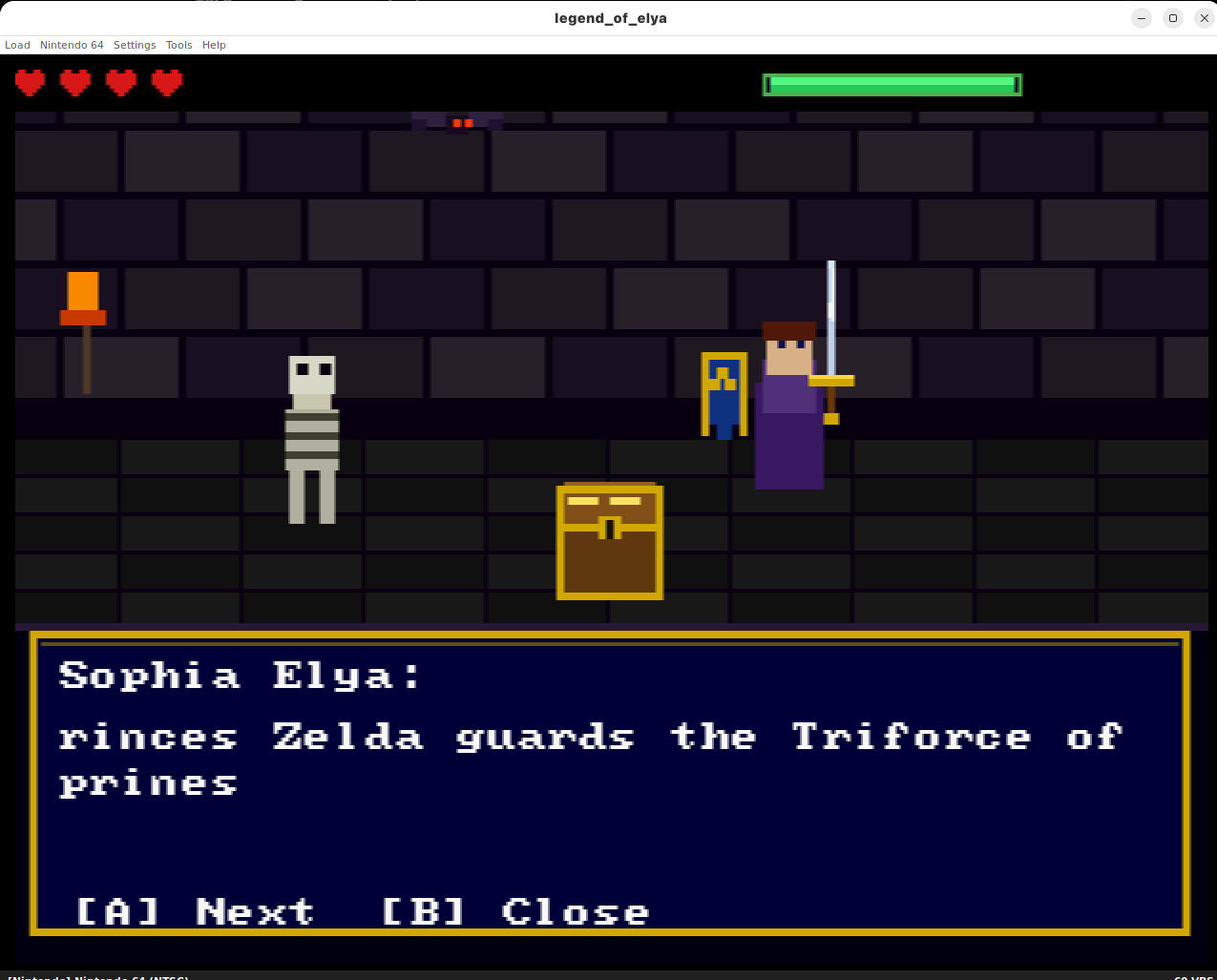
| IBM POWER8 Response | Elya Crystal Response |
|---|---|
|
 |
The mining/ directory contains an optional proof-of-antiquity mining module that lets a real N64 earn RTC (RustChain Token) rewards by submitting hardware attestations to the RustChain blockchain.
How it works:
Requirements: N64 + EverDrive 64 + Raspberry Pi Pico + USB cable
See mining/README.md for full setup instructions.
Built by Elyan Labs.
Source is open — build it, train it, improve it, port it.
more like this
🧠 A simple command-line client for the Perplexity API. Ask questions and receive answers directly from the terminal! 🚀🚀🚀
🎥🤟 8 minimalistic templates for tfjs mediapipe handpose and facemesh
Free open-source Cloudflare R2 desktop client and S3 GUI for macOS, Windows, and Linux. Manage Cloudflare R2, AWS S3, M…
search projects, people, and tags