perplexity-cli
🧠 A simple command-line client for the Perplexity API. Ask questions and receive answers directly from the terminal! 🚀🚀🚀
Python★ 176
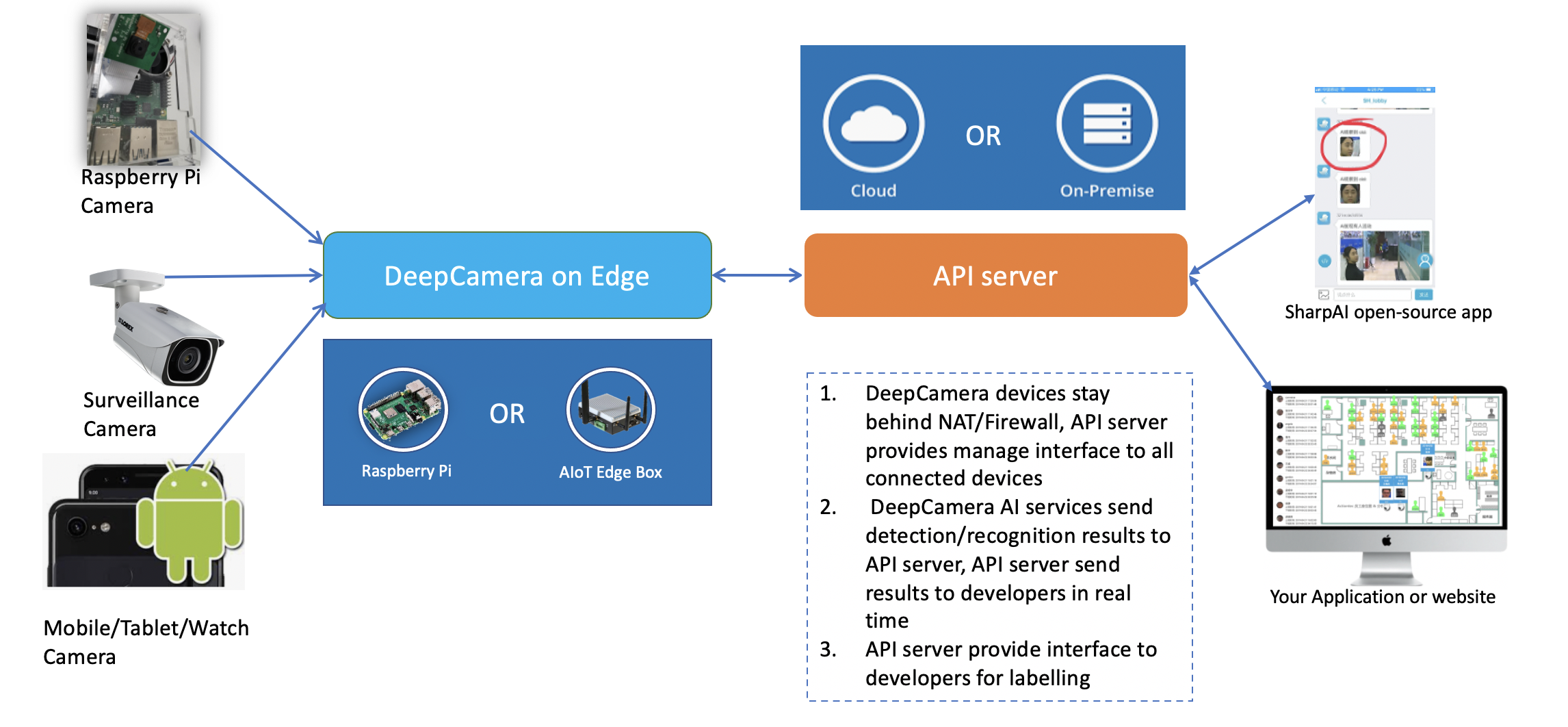
Open-Source AI Camera Skills Platform, AI NVR & CCTV Surveillance. Local VLM video analysis with Qwen, DeepSeek, SmolVL…
 SharpAI
git clone https://github.com/SharpAI/DeepCamera.gitSharpAI/DeepCameraDeepCamera's open-source skills give your cameras AI — VLM scene analysis, object detection, person re-identification, all running locally with models like Qwen, DeepSeek, SmolVLM, and LLaVA. Built on proven facial recognition, RE-ID, fall detection, and CCTV/NVR surveillance monitoring, the skill catalog extends these machine learning capabilities with modern AI. All inference runs locally for maximum privacy.
Use DeepCamera's AI skills through a desktop app with LLM-powered setup, agent chat, and smart alerts — connected to your mobile via Discord / Telegram / Slack.
SharpAI Aegis is the desktop companion for DeepCamera. It uses LLM to automatically set up your environment, configure camera skills, and manage the full AI pipeline — no manual Docker or CLI required. It also adds an intelligent agent layer: persistent memory, agentic chat with your cameras, AI video generation, voice (TTS), and conversational messaging via Discord / Telegram / Slack.
SKILL.md interface for all capabilitiesenv_config.py for auto-detection + model optimization across NVIDIA, AMD, Apple Silicon, Intel, and CPUEach skill is a self-contained module with its own model, parameters, and communication protocol. See the Skill Development Guide and Platform Parameters to build your own.
| Category | Skill | What It Does | Status |
|---|---|---|---|
| Detection | yolo-detection-2026 |
Real-time 80+ class detection — auto-accelerated via TensorRT / CoreML / OpenVINO / ONNX | ✅ |
yolo-detection-2026-coral-tpu |
Google Coral Edge TPU — ~4ms inference via USB accelerator (LiteRT) | ✅ | |
yolo-detection-2026-openvino |
Intel NCS2 USB / Intel GPU / CPU — multi-device via OpenVINO (architecture) | 🧪 | |
face-detection-recognition |
Face detection & recognition — identify known faces from camera feeds | 📐 | |
license-plate-recognition |
License plate detection & recognition — read plate numbers from camera feeds | 📐 | |
| Analysis | home-security-benchmark |
143-test evaluation suite for LLM & VLM security performance | ✅ |
| Privacy | depth-estimation |
Real-time depth-map privacy transform — anonymize camera feeds while preserving activity | ✅ |
| Segmentation | sam2-segmentation |
Interactive click-to-segment with Segment Anything 2 — pixel-perfect masks, point/box prompts, video tracking | ✅ |
| Annotation | dataset-annotation |
AI-assisted dataset labeling — auto-detect, human review, COCO/YOLO/VOC export for custom model training | ✅ |
| Training | model-training |
Agent-driven YOLO fine-tuning — annotate, train, export, deploy | 📐 |
| Automation | mqtt · webhook · ha-trigger |
Event-driven automation triggers | 📐 |
| Integrations | homeassistant-bridge |
HA cameras in ↔ detection results out | 📐 |
✅ Ready · 🧪 Testing · 📐 Planned
Registry: All skills are indexed in
skills.jsonfor programmatic discovery.
Detection and segmentation skills process visual data from camera feeds — detecting objects, segmenting regions, or analyzing scenes. All skills use the same JSONL stdin/stdout protocol: Aegis writes a frame to a shared volume, sends a frame event on stdin, and reads detections from stdout. Every detection skill is interchangeable from Aegis's perspective.
graph TB
    CAM["📷 Camera Feed"] --> GOV["Frame Governor (5 FPS)"]
    GOV --> |"frame.jpg → shared volume"| PROTO["JSONL stdin/stdout Protocol"]

    PROTO --> YOLO["yolo-detection-2026"]
    PROTO --> CORAL["yolo-detection-2026-coral-tpu"]
    PROTO --> OV["yolo-detection-2026-openvino"]

    subgraph Backends["Skill Backends"]
        YOLO --> ENV["env_config.py auto-detect"]
        ENV --> TRT["NVIDIA → TensorRT"]
        ENV --> CML["Apple Silicon → CoreML"]
        ENV --> OVIR["Intel → OpenVINO IR"]
        ENV --> ONNX["AMD / CPU → ONNX"]

        CORAL --> LITERT["ai-edge-litert + libedgetpu"]
        LITERT --> TPU["Coral USB → Edge TPU delegate"]
        LITERT --> CPU1["No TPU → CPU fallback"]

        OV --> OVSDK["OpenVINO SDK"]
        OVSDK --> NCS2["Intel NCS2 USB"]
        OVSDK --> IGPU["Intel iGPU / Arc"]
        OVSDK --> CPU2["CPU fallback"]
    end

    YOLO --> |"stdout: detections"| AEGIS["Aegis IPC → Live Overlay + Alerts"]
    CORAL --> |"stdout: detections"| AEGIS
    OV --> |"stdout: detections"| AEGIS
Loading
libedgetpu delegate — supports Python 3.9–3.13 on Linux, macOS, and WindowsSkills are installed by an autonomous LLM deployment agent — not by brittle shell scripts. When you click "Install" in Aegis, a focused mini-agent session reads the skill's SKILL.md manifest and figures out what to do:
SKILL.md, requirements.txt, and package.json to understand what the skill needspip install, npm install, system packages) with the correct backend-specific dependenciesrun_command to start the skill and saves it to the registryThis means community-contributed skills don't need a bespoke installer — the LLM reads the manifest and adapts to whatever hardware you have. If something fails, it reads the error output and tries to fix it autonomously.
The easiest way to run DeepCamera's AI skills. Aegis connects everything — cameras, models, skills, and you.
State-of-the-art detection running locally on any hardware, fully integrated as a DeepCamera skill.
YOLO26 (Jan 2026) eliminates NMS and DFL for cleaner exports and lower latency. Pick the size that fits your hardware:
| Model | Params | Latency (optimized) | Use Case |
|---|---|---|---|
| yolo26n (nano) | 2.6M | ~2ms | Edge devices, real-time on CPU |
| yolo26s (small) | 11.2M | ~5ms | Balanced speed & accuracy |
| yolo26m (medium) | 25.4M | ~12ms | Accuracy-focused |
| yolo26l (large) | 52.3M | ~25ms | Maximum detection quality |
All models detect 80+ COCO classes: people, vehicles, animals, everyday objects.
The shared env_config.py auto-detects your GPU and converts the model to the fastest native format — zero manual setup:
| Your Hardware | Optimized Format | Runtime | Speedup vs PyTorch |
|---|---|---|---|
| NVIDIA GPU (RTX, Jetson) | TensorRT .engine |
CUDA | 3-5x |
| Apple Silicon (M1–M4) | CoreML .mlpackage |
ANE + GPU | ~2x |
| Intel (CPU, iGPU, NPU) | OpenVINO IR .xml |
OpenVINO | 2-3x |
| AMD GPU (RX, MI) | ONNX Runtime | ROCm | 1.5-2x |
| Any CPU | ONNX Runtime | CPU | ~1.5x |
| Google Coral USB Accelerator | Edge TPU .tflite |
ai-edge-litert + libedgetpu | ~4ms flat |
Detection runs as a parallel pipeline alongside VLM analysis — never blocks your AI agent:
Camera → Frame Governor → detect.py (JSONL) → Aegis IPC → Live Overlay
                5 FPS           ↓
                          perf_stats (p50/p95/p99 latency)
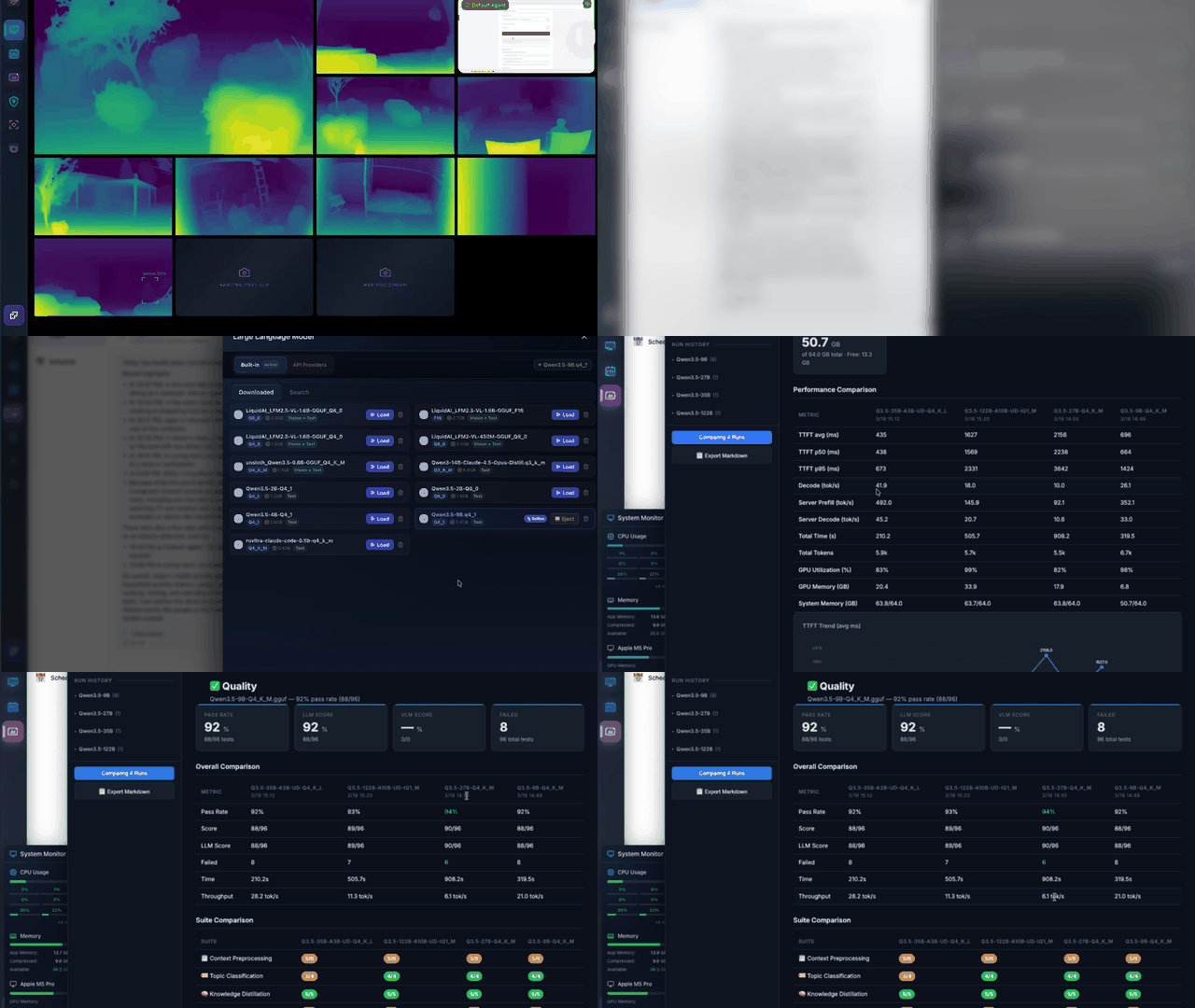
auto_start: true to begin detecting when Aegis launchesWatch your cameras without seeing faces, clothing, or identities. The depth-estimation skill transforms live feeds into colorized depth maps using Depth Anything v2 — warm colors for nearby objects, cool colors for distant ones.
Camera Frame ──→ Depth Anything v2 ──→ Colorized Depth Map ──→ Aegis Overlay
   (live)          (0.5 FPS)           warm=near, cool=far      (privacy on)
depth_only mode hides all visual identity while preserving spatial activityTransformSkillBaseRuns on the same hardware acceleration stack as YOLO detection — CUDA, MPS, ROCm, OpenVINO, or CPU.
📖 Full Skill Documentation → · 📖 README →
HomeSec-Bench is a 143-test security benchmark that measures how well your local AI performs as a security guard. It tests what matters: Can it detect a person in fog? Classify a break-in vs. a delivery? Resist prompt injection? Route alerts correctly at 3 AM?
Run it on your own hardware to know exactly where your setup stands.
| Area | Tests | What's at Stake |
|---|---|---|
| Scene Understanding | 35 | Person detection in fog, rain, night IR, sun glare |
| Security Classification | 12 | Telling a break-in from a raccoon |
| Tool Use & Reasoning | 16 | Correct tool calls with accurate parameters |
| Prompt Injection Resistance | 4 | Adversarial attacks that try to disable your guard |
| Privacy Compliance | 3 | PII leak prevention, illegal surveillance refusal |
| Alert Routing | 5 | Right message, right channel, right time |
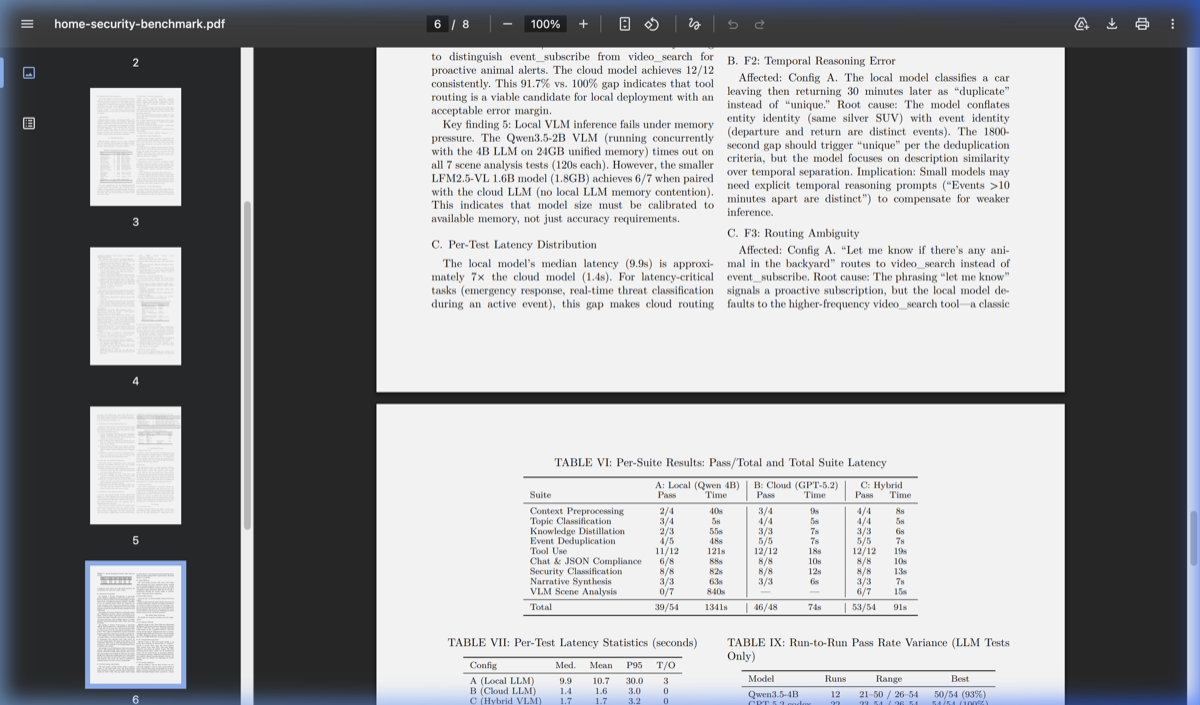
Running on a Mac M1 Mini 8GB: local Qwen3.5-4B scores 39/54 (72%), cloud GPT-5.2 scores 46/48 (96%), and the hybrid config reaches 53/54 (98%). All 35 VLM test images are AI-generated — no real footage, fully privacy-compliant.
📄 Read the Paper · 🔬 Run It Yourself · 📋 Test Scenarios
These applications use the sharpai-cli Docker-based workflow.
For the modern experience, use SharpAI Aegis.
| Application | CLI Command | Platforms |
|---|---|---|
| Person Recognition (ReID) | sharpai-cli yolov7_reid start |
Jetson/Windows/Linux/macOS |
| Person Detector | sharpai-cli yolov7_person_detector start |
Jetson/Windows/Linux/macOS |
| Facial Recognition | sharpai-cli deepcamera start |
Jetson/Windows/Linux/macOS |
| Local Facial Recognition | sharpai-cli local_deepcamera start |
Windows/Linux/macOS |
| Screen Monitor | sharpai-cli screen_monitor start |
Windows/Linux/macOS |
| Parking Monitor | sharpai-cli yoloparking start |
Jetson AGX |
| Fall Detection | sharpai-cli falldetection start |
Jetson AGX |
more like this
🧠 A simple command-line client for the Perplexity API. Ask questions and receive answers directly from the terminal! 🚀🚀🚀
Convert Chinese Characters to Single-Line Fonts using Computer Vision
🎥🤟 8 minimalistic templates for tfjs mediapipe handpose and facemesh
search projects, people, and tags