FlatlandRT
FlatlandRT is a 2D ray tracer visualization tool
 Vertexwahn
FlatlandRT
Description
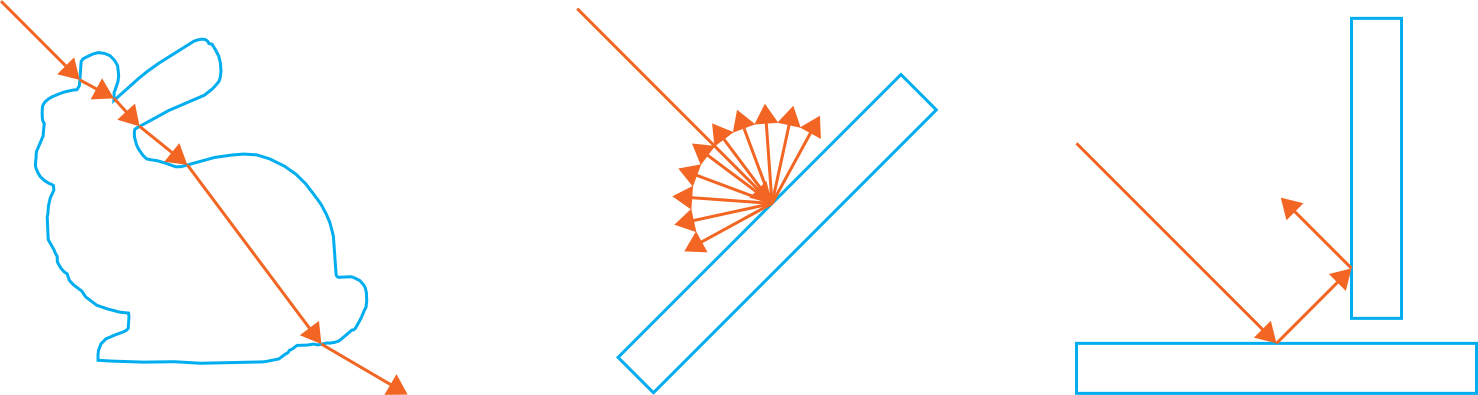
FlatlandRT is a 2D ray tracer visualization tool. The following pictures were created using FlatlandRT:
From left to right: Refraction, ambient occlusion and reflection:
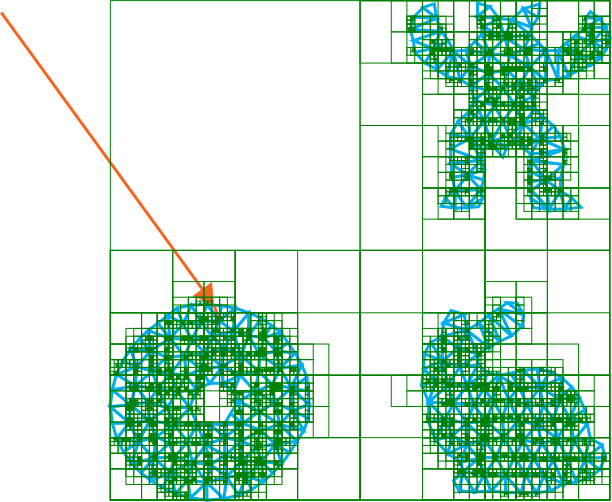
Quadtree intersection of 2D triangle meshes:
More examples scenes can be found here. See the user manual if you want to find out how to use it.
Quick start
This project uses Bazel as a build system. The current used version is defined in .bazelversion.
Prerequisites:
The following tools should be installed:
- Git
- Bazel
- A C++ compiler (GCC, Visual Studio, Clang, etc.)
Checkout, build, and run:
You can use Flatland by invoking the following commands:
All platforms:
git clone https://github.com/Vertexwahn/FlatlandRT # clone the repository
cd FlatlandRT # change directory to cloned repository
cd devertexwahn # switch to the location where the MODULE.bazel file is located
Render a scene with Windows 10/11 x64 with Visual Studio 2019:
bazel --output_base=C:/bazel_output_base run --config=vs2019 //flatland/cli:flatland.cli -- --scene_filename=C:\scenes\bunny.flatland.xml
Render a scene with Windows 10/11 x64 with Visual Studio 2022:
bazel --output_base=C:/bazel_output_base run --config=vs2022 //flatland/cli:flatland.cli -- --scene_filename=C:\scenes\bunny.flatland.xml
For more hints on how to use Bazel on Windows have a look at the Bazel on Windows document.
Render a scene with Ubuntu 22.04:
bazel run --config=gcc11 //flatland/cli:flatland.cli -- --scene_filename=$(pwd)/flatland/scenes/bunny/bunny.flatland.xml
Render a scene with Ubuntu 24.04:
bazel run --config=gcc13 //flatland/cli:flatland.cli -- --scene_filename=$(pwd)/flatland/scenes/bunny/bunny.flatland.xml
Render a scene with macOS 11/12/13:
bazel run --config=macos //flatland/cli:flatland.cli -- --scene_filename=$(pwd)/flatland/scenes/bunny/bunny.flatland.xml
Building & Testing
Building and testing with Linux
Command line (bash/zsh)
# Run all tests using GCC 11
bazel test --config=gcc11 //...
# Build all targets uing GCC 11
bazel build --config=gcc11 //...
# Run all tests using GCC 13
bazel test --config=gcc13 //...
# Build all targets uing GCC 13
bazel build --config=gcc13 //...
# Run all tests using Clang 14
bazel test --config=clang14 //...
# Build all targets uing Clang 14
bazel build --config=clang14 //...
CLion
There is a Bazel plug-in for CLion. It can be downloaded from here.
You can use the following .bazelproject file, e.g.:
directories:
  .

test_sources:
  flatland/tests

derive_targets_from_directories: true

additional_languages:
  python

build_flags:
  --config=gcc13
Code coverage
Make sure that lcov is installed.
sudo apt install lcov
Go to the directory that contains the MODULE.bazel file and execute:
./coverage.sh --additional_bazel_config=buchgr_remote_cache
open coverage_report/index.html
Address Sanitizer
There is a build config called asan that can be used for detecting memory errors.
bazel run --config=asan --compilation_mode=opt //flatland/cli:flatland.cli -- $(pwd)/flatland/scenes/sphere.flatland.xml
Clang Tidy
bazel build --config=clang-tidy //core:object
or
bazel build //core:object \
  --aspects @bazel_clang_tidy//clang_tidy:clang_tidy.bzl%clang_tidy_aspect \
  --output_groups=report
Building with Windows
Command line (Powershell)
# Build with Visual Studio C++ Compiler
bazel build --config=vs2022 //...
Using Visual Studio
Use Lavender to generate a solution and project files for Visual Studio.
python3 G:\dev\lavender\generate.py --config=vs2022 //...
Lavender is far from being perfect. It might be necessary to do some modifications to the generated solution and project files.
Development process
I made a short video where I describe how I use test driven development to implement this project:
Ray tracing 101
I have written some blog post about ray tracing that can be found here: Ray Tracing 101
License
The source code of FlatlandRT itself is under the Apache License 2.0 (see LICENSE). The license of its third-party dependencies or some third-party code fragments can and is under different license terms. See copyright notes in the next section.
Copyright notes
FlatlandRT makes use of several software libraries.
Some tools and libraries were copied to this repository (see third_party folder).
The corresponding licenses can be found in the third_party folder of this repository.
Besides this,
some source code was directly copied from other open-source software libraries or programs.
This is always clearly stated as a comment in the source code of FlatlandRT.
If you find any copyright or license violations or issues please let me know.
Copied source code/ideas
- Mitsuba Renderer 2 (https://github.com/mitsuba-renderer/mitsuba2) (scene file format) (License)
- pbrt, Version 3 (https://github.com/mmp/pbrt-v3) (Refract, face_forward functions) (License)
- pbrt, Version 4 (https://github.com/mmp/pbrt-v4) (concentric sampling of unit disk) (License)
- bazel_clang_tidy (https://github.com/erenon/bazel_clang_tidy) (almost everything) (License)
Build related
- LLVM toolchain for Bazel (https://github.com/grailbio/bazel-toolchain) (building Flatland with LLVM) (License)
Third-party dependencies
- Abseil (https://abseil.io/) (see
third_partyfolder) - Boost (https://www.boost.org/) (License)
- Boost (third party dependency) (License)
- Catch2 (https://github.com/catchorg/Catch2) (License)
- Eigen (License)
- Google Test (https://github.com/google/googletest) (License
- Imath
- OpenEXR (https://github.com/AcademySoftwareFoundation/openexr) (License)
- gflags (https://github.com/gflags/gflags/) (see
third_partyfolder) - glog (https://github.com/google/glog) (see
third_partyfolder) - hypothesis (https://github.com/wjakob/hypothesis) (see
third_partyfolder) - libpng (http://www.libpng.org/pub/png/libpng.html) (License)
- pcg-cpp (https://github.com/imneme/pcg-cpp/)
- pugixml (https://pugixml.org/, https://github.com/zeux/pugixml)
- rules_pkg
- yaml-cpp (https://github.com/jbeder/yaml-cpp) (third party dependency) (License)
- zlib (https://zlib.net/) (License)
- {fmt} (https://github.com/fmtlib/fmt) (License)
Artwork
The Stanford Bunny was derived from the Stanford Bunny provided from the Stanford 3D Scanning Repository (see here).
The data for the Donut, Armadillo, and Stanford Bunny for the 2D triangle data was derived from https://github.com/mmacklin/sandbox.
Credits
A big thank goes to all the providers, developers, and maintainers of the aforementioned open-source projects and artifacts.
more like this