agentlytics
Comprehensive analytics dashboard for AI coding agents — Cursor, Windsurf, Claude Code, VS Code Copilot, Zed, Antigravi…
JavaScript★ 555
Terminal UI to manage AI coding-agent sessions (Claude Code, OpenCode, Codex, Grok Build) in tmux: live status, group t…
 YoanWai
The fastest workflow for every AI coding agent.

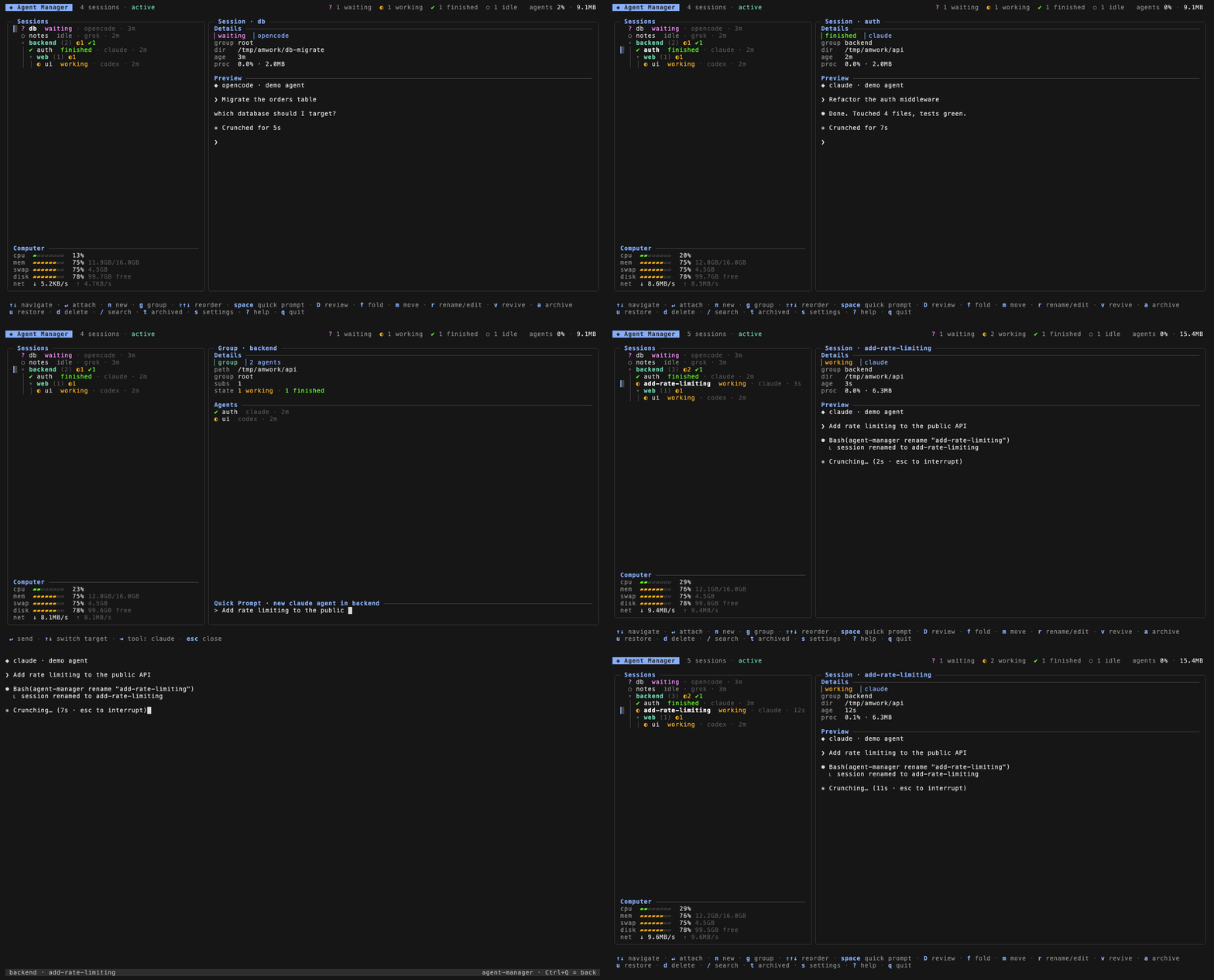
Claude Code, Codex, OpenCode, and Grok run side by side, each in its own tmux session, so they keep working after you quit the manager.
Instead of hunting through terminal tabs to see which agent is done and which is stuck, every session shows up in one list with live status, grouped into a project tree you can fold and reorder. You answer any of them without attaching: space sends a prompt straight into a session's pane, or spawns a new agent in the selected group. A dead session revives on its own conversation with v. And ctrl+r opens a full-file diff of what an agent changed, syntax-highlighted, where the comments you leave on lines go back to the agent's pane as one review prompt when you press C.
Not here yet: worktree creation, cost tracking, mouse-driven navigation, and agents that can talk to each other.
Jump to: Install · Keys · Quick prompt · Diff review · Status · Configuration
Status detection currently supports Claude Code, OpenCode, Codex, and Grok Build out of the box. Any other CLI tool can run as a session; add a [tools.<name>] block with status rules to get live status for it (see Configuration).
brew install yoanwai/tap/agent-manager
Installs tmux with it if missing. The tap ships a cask, so an install from the older formula switches over with brew uninstall agent-manager followed by the command above.
curl -fsSL https://raw.githubusercontent.com/YoanWai/agent-manager/main/install.sh | sh
Downloads the latest release for your platform, verifies it against the published checksums, and installs it to ~/.local/bin. Set AGENT_MANAGER_INSTALL_DIR for another directory and AGENT_MANAGER_VERSION to pin a version. Install tmux with your own package manager.
yay -S agent-manager-bin
agent-manager-bin in the AUR installs the released binary and pulls in tmux and git.
mise use -g ubi:YoanWai/agent-manager
Reads the GitHub release directly, so it needs no registry entry. Install tmux with your own package manager.
go install github.com/YoanWai/agent-manager@latest
Requires Go 1.26+ and tmux 3.1+; installs to $(go env GOPATH)/bin.
Download from Releases (macOS and Linux, amd64/arm64).
Run inside WSL2: agent-manager lives on tmux, which is a Linux/macOS tool. In a WSL shell, install with the install script above, with Homebrew, or grab the Linux binary from Releases.
The manager checks GitHub Releases once a day and shows a ↑ vX.Y.Z available badge in the header when a newer version is out. Pull it in the way you installed:
brew upgrade yoanwai/tap/agent-manager                                                    # Homebrew
curl -fsSL https://raw.githubusercontent.com/YoanWai/agent-manager/main/install.sh | sh   # Install script
mise upgrade --bump ubi:YoanWai/agent-manager                                             # mise
go install github.com/YoanWai/agent-manager@latest                                        # Go
agent-manager
Sessions run inside tmux (am_* namespace), so they survive the manager quitting. Inside a session, Ctrl+Q detaches back to the manager and Ctrl+R opens its diff review. agent-manager --version prints the version.
Agent sessions live on a private tmux server named agentmgr, so they never mix with the tmux you run yourself and a kill-server on your own socket leaves them alone. To reach one from a plain shell, name that server: tmux -L agentmgr ls, then tmux -L agentmgr attach -t am_<id>.
| Key | Action |
|---|---|
n |
New session (name, tool, directory, optional starting prompt, group picker) |
g |
New group (name, parent, default path) |
enter |
Focus session in place (keys go to the agent, list stays) / fold group |
A |
Attach session full screen (Settings can swap it with enter) |
ctrl+q |
Inside a session: back to the manager; in the list: quit |
q |
Focused session: back to the list |
K / J (or shift+↑ / shift+↓) |
Reorder session or group among its visible siblings |
m |
Move session to another group |
r |
Rename session / edit tool; edit group name and default path |
x |
Kill the selected session, or every live session under a group: frees the RAM their agents hold, and the rows stay for v |
X |
Kill every live session in view |
v |
Revive a dead session, or every dead session under a group |
V |
Revive every dead session in view |
a / u |
Archive / restore a session, or a group and its entire subtree |
d |
Delete session, or a group + its entire subtree |
space |
Quick prompt: answer the selected session, or spawn an agent in the selected group |
ctrl+r |
Review the selected session's changes: full-screen whole-file diffs, with c to comment a line and C to send the comments to the agent |
F |
Fold / unfold every group |
s |
Settings (quick-spawn tool, theme, review layout, after quick send) |
| |
Resize the split: ←→ nudge the divider, enter commits, esc cancels |
t |
Toggle archived view |
e |
Hide / show empty groups |
/ |
Search |
? |
Help |
q |
Quit (sessions keep running) |
The wheel scrolls the list and the diff. Mouse tracking stays off so click-drag keeps selecting text natively in your terminal, which is why the pointer does not move the selection (#110).
Press space to dock a prompt bar at the bottom of the sidebar. The target follows the cursor while the bar is open (↑↓ still navigate):
enter sends the typed text straight into the session's pane, so the agent gets it as a user message without you attaching. The bar clears and stays open, ready for the next answer; Settings (s) can make it close instead.enter spawns a new agent in that group with the prompt embedded, using the group's default path. The spawn tool starts at the Settings default and tab cycles it (claude ↔ opencode ↔ any configured tool); the footer shows the current pick. The agent starts working on the prompt immediately.ctrl+v pastes an image from the system clipboard as an [Image #1] chip at the caret. The image is saved under agent-manager-pastes in your temp directory, and on send each chip is swapped back for its path, so the paths reach the agent in the order and the places you pasted them. backspace next to a chip removes the whole chip, and an edit that swallows one releases its image. A clipboard holding text rather than an image pastes as text.
esc closes the bar. The new-session form's optional prompt field launches an agent the same way; tools whose CLI takes the prompt behind a flag declare it with prompt_flag (see Configuration).
x ends a session that is holding RAM you want back, and on a group row it ends every live session under it; X ends every live session in view. Each asks to confirm first, and what it ends is the tmux session, not the record: the row stays in the tree, marked dead, with its name, group, and conversation id intact.
v relaunches a dead session under its old id, keeping its name, group, and history. When the manager holds that session's own conversation id, revive resumes that exact conversation through the tool's resume_by_id_command: claude --resume {id}, codex resume {id}, opencode --session {id}, grok --resume {id}.
The id arrives one of two ways: tools with a session_id_flag launch under an id the manager mints, and tools that mint their own are read back by a session_store capturer (codex, opencode). Without an id, revive falls back to revive_command (claude --continue), which resumes the working directory's most recent conversation, and the manager says so in the status line, since sessions sharing a directory would otherwise land on the wrong one. On a group row v revives every dead session under it, and V revives every dead session in view; both revive what they can and name the first failure rather than stopping.
Sessions spawned without a custom name (every quick spawn, and the form with the name left blank) get a placeholder like claude-a1b2, and their first prompt opens by asking the agent to run agent-manager rename "<name>" once with a short name for the broad feature of the session (not a single subtask). The directive also tells the agent not to rename again unless you ask. When the first prompt cannot carry the directive (a /slash command, or no prompt at all), the manager sends it as its own message once the tool's input box appears in the pane. The subcommand drops the name into a per-session file; the manager picks it up on the next poll and updates the sidebar row and the tmux status bar. This works with any tool, since it only needs the agent to read its prompt and run one shell command.
Sessions you name yourself keep that name: the first prompt only notes that agent-manager rename is available later if you ask, and does not instruct the agent to rename now. You can still ask an agent to rename its session later, or run agent-manager rename yourself from a shell inside the session.
A session's working directory is often an umbrella folder holding many repos, so review can only guess which one the agent means. An agent that knows which repo it is working in can say so by running agent-manager review-repo <path> from a shell inside its session. The subcommand checks that the path is (or sits inside) a git repo, resolves it to the repo root, and drops it into a per-session file; the manager picks it up on the next poll and review opens on that repo the next time you open it. A path that is not inside a git repo is rejected, so a declaration is always a fact rather than a guess.
An agent can also declare what its branch diffs against by running agent-manager review-base <ref> from inside its worktree: the ref is validated in that repo, stored per session and repo, and the "vs target" scope uses it from then on. agent-manager review-base --clear returns to automatic detection. A stored ref that stops resolving surfaces as an error in review, and B opens a target picker (the repo's branches plus an auto entry) to set or clear it by hand.
Agents usually work in git worktrees, one branch per worktree, and those worktrees can live anywhere on disk. A declared path that is a worktree root is accepted wherever it lives, so one review-repo call names both the repo and the branch under review. Review resolves its target in a fixed order: a repo you picked by hand with r or b wins for as long as the manager is running, then the agent's declared repo, then the ranking (dirty working trees first, then most recent commit). When the picked or declared path stops being a git repo, review says so in the status line and r is there to pick the right one.
Every session the manager spawns or revives carries the agent-manager MCP server, so MCP-capable agents see rename, review_repo, review_base and review_mode (which sets the diff scope review opens on) as native tools with descriptions telling them when to call each: no prompt injection, no per-project setup. The server lives in the same binary (agent-manager mcp, stdio) and identifies the calling session through its environment.
Registration is per tool. The built-in claude, codex, opencode and grok tools register automatically: claude gets a generated --mcp-config file, codex gets -c mcp_servers... overrides, opencode gets an OPENCODE_CONFIG merge file, and grok gets a one-time grok mcp add --scope user entry on its first launch. A custom tool opts in with mcp = "<style>" in its config section, or out with mcp = "none". The rename, review-repo and review-base CLI subcommands keep working everywhere, MCP or not.
Press ctrl+r on a session to open a full-screen review of its repo: changed files with +/− counts on the left, the whole file on the right with syntax highlighting and changed lines tinted, so every edit reads in full context. The diff refreshes as the agent keeps editing.
| Key | Action |
|---|---|
↑↓ / jk, ctrl+d / ctrl+u |
Scroll the file |
g / G |
Jump to top / bottom |
J / K (or tab / shift+tab) |
Previous / next file |
n / N |
Jump between changes |
u |
Toggle unified and side-by-side |
s |
Cycle the scope: uncommitted, vs target, last commit, staged |
r |
Pick the repo when the session's directory holds several (type to filter) |
b |
Pick the branch from the repo's worktrees |
B |
Pick the target (merge-into branch) the "vs target" scope compares against |
space |
Mark a file reviewed |
c / d |
Write / drop a line comment |
C |
Send every comment to the agent as one review prompt (enter or y confirms) |
esc / q |
Close the review |
Each changeable value in the header wears its own key, so the scope, layout, repo, and target pills read as s, u, r, B legends at a glance.
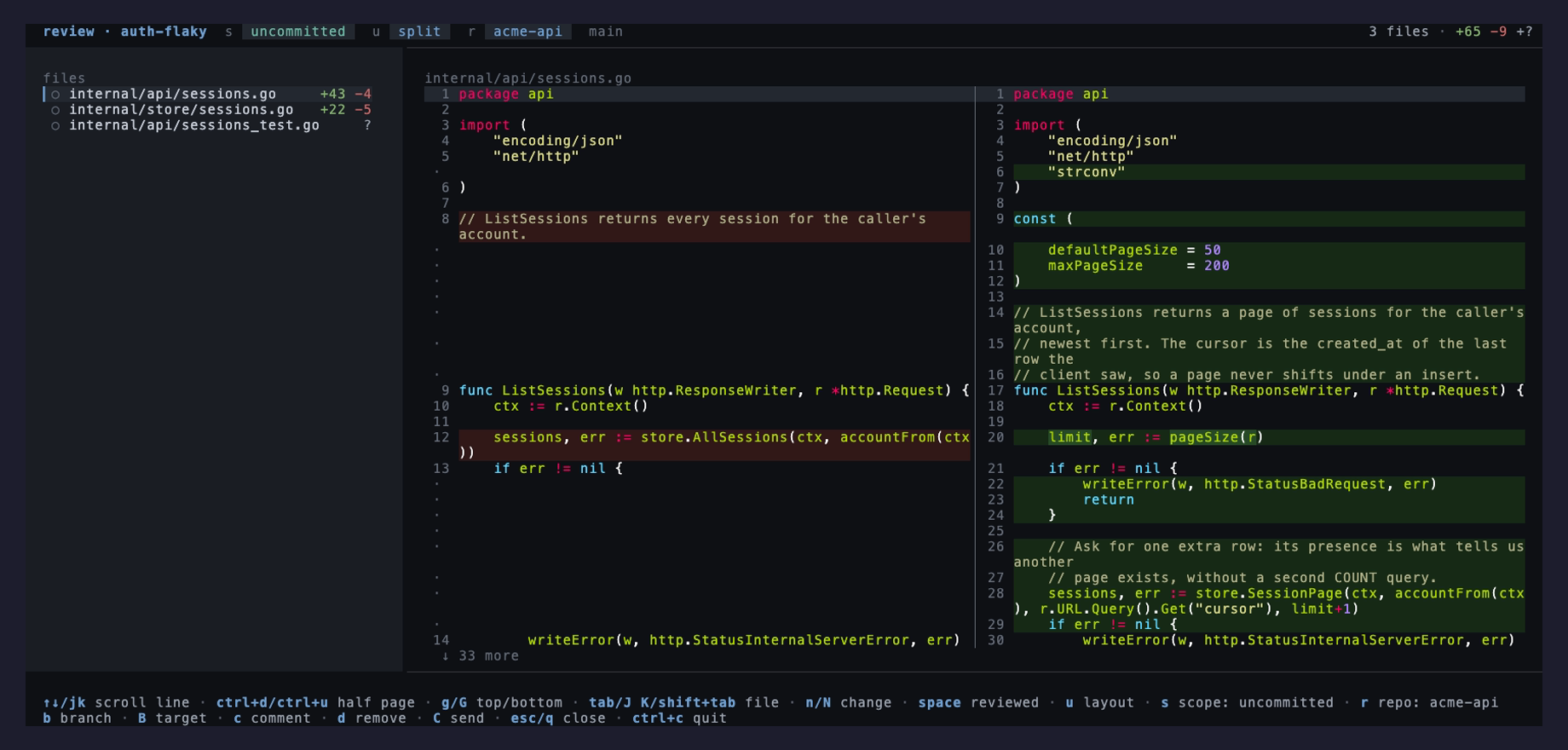
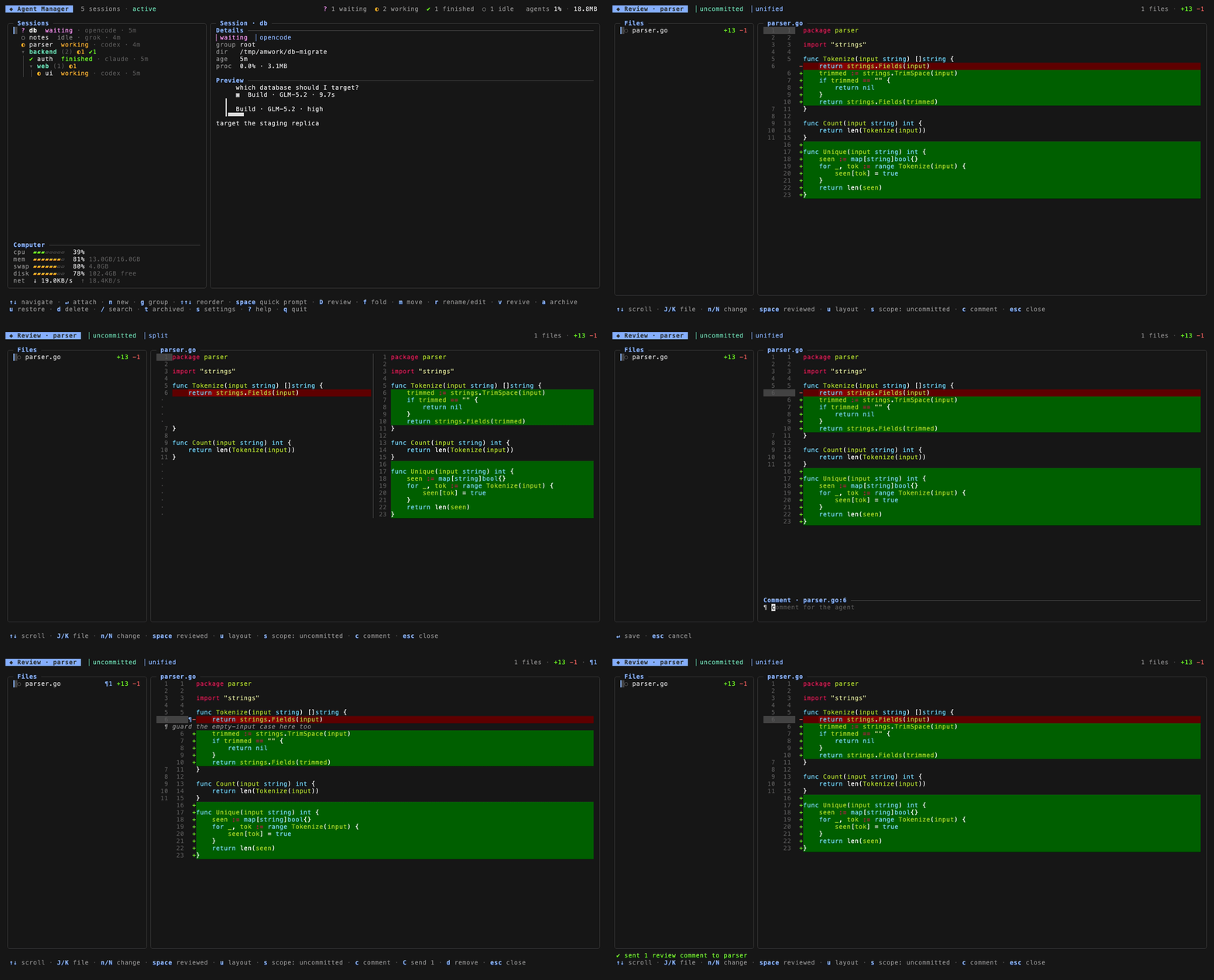
Comments stay on the review screen until you send them: C flattens every one of them into a single prompt, asks you to confirm, and delivers it into the agent's pane, so the agent starts addressing your notes while you watch the diff update.
Groups are paths (backend/api/auth) forming a tree of unlimited depth. Sessions can live at any node, including the root. Create subgroups inline with g, reorder both groups and sessions with K / J (or shift+↑↓; the order persists), fold a subtree with enter on its row, fold or unfold the whole tree with F, hide or restore empty groups visually with e, and edit a group's name and default path with r. On a session, r renames it and tab cycles the tool (status rules and revive follow the new tool; useful when you quit one agent in the pane and start another).
Each session's tmux pane is polled (default every 2s) to derive a status:
| Status | Meaning |
|---|---|
working |
The agent is busy on a turn |
waiting |
Blocked on you: a dialog, a permission ask, or a plain-text question |
finished |
Turn ended — an alert that clears to idle once you enter the session |
errored |
The tool reported an error |
idle |
Nothing running |
dead |
The tmux session is gone |
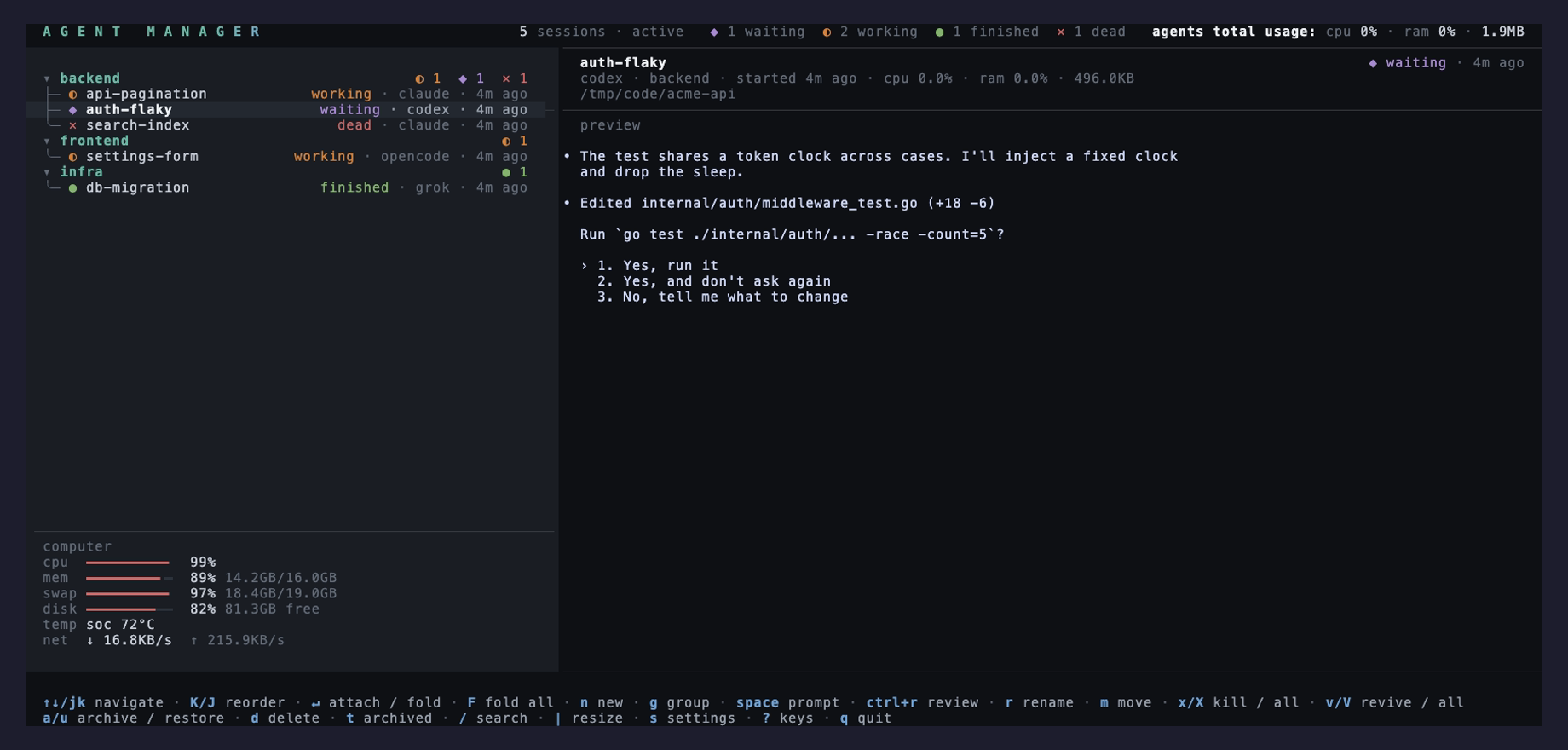
Each row carries its status and tool inline, and a folded group keeps a count per status so a collapsed subtree still tells you whether anything needs you. Selecting a session shows the tail of its pane on the right, which is how a waiting agent's actual question reaches you without attaching. A session with no window left, archived or killed, shows the snapshot taken when it still had one.
Detection matches per-tool regex rules against the visible pane, analyzes the newest turn to tell finished from waiting, and treats streaming output (content changing between polls) as working. A turn that ends without any turn-summary line still resolves: when a working pane goes quiet, the turn counts as finished, or waiting when it ends on a question. Work that outlives the turn which started it (background agents) is matched by busy_line, so a turn-end summary keeps reading as working while that work runs. Polling keeps running while you are inside a session, so statuses stay live. The selected session's pane tail renders in the preview panel, and moving the cursor fetches the preview immediately.
For Claude Code, status comes first-hand from hook events instead of pane guessing: sessions launch with a generated --settings file whose hooks write the lifecycle state (working, waiting, finished, idle) to a per-session status file that the poller reads first. Pane rules still refine it — hooks cannot see a plain-text question, an Esc interrupt, or an error line, so a matching pane verdict upgrades the hook status — and they take over fully as fallback when the hook file is missing or stale. Enabled per tool with status_source = "claude-hooks".
The header shows a fleet summary: per-status session counts, plus agents total usage: cpu N% · ram M% · X GB for every live agent's full process tree (shell, agent, and children). CPU is that tree's CPU time over the last poll as a share of total machine capacity (same 0–100% unit as the computer gauge). RAM is resident set as a share of installed memory, with absolute size beside it. The selected session's detail line uses the same scale for that session alone.
The Computer block in the sessions panel shows machine gauges:
Total - MemAvailable, so file cache is not counted as used.used/total * 100). On macOS the swap file grows under pressure, so the denominator is the live size from vm.swapusage, not a fixed partition.cpu, gpu and soc readings in °C, each the hottest sensor in its category, sampled every 5s. Apple Silicon draws no CPU/GPU line, so its dies report as one soc figure. A reading appears when the machine exposes that sensor.s opens Settings, where ↑↓ move between fields and ←→ change the focused one.
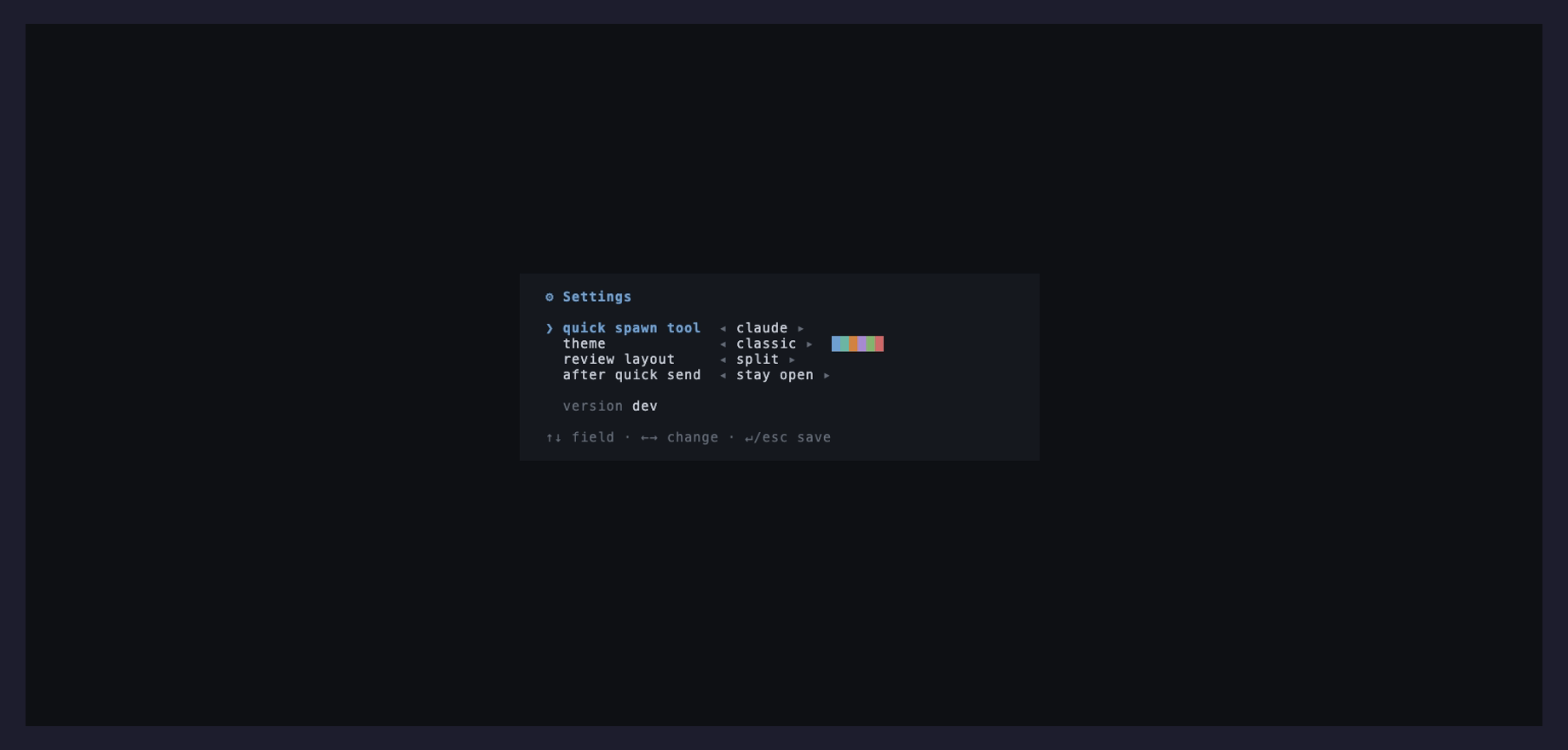
Nine palettes ship: classic, solarized dark, catppuccin mocha, tokyo night, gruvbox dark, nord, dracula, rosé pine, and monochrome. The swatch strip beside the name previews the palette, and the theme applies as you step through it, so the picker is a live preview of the whole UI. The manager also matches the terminal's own background to the palette, so the window has no seam against it, and restores the terminal's background on exit. Your pick is saved with the rest of the state and restored on the next run.
Config lives in your OS user config dir (~/Library/Application Support/agent-manager/config.toml on macOS, ~/.config/agent-manager/config.toml on Linux) and is created on first run with working defaults for Claude Code, OpenCode, Codex, and Grok Build.
Top-level: poll_interval (default "2s") sets how often panes are polled for status, preview, and stats.
Add any CLI tool as a [tools.<name>] block:
[tools.mytool]
command = "mytool"
default_status = "idle"
rules = [
  { state = "working", pattern = "esc to interrupt" },
  { state = "errored", pattern = "(?im)^\\s*error:" },
]
Rules match top-down against the visible pane text; first match wins, and default_status applies when nothing matches.
Status detection. Optional per-tool fields refine it: activity_cutoff (regex locating the tool's input box, everything above it is turn content), turn_end (a turn-summary line marking the turn as over), busy_line (work that outlives its turn, such as background agents), chrome_line, blocked_line, and trailing_note. status_source = "claude-hooks" switches status to Claude Code hook events (see Status). The generated config's claude and opencode blocks show all of them in use.
Revive. resume_by_id_command resumes one exact conversation, with {id} replaced by the session's captured agent id. That id comes either from launching under an id the manager mints (session_id_flag, e.g. --session-id) or from reading back an id the tool minted itself (session_store = "codex" | "opencode"). revive_command is what v falls back to when no id is available, e.g. claude --continue.
Prompts. prompt_flag controls how the new-session form's optional prompt is embedded into the launch command. Tools that take the prompt as a positional argument (Claude Code: claude 'the prompt') leave it empty; tools whose positional argument means something else declare the flag (OpenCode: prompt_flag = "--prompt", since its positional argument is the project path). The prompt only shapes the launch command; revive (v) uses the revive commands untouched.
MCP. mcp = "claude" | "codex" | "opencode" | "grok" | "none" picks how the agent-manager MCP server is registered into the tool's sessions (see MCP). An empty value uses the tool's config key when it names a known style.
State is stored next to the config in state.db (SQLite).
go test ./...   # includes end-to-end tests against a real tmux server
go run .
Bug reports, feature ideas, and pull requests are welcome. See CONTRIBUTING.md for setup and the checks CI runs. Questions and setups worth sharing go in Discussions. Security reports go through a private advisory; see SECURITY.md.
more like this
Comprehensive analytics dashboard for AI coding agents — Cursor, Windsurf, Claude Code, VS Code Copilot, Zed, Antigravi…
meine 🌒 - A CLI file manager and system utility built with Textual. It combines intuitive command parsing with rich t…
Skill Claude Code de veille tech francophone. Agrège les flux RSS (Journal du Hacker, Human Coders News…) et produit un…
A to-do list that runs your Claude Code agents — capture anywhere, dispatch in parallel, review from your phone.
search projects, people, and tags