agentlytics
Comprehensive analytics dashboard for AI coding agents — Cursor, Windsurf, Claude Code, VS Code Copilot, Zed, Antigravi…
JavaScript★ 555
Age of Agents — watch your AI coding sessions grow a peaceful pixel-art realm. Run it with npx age-of-agents.
 agentsmill
Watch your AI coding sessions grow a peaceful pixel-art realm.
Every Claude Code, Codex, OpenCode or Koda session becomes a settler walking out of the keep. The tool it runs decides which workshop it visits, subagents become workers, and tokens fill the storehouse — a calm, Age-of-Empires-style kingdom of your work. No combat, just a quiet realm you can watch at a glance.
▶ Live site · Quick start · How it works · Architecture
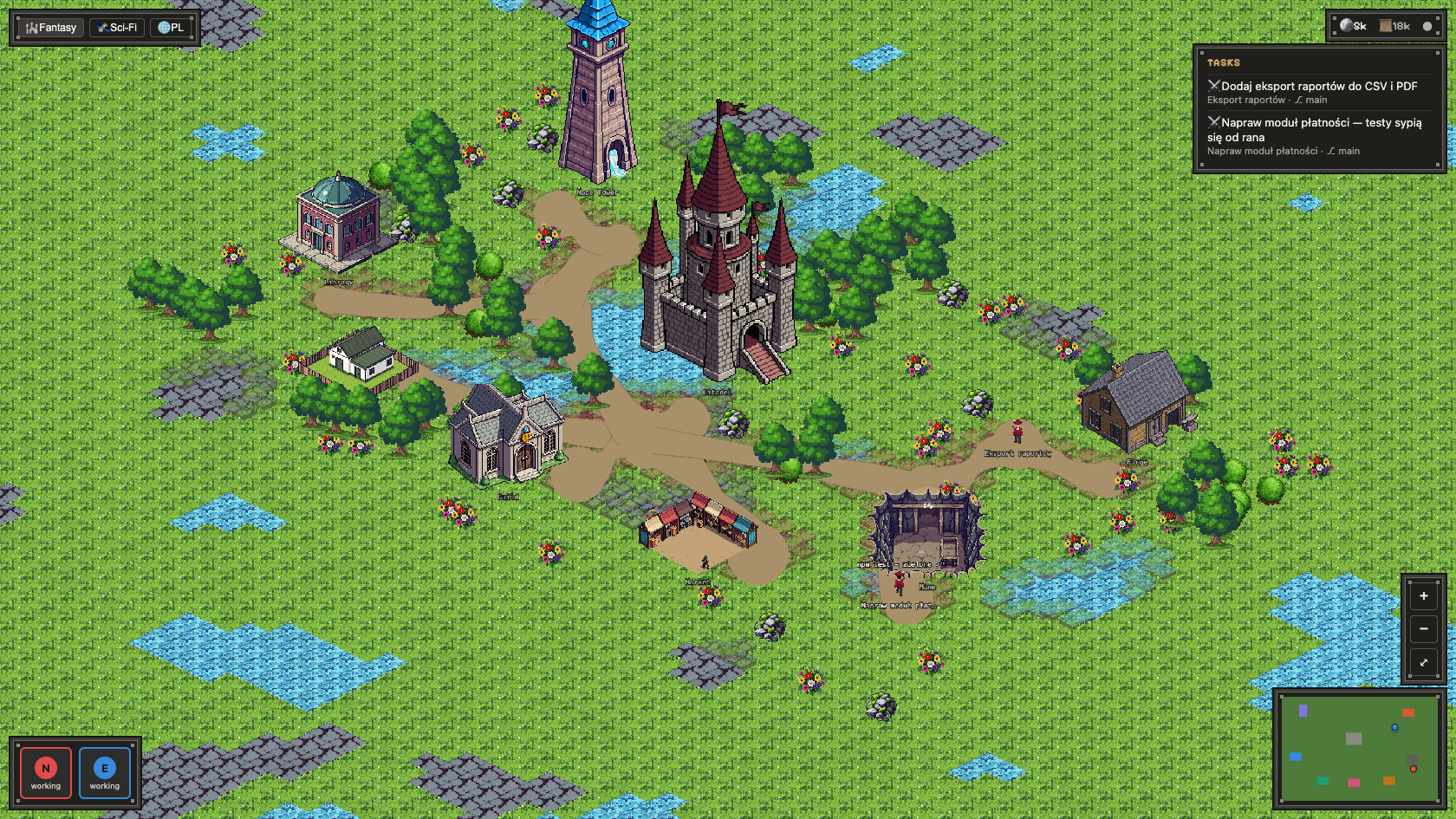
Age of Agents (npm package age-of-agents) runs as a small local web app
alongside your normal CLI workflow. It watches your agent session transcripts and
renders them as a calm, real-time strategy realm:
A glanceable, second-monitor view of what your agents are quietly up to.
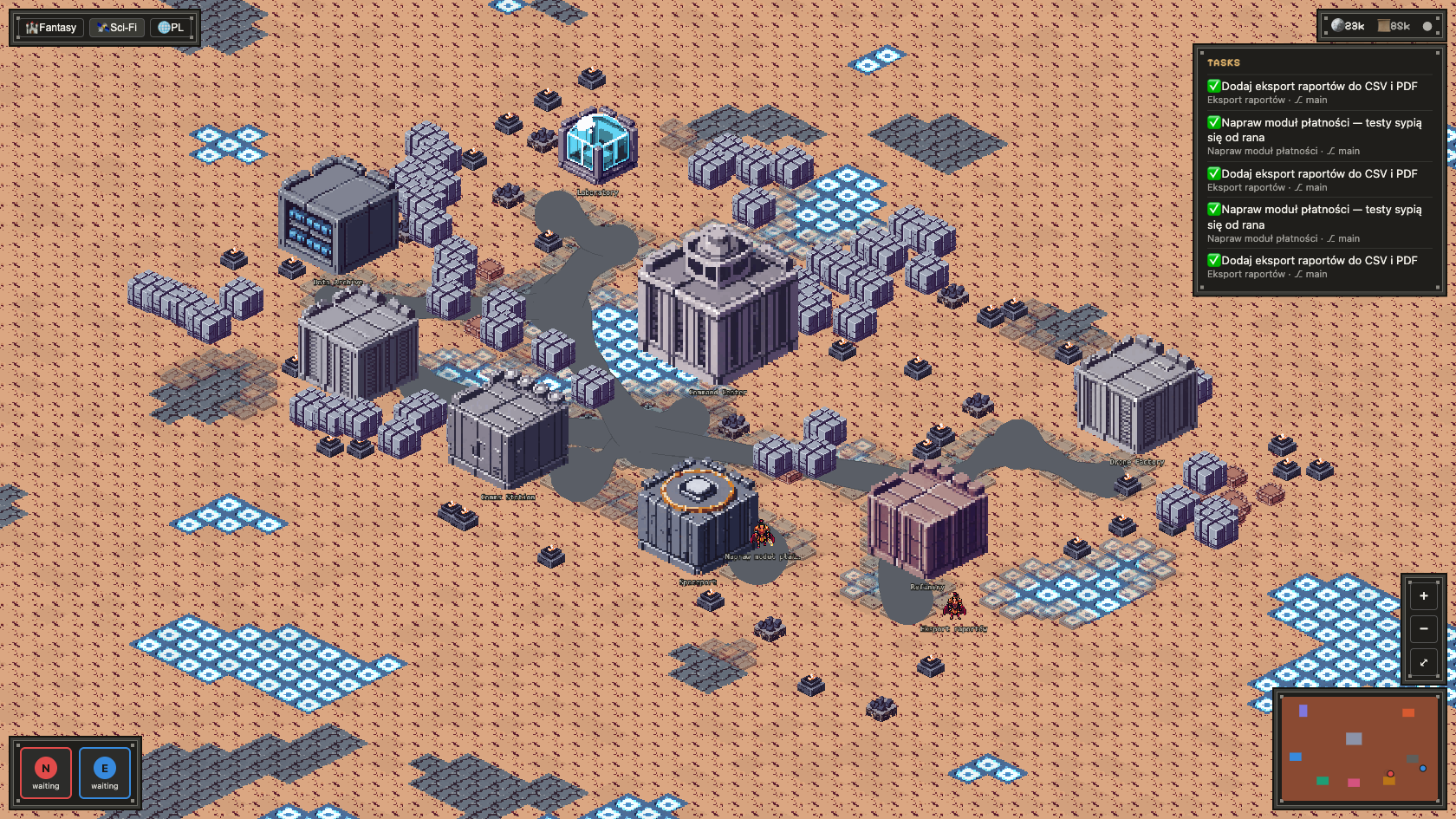
| Fantasy | Sci-Fi |
|---|---|
|
 |
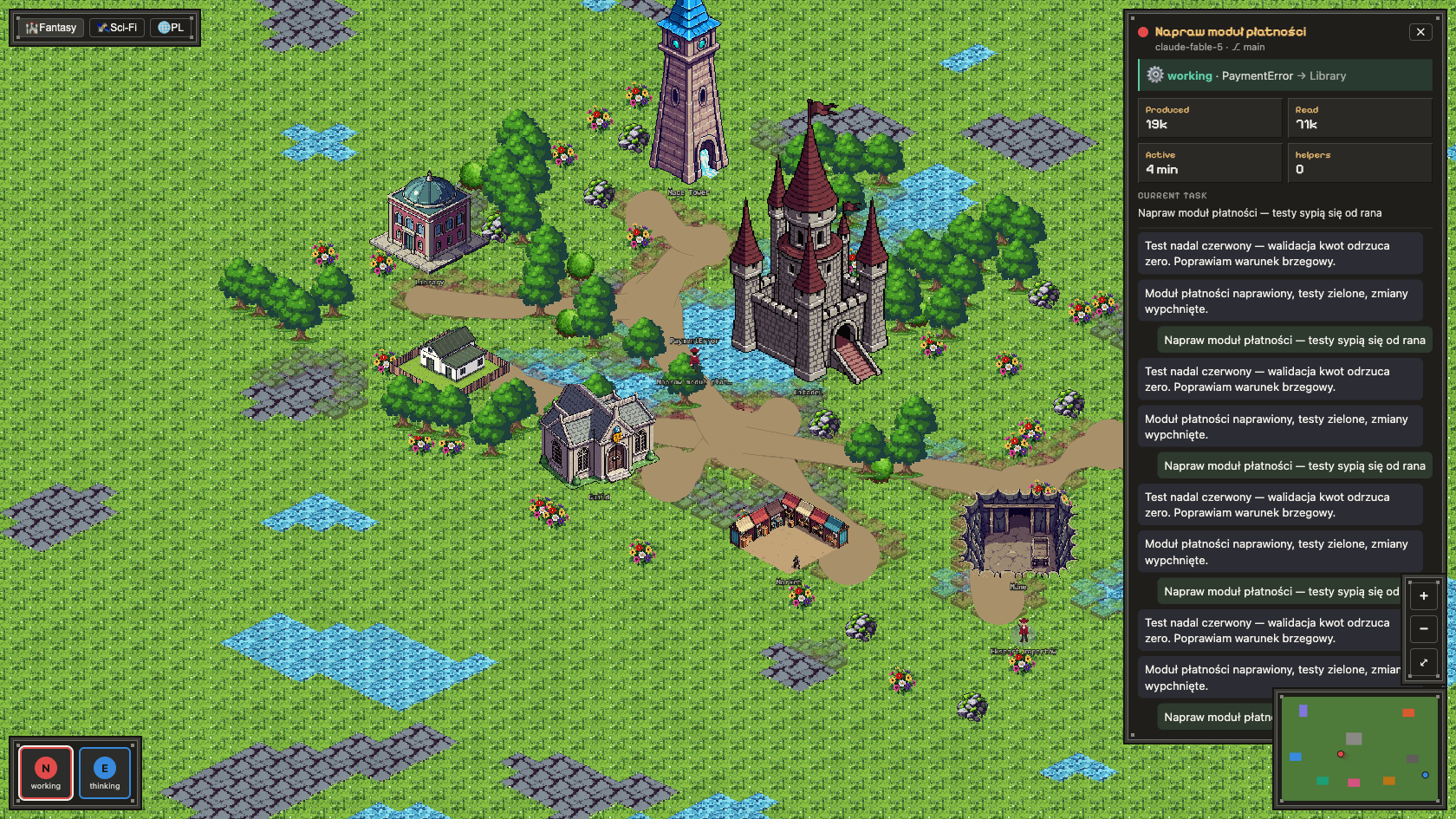
Session detail — click a settler to inspect its task, token economy and live activity:
Install — npm i -g. Install it globally for the short aoa command; update with npm update -g age-of-agents when new versions ship:
npm i -g age-of-agents
aoa            # watches ~/.claude, ~/.codex, ~/.opencode & ~/.koda sessions (+ Claude in local Docker), prints the URL
aoa --demo     # calm demo mode (fake sessions)
aoa --open     # also open the browser
The server binds to
127.0.0.1only and never writes your transcripts anywhere — it just reads them locally and broadcasts game state over a local WebSocket. See Privacy.
git clone https://github.com/agentsmill/age-of-agents
cd age-of-agents && npm install
npm run demo     # server (demo) + client (Vite) → http://localhost:5173
npm run dev      # visualize your real sessions
For focused local testing you can limit which session sources are watched:
AOA_SOURCES=codex npm run dev
AOA_SOURCES=claude,codex npm run dev
AOA_CODEX_LOOKBACK_DAYS=3 npm run dev
AOA_SOURCES accepts claude, codex, opencode, and koda.
Codex watches recent date folders by default instead of the entire historical
~/.codex/sessions tree.
Local engines don't write transcripts, so Age of Agents captures them through a small logging proxy. Two ways in:
Ollama (terminal):
aoa local llama3 # wraps `ollama run llama3` and logs it as a hero
The session shows up on the battlefield; the model appears in the Modele tab, where you can assign a sprite (context window is read automatically from Ollama).
Any OpenAI-compatible backend (llama.cpp / vLLM / oMLX / coding agents):
LLM_BASE_URL=http://localhost:8000/v1 aoa local-proxy # prints a proxy URL
Point your client's base URL at the printed proxy URL. Default backend base URLs:
| Backend | Default base URL |
|---|---|
| Ollama | http://localhost:11434/v1 |
| llama.cpp | http://localhost:8080/v1 |
| vLLM | http://localhost:8000/v1 |
| oMLX | http://localhost:10240/v1 |
Overrides: LLM_BASE_URL, LLM_MODEL, LLM_API_KEY.
agent session transcript ──▶ server (watcher + state machine) ──▶ WebSocket ──▶ client (PixiJS realm + HUD)
Fact, and runs a small per-session state machine (thinking / working / resting / idle / returning).HeroSnapshot for every session over a WebSocket. The snapshot carries what the session is doing (currentTool, recent actions, tokens) — never raw coordinates.docker exec — no image changes, no host bind-mounts required. Containerized settlers carry a 🐳 badge in the side panel. Disable with AGENTCRAFT_DOCKER=0.Run several projects at once and each becomes its own city in the top bar — switch between them, or pick All to see every settler together. A city shows how many agents are active and which kind (Claude, Codex, OpenCode, Koda).
Select a city to open the Architect's Hall, a side panel that surfaces two optional, third-party signals about that project — read-only and entirely opt-in:
.beads/issues.jsonl (falling back to bd list --json). Turn it on in a project with bd init.graphify-out/graph.json. Generate it with the bundled, dependency-free generator — run npm run graphify in a project (or node scripts/graphify.mjs <dir>) to scan relative imports and write graphify-out/graph.json. You can also use the external Graphify tool; the schema is the same.Neither tool is bundled or required. If a project has no .beads/ or graphify-out/, the panel just reads "not initialized"; it polls every few seconds, so intel appears as soon as the files do.
Two full art sets, switchable from the top bar:
A small npm-workspaces monorepo, published as the single age-of-agents CLI:
| Package | Stack | Responsibility |
|---|---|---|
packages/shared |
TypeScript | WebSocket protocol types (GameEvent, snapshots) |
packages/server |
Node + Fastify + ws + SQLite |
transcript watcher, state machine, hooks endpoint, demo generator, CLI |
packages/client |
Vite + React 19 + PixiJS v8 | the game realm, HUD, minimap, side panel |
npm test      # unit tests (server + client)
npm run build # production client + bundled CLI (dist/cli.js)
127.0.0.1 only — nothing is exposed to your network.~/.claude/settings.json (a fast event channel). Demo mode touches nothing of yours.127.0.0.1-only; with the mode off, Age of Agents remains a passive read-only observer. When on, an unanswered prompt (timeout or app closed) always falls back to the terminal — the app never auto-allows. "Always allow" rules live in ~/.age-of-agents/permission-policy.json; the app never edits the permission rules in ~/.claude/settings.json.npm i @anthropic-ai/claude-agent-sdk), a 🚀 Launch agent button lets you start a Claude Code session from the panel — pick a folder, type a prompt, choose a permission mode. These app-owned sessions are real Claude Code runs (they use your account and tokens) and you answer their permission prompts, plan approvals and multiple-choice questions (a centered "agent question" modal) directly in the panel. The SDK is an optional dependency; without it the button is hidden and nothing changes.
claude setup-token, then start the app from a shell where CLAUDE_CODE_OAUTH_TOKEN is set (and ANTHROPIC_API_KEY is unset, or it takes precedence). Without it, launches fail with 401 Invalid authentication credentials; the launch dialog warns when no auth is present.The server binds to 127.0.0.1 only and is built for local use. It defends against the realistic threat — a malicious web page in your browser (a "drive-by" that scripts localhost) — with two layers:
403). A cross-origin page always sends an Origin header, so it cannot connect or post.~/.age-of-agents/session-token (0600) is required for the WebSocket handshake and for sensitive endpoints (launch/stop/message, hook install/uninstall, config writes, /fs/list). The app fetches it from /session-token, which is only served to allowlisted origins. Installed hooks and local tools keep working with no setup — the token is auto-created on first run./fs/list (the folder picker) is confined to your home directory. The server refuses to bind to a non-loopback host unless you explicitly set AOA_ALLOW_REMOTE=1.
Honest boundaries: loopback is not isolated per user, so this does not fully protect against another user on a shared machine, and a process running as you can read the token file. Those are out of scope for a local-first tool.
All pixel-art assets in packages/client/public/assets/ were generated by the author with PixelLab and are the author's own work — released here under the same MIT license as the code. Without any assets the game still runs on procedurally generated placeholders.
assets-manifest.json + scripts/download-assets.mjs are an optional helper for swapping in alternative third-party packs locally; those packs are never committed (some forbid redistribution) and are not needed to run the game.
Issues and PRs are welcome. To get going: npm install, then npm run demo to see the realm, and npm test before opening a PR.
MIT © Mateusz Pawelczuk. Art assets generated with PixelLab, redistributed under MIT per PixelLab's Terms of Service.
Inspired by AgentCraft. Built with PixiJS, React, Fastify and PixelLab.
more like this
Comprehensive analytics dashboard for AI coding agents — Cursor, Windsurf, Claude Code, VS Code Copilot, Zed, Antigravi…
TachiSnap — Pixel Snapper for animation pixel artists. Rust + WebAssembly client-side tool for cleaning up AI-generated…
search projects, people, and tags