chinese-hershey-font
Convert Chinese Characters to Single-Line Fonts using Computer Vision
Python★ 161
A C++ Background Subtraction Library with wrappers for Python, MATLAB, Java and GUI on QT
 andrewssobral
git clone https://github.com/andrewssobral/bgslibrary.gitandrewssobral/bgslibrary

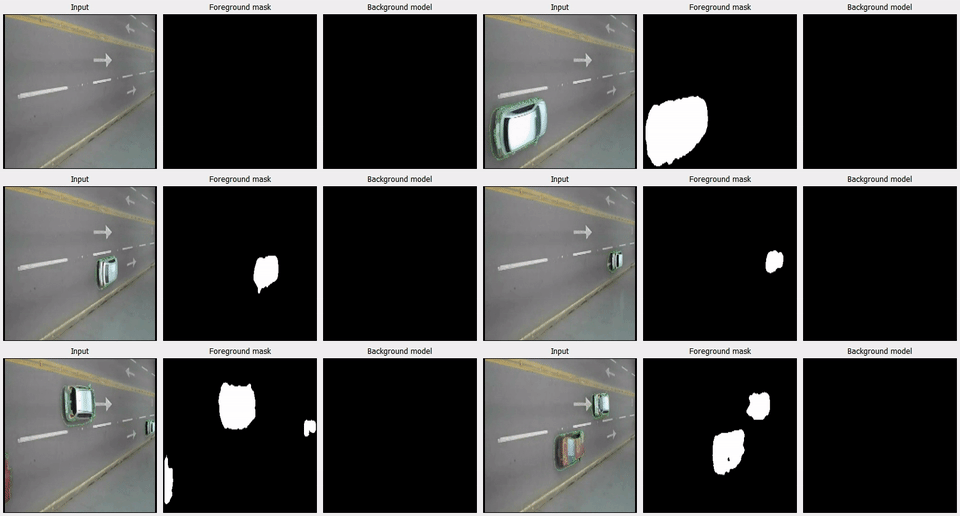
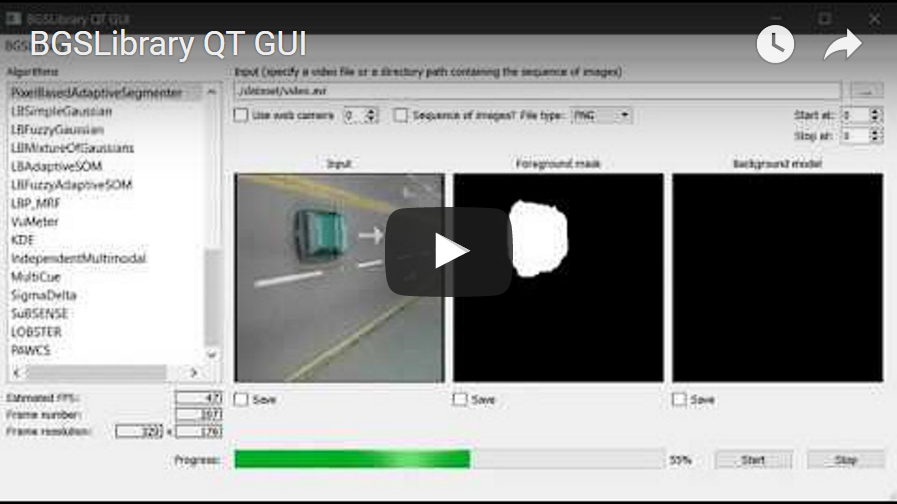
The BGSLibrary (Background Subtraction Library) is a comprehensive C++ framework designed for background subtraction in computer vision applications, particularly for detecting moving objects in video streams. It provides an easy-to-use and extensible platform for researchers and developers to experiment with and implement various background subtraction techniques.
3.3.1 (see Build Status and Release Notes for more info)
The BGSLibrary was developed in early 2012 by Andrews Cordolino Sobral as a C++ framework with wrappers available for Python, Java, and MATLAB. It aims to facilitate foreground-background separation in videos using the OpenCV library.
The library is compatible with OpenCV versions 2.4.x, 3.x, and 4.x. It can be compiled and used on Windows, Linux, and Mac OS X systems.
The library's source code is available under the MIT license, making it free for both academic and commercial use.
#include <iostream>
#include <algorithm>
#include <iterator>
#include <vector>

// Include the OpenCV and BGSLibrary libraries
#include <opencv2/opencv.hpp>
#include <bgslibrary/algorithms/algorithms.h>

int main( int argc, char** argv )
{
    // Gets the names of the background subtraction algorithms registered in the BGSLibrary factory
    auto algorithmsName = BGS_Factory::Instance()->GetRegisteredAlgorithmsName();

    // Displays the number of available background subtraction algorithms in the BGSLibrary
    std::cout << "Number of available algorithms: " << algorithmsName.size() << std::endl;

    // Displays the list of available background subtraction algorithms in the BGSLibrary
    std::cout << "List of available algorithms:" << std::endl;
    std::copy(algorithmsName.begin(), algorithmsName.end(), std::ostream_iterator<std::string>(std::cout, "\n"));

    // Returns 0 to indicate that the execution was successful
    return 0;
}
You can either install BGSLibrary via pre-built binary package or build it from source.
Building from source? Clone with submodules. BGSLibrary bundles pybind11 as a git submodule (used by the
Python wrapper), so clone recursively:
git clone --recursive https://github.com/andrewssobral/bgslibrary.git
Already cloned without --recursive? Fetch the submodule with:
git submodule update --init --recursive
The
pip install pybgspath below does not need this — the published PyPI package already bundlespybind11.
Supported Compilers:
Other compilers might work, but are not officially supported. The bgslibrary requires some features from the ISO C++ 2014 standard.
pybgs) via pip — quickest for Python usersIf you only need the Python bindings, install the published package:
pip install pybgs
The same package is also published under the name bgslibrary
(pip install bgslibrary) — either way the importable module is always pybgs.
Minimal usage (background subtraction on a video):
import cv2
import pybgs as bgs

algorithm = bgs.FrameDifference()          # see the note below on which algorithms are available
capture = cv2.VideoCapture("dataset/video.avi")
while True:
    ok, frame = capture.read()
    if not ok:
        break
    fg_mask = algorithm.apply(frame)             # foreground mask (CV_8UC1)
    bg_model = algorithm.getBackgroundModel()    # current background model
    cv2.imshow("frame", frame)
    cv2.imshow("foreground", fg_mask)
    cv2.imshow("background", bg_model)
    if cv2.waitKey(10) & 0xFF == 27:             # Esc to quit (mask for 64-bit platforms)
        break
cv2.destroyAllWindows()
Runnable demos: demo.py, demo2.py, and the
Python examples repo.
Important
pip install pybgs builds from source, so it needs a C++ compiler and an OpenCV
development install on your machine (e.g. libopencv-dev on Ubuntu, brew install opencv on
macOS). If you don't have OpenCV, prefer the Pixi build below — it provides OpenCV for you.pybgs was compiled against — not on your
opencv-python/cv2 version. On OpenCV ≥ 4 the DP*/T2F* family is unavailable (26
algorithms vs ~39 on OpenCV 2/3 — see the compatibility table).
Always gate on the binding, e.g. if hasattr(bgs, "DPAdaptiveMedian"): ..., never on cv2.__version__.Pixi provides a clean and reproducible way to build BGSLibrary with no manual OpenCV installation. It works on macOS, Linux, and Windows (WSL recommended).
curl -fsSL https://pixi.sh/install.sh | sh
Restart your terminal after installation.
The repository already ships a pixi.toml that declares all build
dependencies — OpenCV, CMake, Ninja, compilers and pkg-config, plus
Python and NumPy for the Python wrapper — and all the build tasks used
below. Just clone the repository (recursively — see above); there is no need to
run pixi init or add anything by hand.
List the available tasks at any time with:
pixi task list
pixi shell
pixi run configure
pixi run build
This generates:
build/bgslibrarybuild/libbgslibrary_core.*To build and use the Python bindings (import pybgs):
pixi run build_python     # configure + build pybgs (BGS_PYTHON_SUPPORT=ON, into build_py/)
pixi run install_python   # install pybgs into the Pixi environment's site-packages
python -c "import pybgs"  # verify the import works
pybgs is compiled against the OpenCV, Python and NumPy provided by the
Pixi environment, so no system Python or OpenCV installation is required.
pixi run build_examples
This produces:
examples/build/bgs_demoexamples/build/bgs_demo2Camera demo:
pixi run run
Demo using a video file:
pixi run run_bgs_demo
Demo using an image sequence:
pixi run run_bgs_demo2
pixi run install
The library and headers go into .pixi/envs/default/
You can then use bgslibrary from other CMake projects in the same environment, for example:
find_package(BGSLibrary REQUIRED)
To clean build artifacts:
pixi run clean          # Clean main build
pixi run clean_examples # Clean examples
To rebuild everything from scratch:
pixi run rebuild     # Rebuild main project
pixi run rebuild_all # Rebuild main project + examples
These tasks automatically handle dependencies, ensuring a consistent build state.
pip install pybgs fails to build / cannot find OpenCV — it compiles from source and needs a C++
compiler and OpenCV development files. Install OpenCV (libopencv-dev on Ubuntu, brew install opencv on
macOS) and a compiler, or use the Pixi build above, which provides OpenCV for you.AttributeError: module 'pybgs' has no attribute 'DPAdaptiveMedian' (or another DP*/T2F* algorithm) —
those algorithms only compile on OpenCV 2.x/3.x, so they are absent when pybgs was built against OpenCV ≥ 4.
Check availability with hasattr(bgs, "DPAdaptiveMedian"); to use them, build against OpenCV 2/3 (see the
compatibility table below).import cv2 raises an ABI / NumPy error with OpenCV 3.4.x — numpy 2.x is incompatible with the older
opencv-python 3.4.x; pin numpy<2 in that environment.| Algorithm | OpenCV < 3.0 (42) | 3.0 <= OpenCV <= 3.4.7 (41) | 3.4.7 < OpenCV < 4.0 (39) | OpenCV >= 4.0 (26) |
|---|---|---|---|---|
| AdaptiveBackgroundLearning | ✔️ | ✔️ | ✔️ | ✔️ |
| AdaptiveSelectiveBackgroundLearning | ✔️ | ✔️ | ✔️ | ✔️ |
| CodeBook | ✔️ | ✔️ | ✔️ | ✔️ |
| DPAdaptiveMedian | ✔️ | ✔️ | ✔️ | ❌ |
| DPEigenbackground | ✔️ | ✔️ | ✔️ | ❌ |
| DPGrimsonGMM | ✔️ | ✔️ | ✔️ | ❌ |
| DPMean | ✔️ | ✔️ | ✔️ | ❌ |
| DPPratiMediod | ✔️ | ✔️ | ✔️ | ❌ |
| DPTexture | ✔️ | ✔️ | ✔️ | ❌ |
| DPWrenGA | ✔️ | ✔️ | ✔️ | ❌ |
| DPZivkovicAGMM | ✔️ | ✔️ | ✔️ | ❌ |
| FrameDifference | ✔️ | ✔️ | ✔️ | ✔️ |
| FuzzyChoquetIntegral | ✔️ | ✔️ | ✔️ | ✔️ |
| FuzzySugenoIntegral | ✔️ | ✔️ | ✔️ | ✔️ |
| GMG | ✔️ | ❌ | ❌ | ❌ |
| IndependentMultimodal | ✔️ | ✔️ | ✔️ | ✔️ |
| KDE | ✔️ | ✔️ | ✔️ | ✔️ |
| KNN | ❌ | ✔️ | ✔️ | ✔️ |
| LBAdaptiveSOM | ✔️ | ✔️ | ✔️ | ✔️ |
| LBFuzzyAdaptiveSOM | ✔️ | ✔️ | ✔️ | ✔️ |
| LBFuzzyGaussian | ✔️ | ✔️ | ✔️ | ✔️ |
| LBMixtureOfGaussians | ✔️ | ✔️ | ✔️ | ✔️ |
| LBP_MRF | ✔️ | ✔️ | ❌ | ❌ |
| LBSimpleGaussian | ✔️ | ✔️ | ✔️ | ✔️ |
| LOBSTER | ✔️ | ✔️ | ✔️ | ✔️ |
| MixtureOfGaussianV1 | ✔️ | ❌ | ❌ | ❌ |
| MixtureOfGaussianV2 | ✔️ | ✔️ | ✔️ | ✔️ |
| MultiCue | ✔️ | ✔️ | ✔️ | ❌ |
| MultiLayer | ✔️ | ✔️ | ❌ | ❌ |
| PAWCS | ✔️ | ✔️ | ✔️ | ✔️ |
| PixelBasedAdaptiveSegmenter | ✔️ | ✔️ | ✔️ | ✔️ |
| SigmaDelta | ✔️ | ✔️ | ✔️ | ✔️ |
| StaticFrameDifference | ✔️ | ✔️ | ✔️ | ✔️ |
| SuBSENSE | ✔️ | ✔️ | ✔️ | ✔️ |
| T2FGMM_UM | ✔️ | ✔️ | ✔️ | ❌ |
| T2FGMM_UV | ✔️ | ✔️ | ✔️ | ❌ |
| T2FMRF_UM | ✔️ | ✔️ | ✔️ | ❌ |
| T2FMRF_UV | ✔️ | ✔️ | ✔️ | ❌ |
| TwoPoints | ✔️ | ✔️ | ✔️ | ✔️ |
| ViBe | ✔️ | ✔️ | ✔️ | ✔️ |
| VuMeter | ✔️ | ✔️ | ✔️ | ✔️ |
| WeightedMovingMean | ✔️ | ✔️ | ✔️ | ✔️ |
| WeightedMovingVariance | ✔️ | ✔️ | ✔️ | ✔️ |
If you use this library for your publications, please cite it as:
@inproceedings{bgslibrary,
author    = {Sobral, Andrews},
title     = {{BGSLibrary}: An OpenCV C++ Background Subtraction Library},
booktitle = {IX Workshop de Visão Computacional (WVC'2013)},
address   = {Rio de Janeiro, Brazil},
year      = {2013},
month     = {Jun},
url       = {https://github.com/andrewssobral/bgslibrary}
}
A chapter about the BGSLibrary has been published in the handbook on Background Modeling and Foreground Detection for Video Surveillance.
@incollection{bgslibrarychapter,
author    = {Sobral, Andrews and Bouwmans, Thierry},
title     = {BGS Library: A Library Framework for Algorithm’s Evaluation in Foreground/Background Segmentation},
booktitle = {Background Modeling and Foreground Detection for Video Surveillance},
publisher = {CRC Press, Taylor and Francis Group.}
year      = {2014},
}
Sobral, Andrews. BGSLibrary: An OpenCV C++ Background Subtraction Library. IX Workshop de Visão Computacional (WVC'2013), Rio de Janeiro, Brazil, Jun. 2013. (PDF in brazilian-portuguese containing an english abstract).
Sobral, Andrews; Bouwmans, Thierry. "BGS Library: A Library Framework for Algorithm’s Evaluation in Foreground/Background Segmentation". Chapter on the handbook "Background Modeling and Foreground Detection for Video Surveillance", CRC Press, Taylor and Francis Group, 2014. (PDF in english).
Some algorithms of the BGSLibrary were used successfully in the following papers:
(2014) Sobral, Andrews; Vacavant, Antoine. A comprehensive review of background subtraction algorithms evaluated with synthetic and real videos. Computer Vision and Image Understanding (CVIU), 2014. (Online) (PDF)
(2013) Sobral, Andrews; Oliveira, Luciano; Schnitman, Leizer; Souza, Felippe. (Best Paper Award) Highway Traffic Congestion Classification Using Holistic Properties. In International Conference on Signal Processing, Pattern Recognition and Applications (SPPRA'2013), Innsbruck, Austria, Feb 2013. (Online) (PDF)
more like this
Convert Chinese Characters to Single-Line Fonts using Computer Vision
🎥🤟 8 minimalistic templates for tfjs mediapipe handpose and facemesh
Open-source, offline-first face recognition attendance platform that runs on any webcam.
search projects, people, and tags