conduit
Native iOS and Android client for Open WebUI, plus direct OpenAI-compatible, Ollama, and OpenRouter connections and sel…
 cogwheel0
Conduit

A native mobile client for Open WebUI, your own model endpoints, and self-hosted agents.


Connect · Screenshots · Features · Getting Started · Privacy · Build from Source

Open WebUI is excellent on the desktop. On mobile it breaks down at the edges: authentication behind a reverse proxy, streaming that drops when the app backgrounds, getting a screenshot into a prompt, starting a chat from the home screen. Conduit is a real Flutter app built to close that gap, and as of 4.0 it works with or without an Open WebUI server at all.
Your chats live on your device first. Nothing routes through a backend the maintainer operates.
Three ways to connect
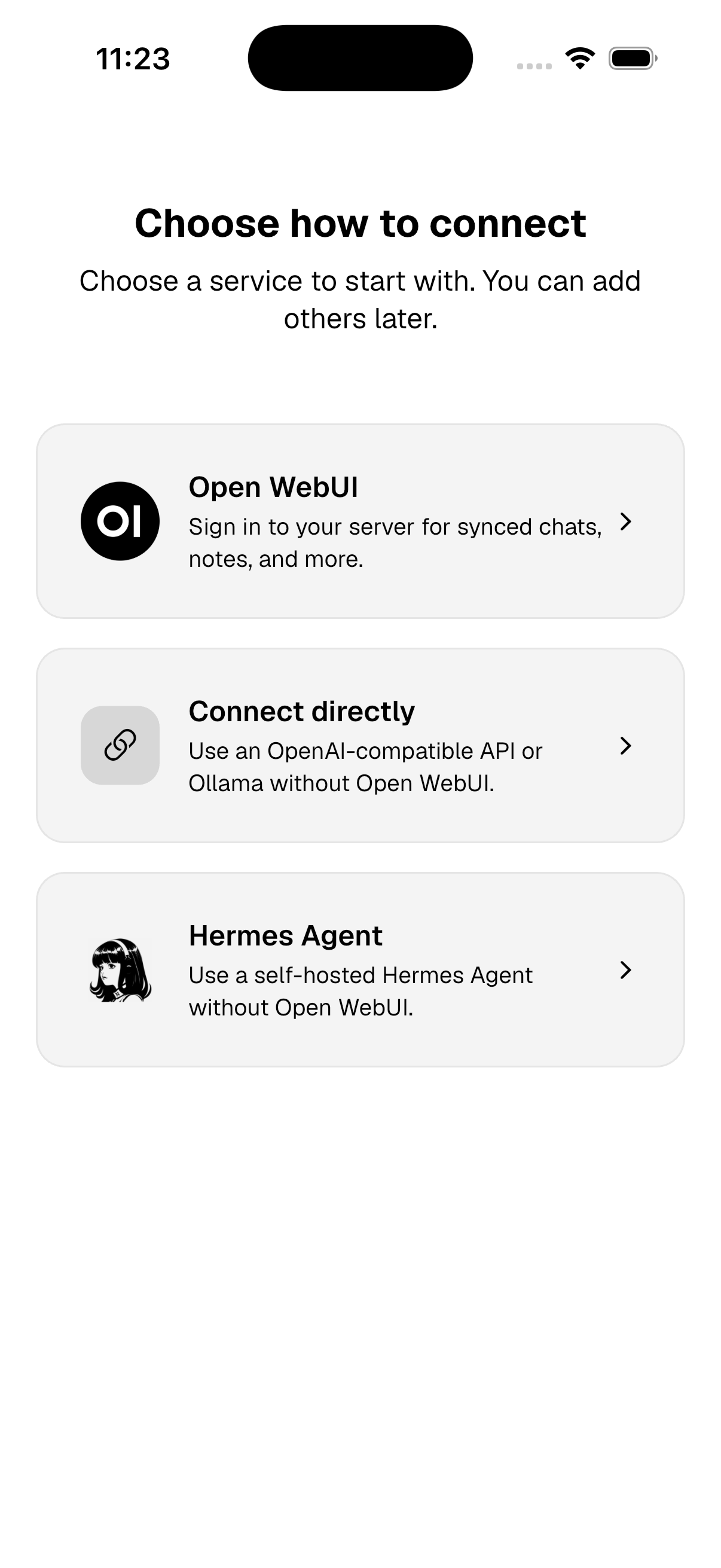
On first launch Conduit asks how you want to connect. Pick one, add the others later, and skip any sign-in you don't need.
| Open WebUI | Your self-hosted server | Full feature set: chats, folders, notes, channels, workspace, tools, web search, image generation |
| Direct | OpenAI-compatible, Ollama, OpenRouter | Talk straight to a provider or a model on your own machine. No Open WebUI account required |
| Hermes | Your self-hosted agent | An agent that runs tools, asks before sensitive steps, and works on a schedule |
Direct connections cover OpenAI-compatible endpoints (Chat Completions or Responses), LM Studio, Azure-style API versions, native Ollama, and first-party OpenRouter. Bring an API key, or skip it for a local endpoint that doesn't want one. Direct connections you already configured in Open WebUI come along automatically. Keys and custom headers stay in platform secure storage.
Hermes Agent connects to your own Hermes server. You watch its tools work live, approve sensitive steps before they run, and let scheduled agents run while you sleep. Conversations and schedules get their own tab, and Conduit only exposes the capabilities your server actually reports.
Screenshots
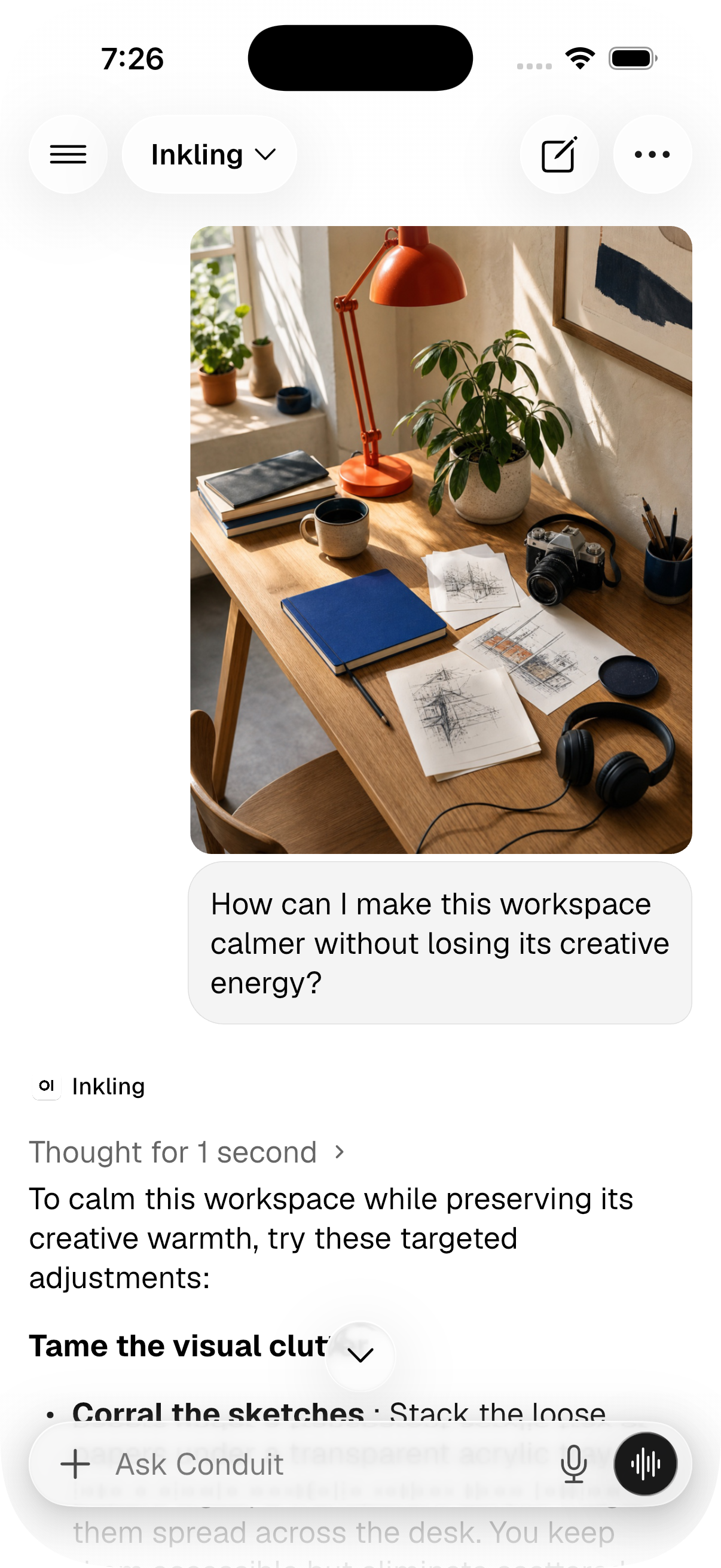
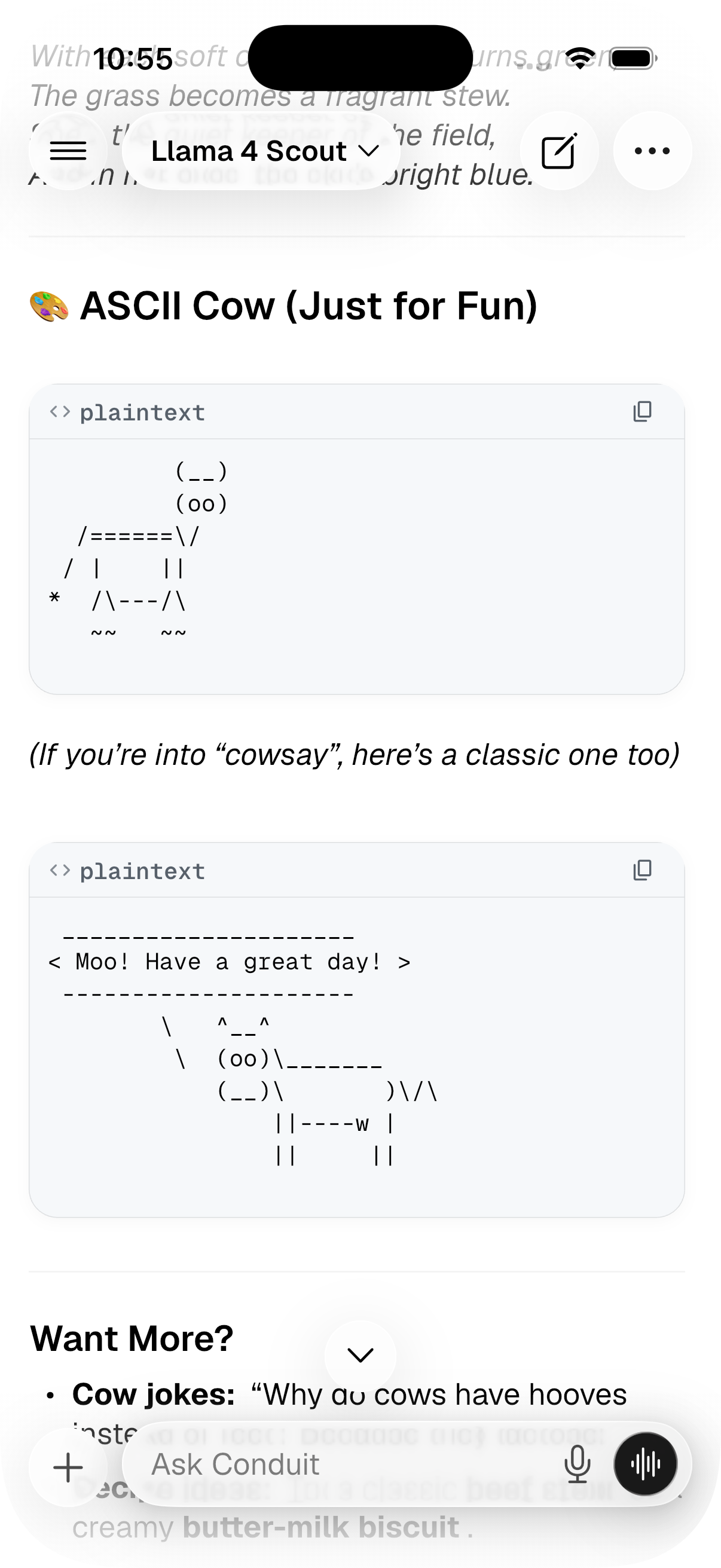
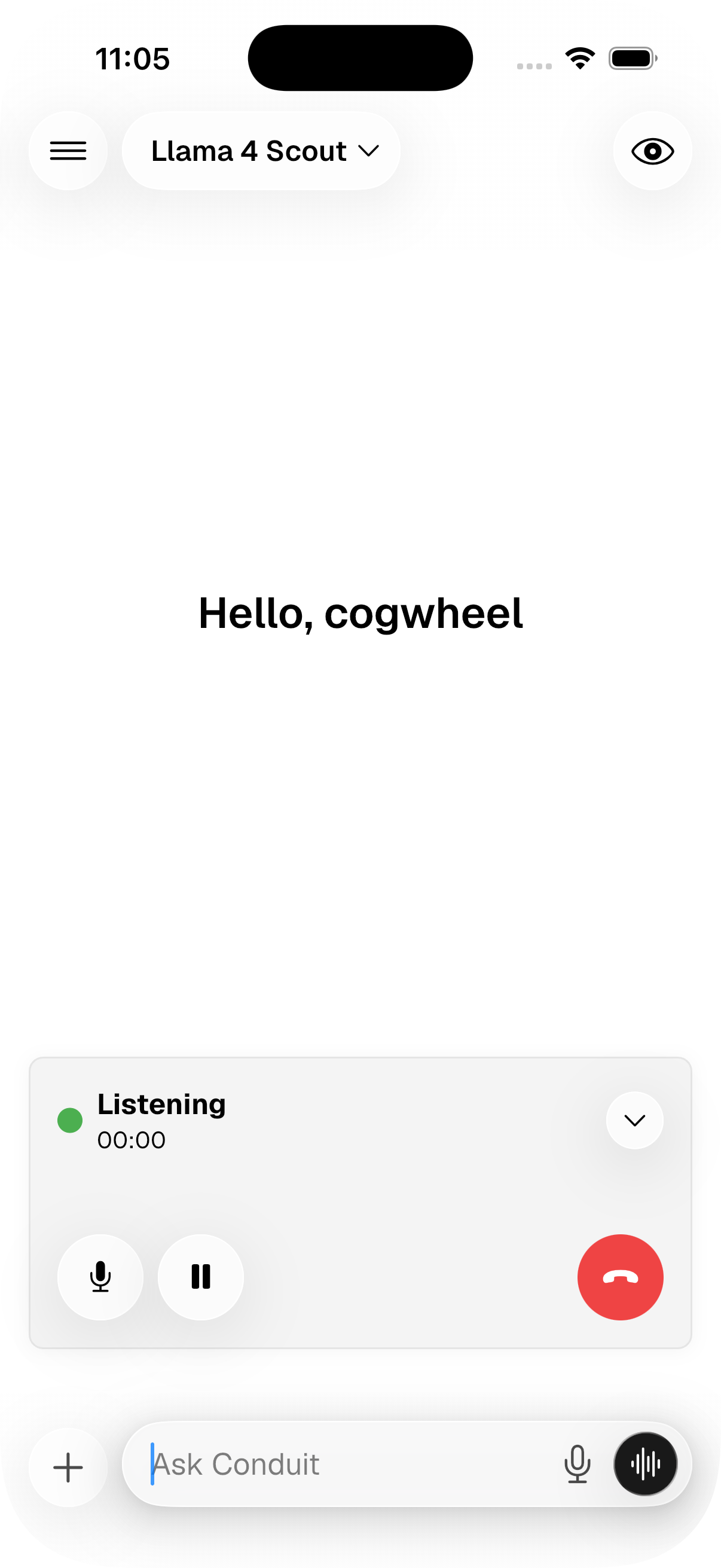
| Chat | Sidebar | Themes | Settings |
|---|---|---|---|
 |
 |
 |
 |
What you get
Chat that survives mobile
Token-by-token streaming over WebSocket. The transcript holds its place while a response grows, pinned prompts stay put, and long conversations load without stalling the UI. Search across conversations, organize with folders, pin what matters, or start a temporary chat that leaves nothing behind.
Rendering that holds up on a phone
Native Flutter surfaces, not a web view wrapped in a shell:
- syntax-highlighted code blocks with copy and preview
- Mermaid diagrams rendered natively
- LaTeX and math
- expandable reasoning, tool-call, and code-execution sections
- inline citations, source cards, and follow-up suggestions
- Chart.js embeds
A real Workspace
Models, knowledge, prompts, tools, and skills as native screens with unified settings navigation. Sections you don't have permission for simply don't appear.
Everything else
| Area | What's included |
|---|---|
| Files and media | Uploads, re-attaching previously uploaded server files, multimodal prompts, clipboard image paste, audio attachments |
| Notes | Autosave, pinning, AI-generated titles, AI enhancement, audio recording, all available offline |
| Channels | Threads and reactions, when your server enables them |
| Voice | Voice input with on-device or server speech recognition, plus a full voice-call mode |
| Home screen | Widgets on iOS and Android for new chat, mic, camera, photos, and clipboard; app quick actions; iOS App Intents and Shortcuts |
| Sharing | Share-sheet ingestion from other apps straight into a prompt |
| Terminal | Interactive sessions over WebSocket with a file browser, shown only when your server exposes it |
| Personalization | Light, dark, and system themes; five accent palettes; adaptive Material and Cupertino UI; haptics |
| Languages | 13 locales: English, German, Spanish, French, Italian, Japanese, Korean, Dutch, Russian, Simplified and Traditional Chinese, Czech, Slovak |
Server-dependent features (channels, notes, web search, image generation, toggle filters, terminal) appear only when your deployment exposes them.
Built for self-hosted reality
Most mobile clients assume a plain login form. Real deployments rarely look like that.
- Every auth path Open WebUI offers: username and password, LDAP, manual JWT entry, SSO and OAuth providers.
- Reverse proxies actually work:
oauth2-proxy, Authelia, Authentik, Pangolin, and Cloudflare Tunnel, by capturing the right cookies and session state on-device. - Custom headers during setup for environments that require
X-API-Key,Authorization, or organization routing headers. - Credentials in Keychain or Keystore, never plain-text local storage.
- Tracks upstream: Conduit supports Open WebUI 0.11.
Getting started
Install from the App Store or Google Play, then pick how you want to connect.
Open WebUI
- Launch Conduit and choose Open WebUI.
- Enter your instance's base URL.
- Add any required custom headers.
- Sign in with username and password, LDAP, JWT, SSO, or proxy auth.
- Pick a model and start chatting.
Direct connection
- Launch Conduit and choose Direct connection.
- Add an OpenAI-compatible or Ollama profile with its base URL and any API key or custom headers.
- Test the connection, enable it, and select a discovered or manually entered model.
- Choose whether new direct chats use Open WebUI history when one is signed in, or stay only on this device. Existing chats keep their current location.
- Start chatting. No Open WebUI account required.
Hermes Agent
- Launch Conduit and choose Hermes Agent.
- Enter your Hermes server URL and
API_SERVER_KEY. - Optionally set a memory key to scope the agent's long-term memory to you. One is generated automatically on first chat if you leave it blank.
- Open the Hermes tab for conversations and scheduled agents.
Privacy
- Chats, notes, and drafts are stored on your device. Notes and drafts stay available without a connection.
- Credentials use platform secure storage: Keychain on iOS, Keystore on Android.
- No third-party analytics or advertising SDKs.
- Diagnostic logging is local and transient.
- No developer-operated backend relays your data. Traffic goes from your device to the server or provider you configured, and nowhere else.
- Signing out lets you choose what stays behind. Clearing everything clears on-device chats too, and fails safely rather than half-deleting.
Full details in PRIVACY_POLICY.md.
Build from source
See docs/BUILDING.md for requirements, submodules, codegen, verification, project layout, and troubleshooting.
git clone --recursive https://github.com/cogwheel0/conduit.git
cd conduit
flutter pub get
dart run build_runner build
flutter run -d ios   # or: flutter run -d android
Clone recursively and run build_runner. The Mermaid renderer is a submodule,
and generated Dart files are git-ignored.
Contributing
Conduit is actively developed and feedback is welcome.
- Bugs → GitHub Issues
- Features, deployment notes, questions → GitHub Discussions
Unsolicited pull requests are not the primary contribution path right now. Open an issue or discussion first so changes line up with the roadmap.
Enterprise and white-label
For private distribution, internal deployment support, or a custom enterprise/white-label build, open a discussion or reach the maintainer at cogwheel@cogwheel.app.
Support
If Conduit is useful to you, you can support development through GitHub Sponsors or Buy Me a Coffee.
Acknowledgements
- Supported by the Vercel OSS Program.
- Tested with BrowserStack.
- Code review provided by
.
License
Released under the GPL-3.0 License.
Conduit is an independent client and is not affiliated with Open WebUI.
more like this
DroidKlipp
Install and monitor KlipperScreen on Android via DroidKlipp APK, USB ADB forwarding, and WiFi fallback