agentlytics
Comprehensive analytics dashboard for AI coding agents — Cursor, Windsurf, Claude Code, VS Code Copilot, Zed, Antigravi…
JavaScript★ 555
Mission control for the One Person Studio — run a fleet of AI coding agents in parallel without losing your mind. Kanba…
 h0x91b
Mission control for the One Person Studio
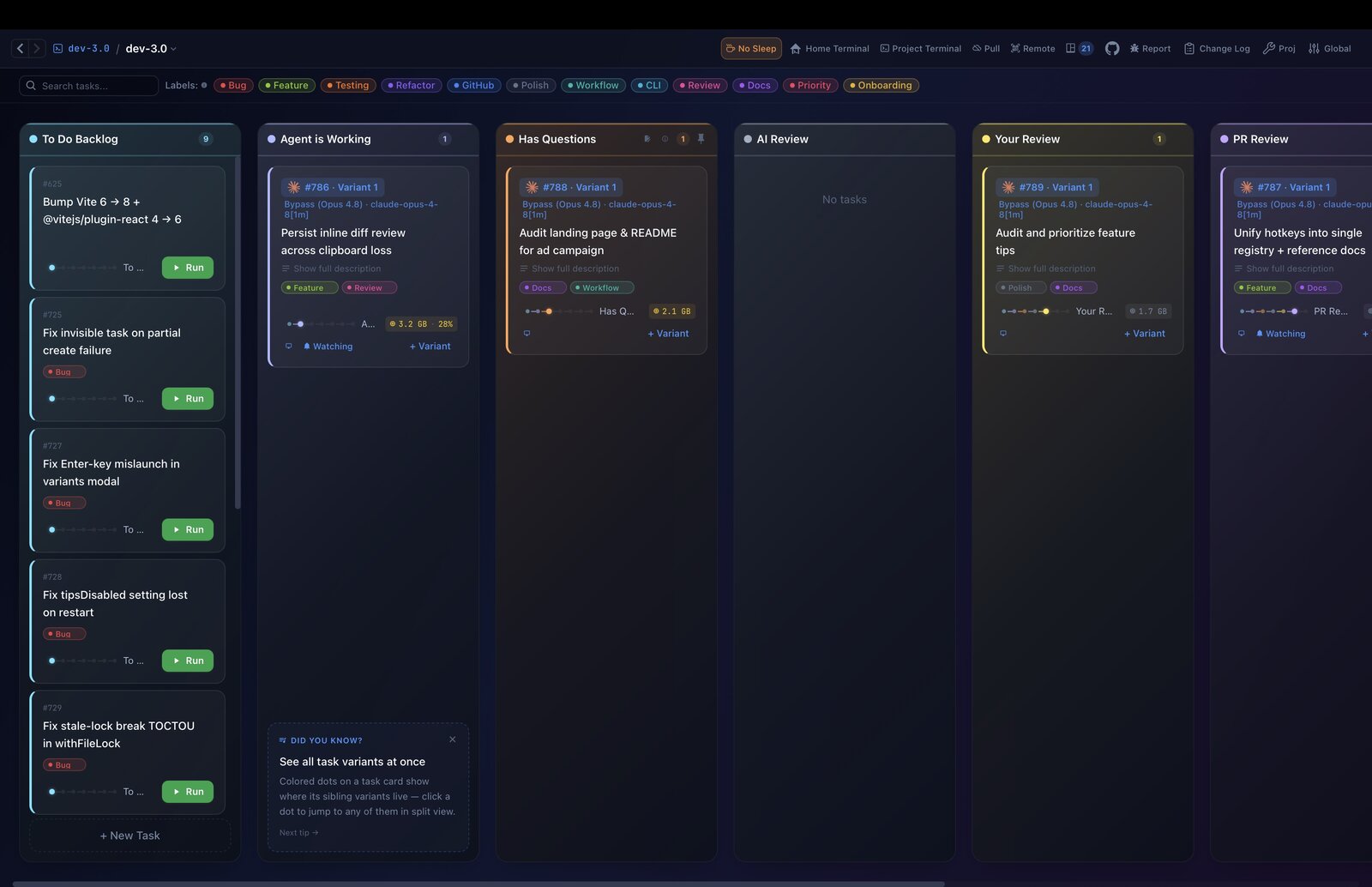
AI writes the code now — your job is commanding the fleet. dev-3.0 is the Kanban-first cockpit for running dozens of AI coding agents at full speed, while one board keeps you focused. Each task gets its own git worktree, tmux session, and terminal.
🤖 The fastest way — paste this into Claude Code, Codex, Gemini CLI, whatever you already run:
Install dev-3.0 by following the guide at https://dev3.h0x91b.com/ai-install.txt
The agent reads the guide, detects your OS, and does the whole install itself.
Or by hand — macOS:
brew tap h0x91b/dev3
brew trust h0x91b/dev3   # newer Homebrew refuses untrusted third-party taps (skip on older brew)
brew install --cask dev3
Linux (headless box, full UI in your browser):
brew tap h0x91b/dev3 && brew trust h0x91b/dev3 && brew install h0x91b/dev3/dev3
dev3 remote
Every option — direct DMG download, CLI tarball without Homebrew, cloud-VM caveats, build from source — in Install.
AI writes the code now. It commits, opens PRs, reviews. Your job changed — from writing to commanding a fleet of agents across more tasks and projects than any one head can hold. The bottleneck moved: it's not your editor anymore, it's your focus. Everything in dev-3.0 is built around that. Two things we optimize for, above all:
1. Your speed — as one person. dev-3.0 optimizes a single developer: you. The unit is always the individual, never the org. It works fine on a team — but it's not a tool for managing other people; it's a tool for each person to command their own fleet and hit their own top speed. Everyone focuses on themselves, and the whole moves faster.
2. Beautiful, and built around you. A cockpit you stare at all day should be fast, gorgeous, and keyboard-first — and it should bend to your way of working, not force one on you. Great tooling doesn't just make you productive; it makes the work fun again. We sweat the polish.
And what we refuse: dev-3.0 is not an IDE — and won't become one.
You're running 5+ AI agents across different terminals, repos, and branches. Switching context takes forever. You lose track of what's where. Merge conflicts pile up because multiple agents edit the same repo.
dev-3.0 gives you a Kanban board where each task is a fully isolated environment:
claude)
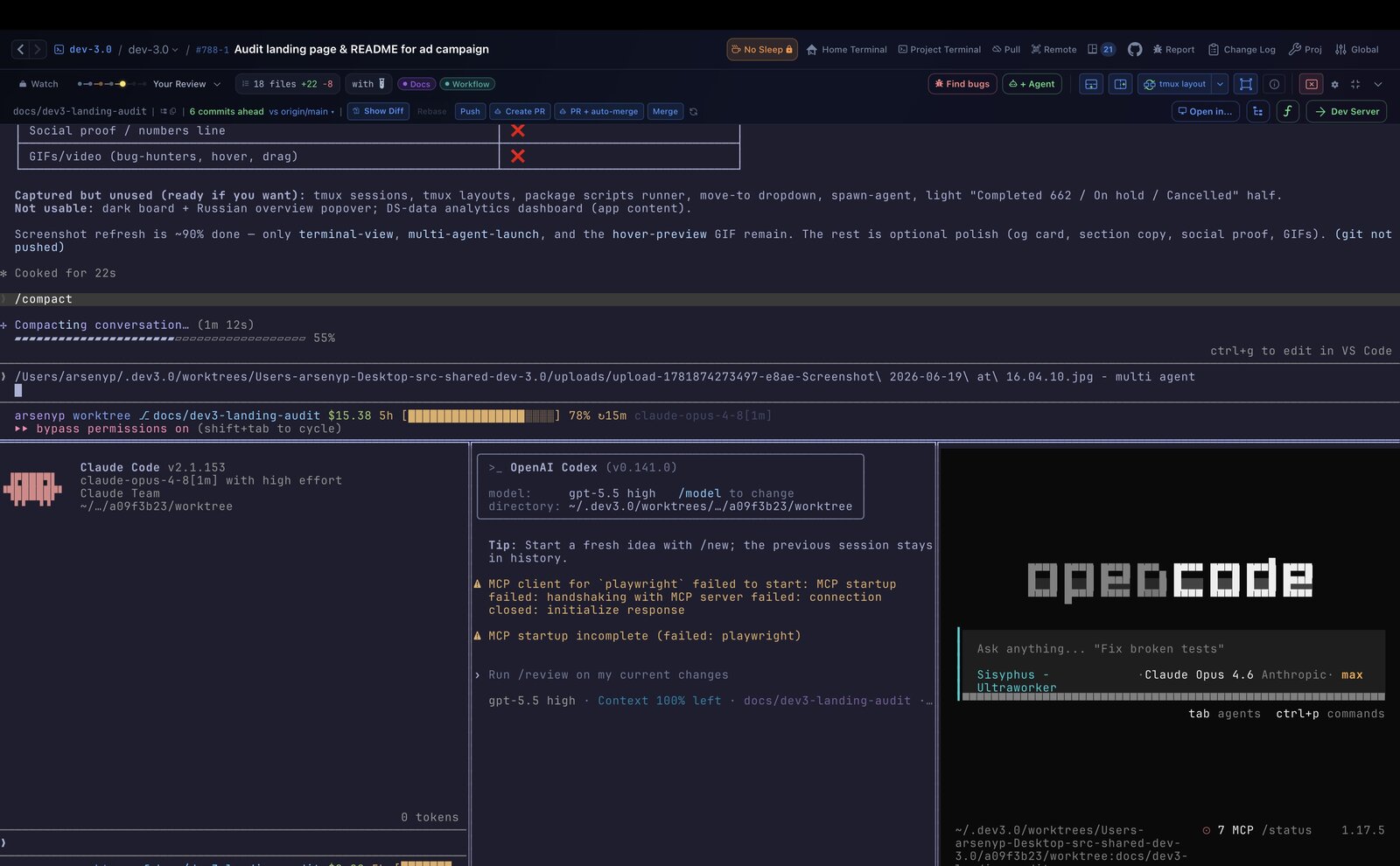
dev3 remote — QR login plus an optional Cloudflare tunnelnode_modules, .venv, build, and other heavy directories into worktrees instantly with near-zero disk overhead
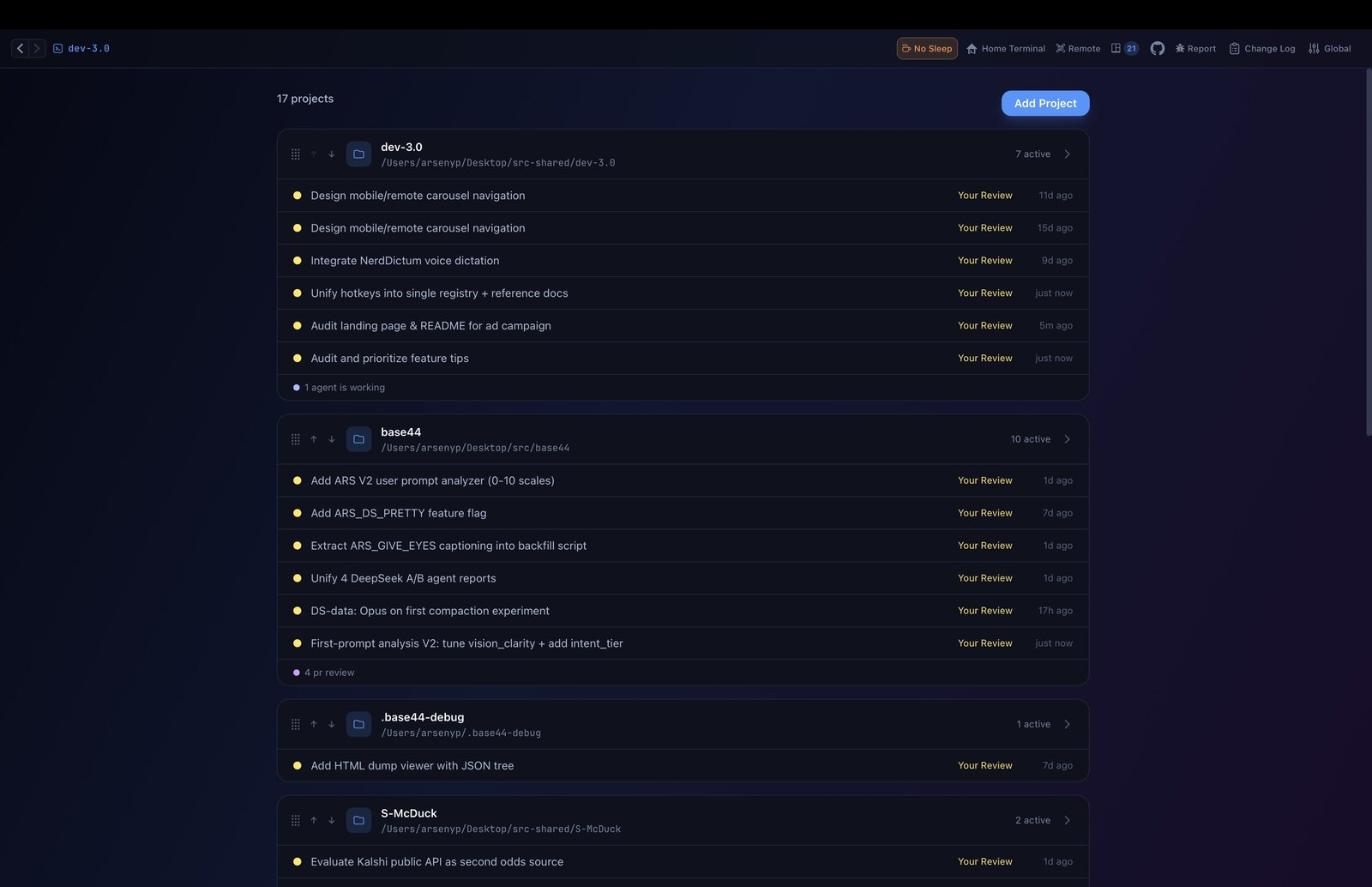
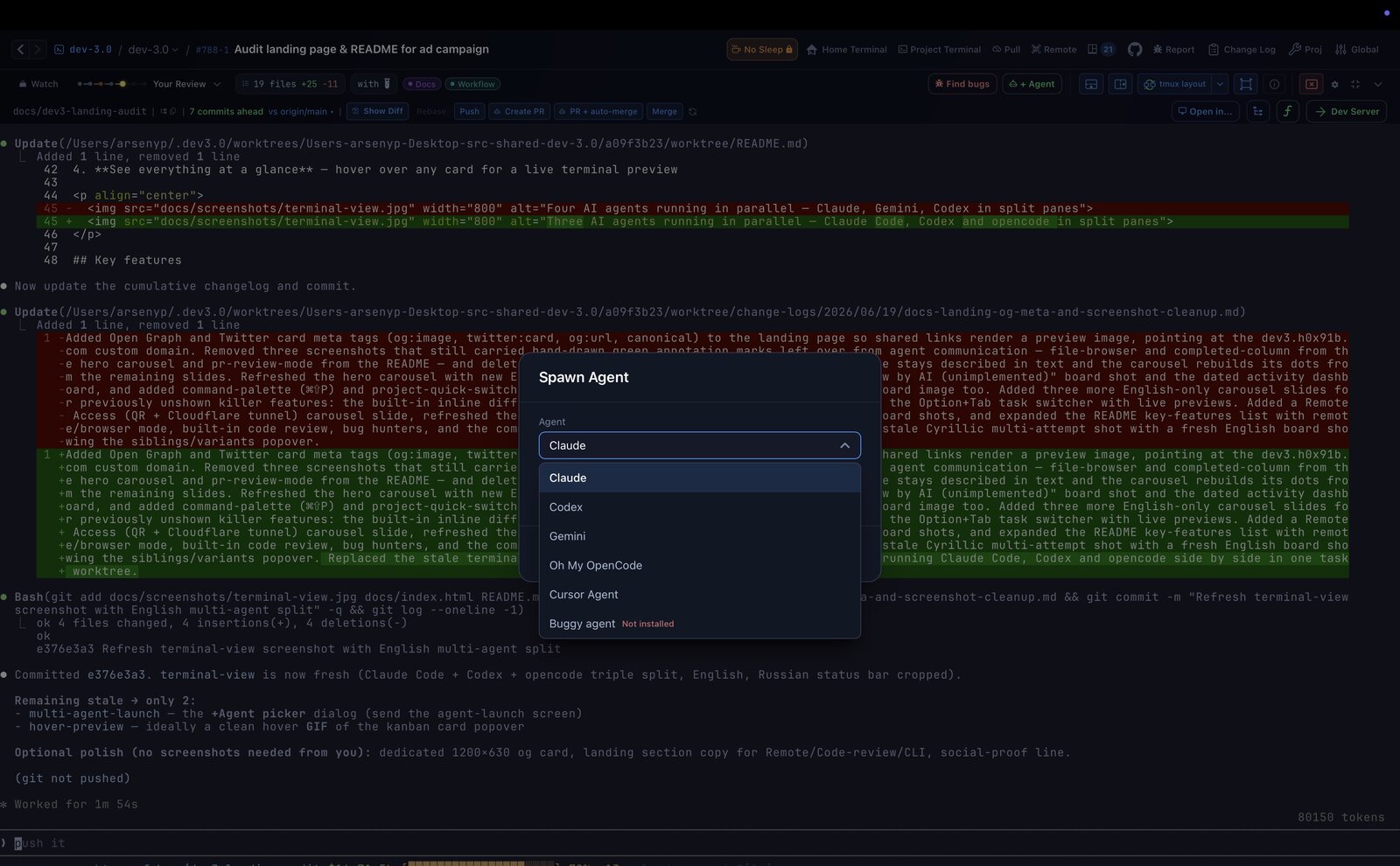
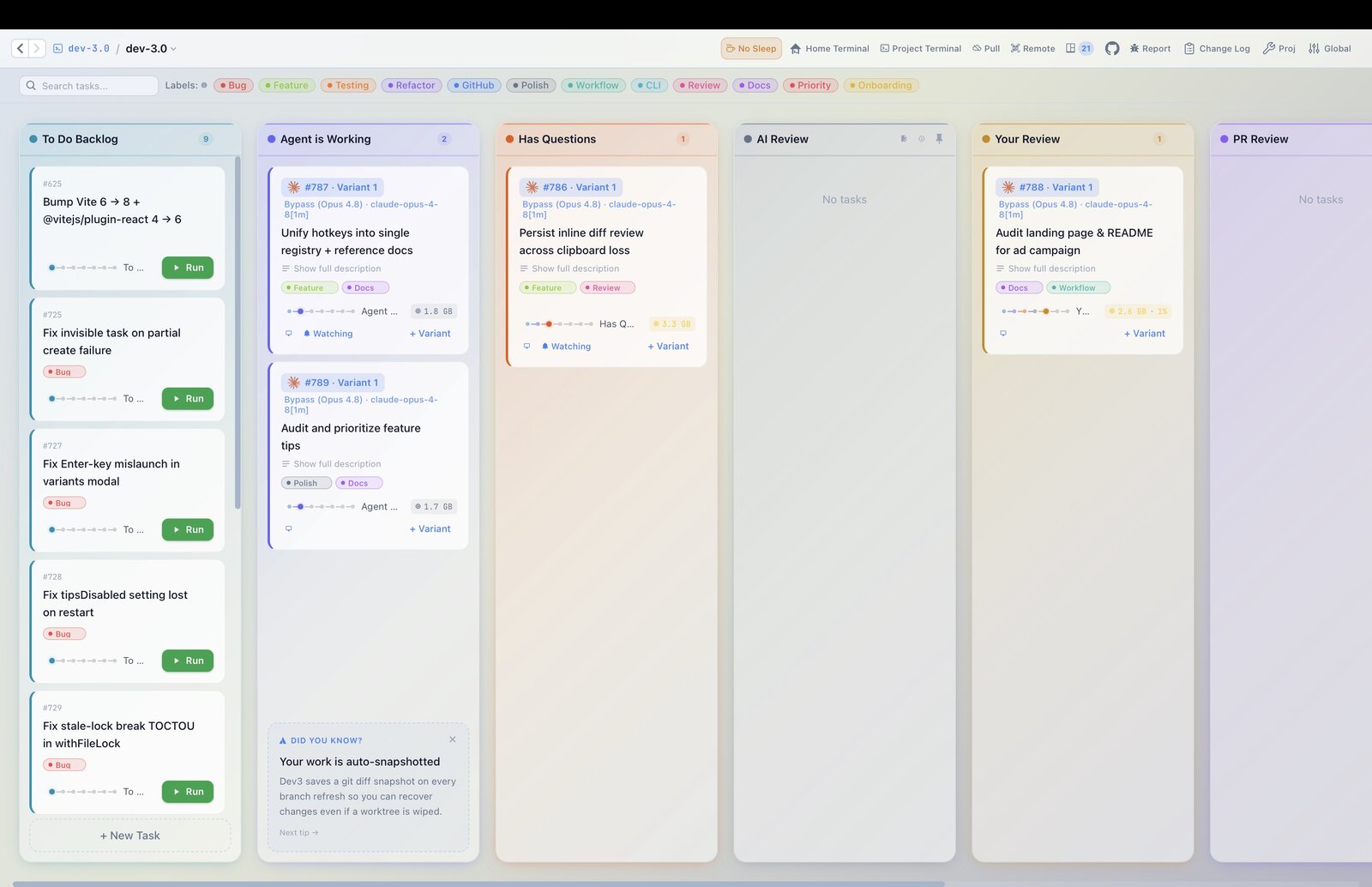
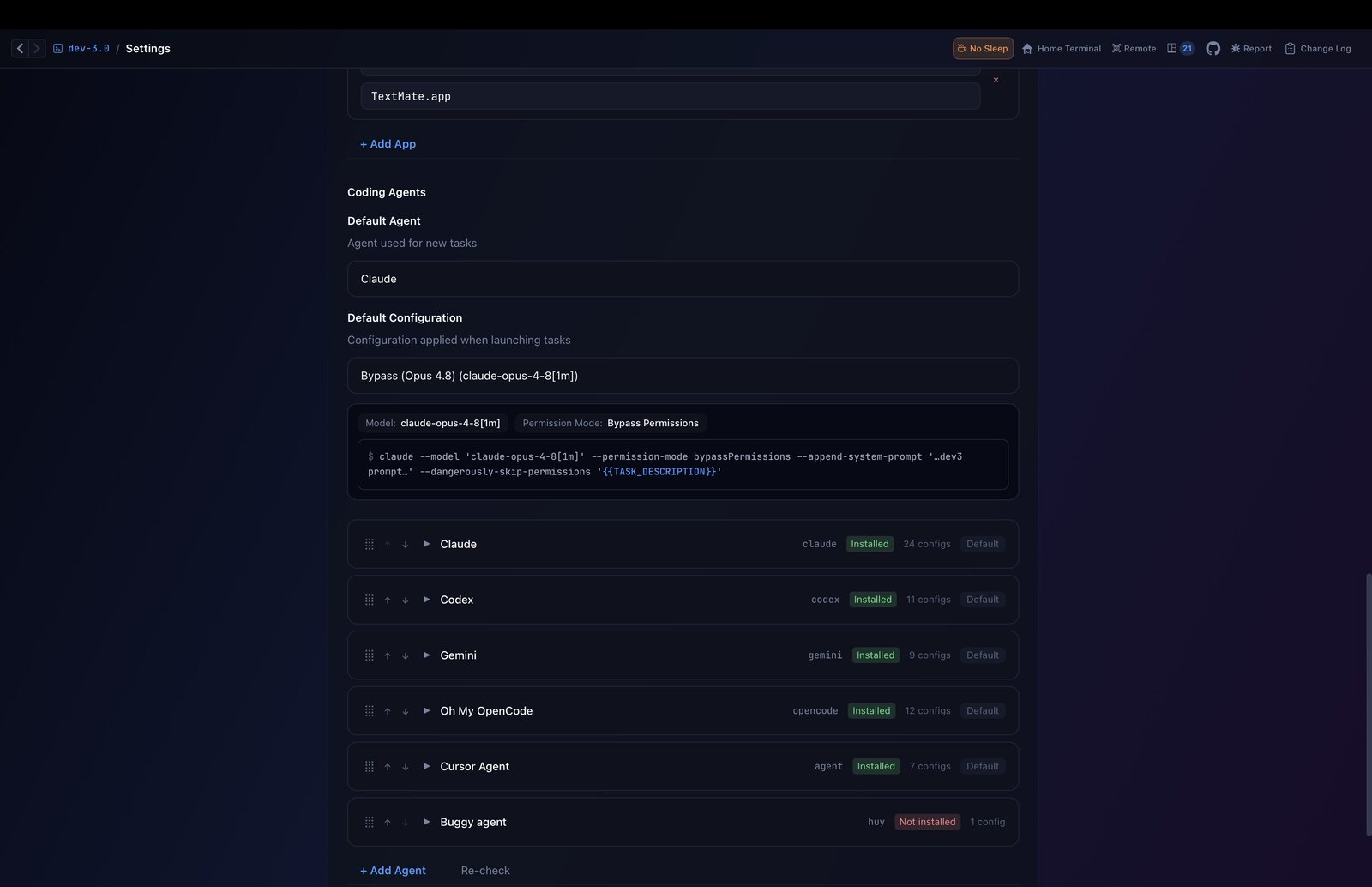
Other tools in this space are great — if you want to live in an editor. dev-3.0 makes a different bet. Pick by your goal, not a feature checklist:
| If you want to… | Reach for… |
|---|---|
| Stay in an editor, hands on the code and git | an agent IDE |
| Buy a platform for a whole team (SSO, seats, audit) | a team orchestrator |
| Run a fleet of agents solo, at speed, without drowning | dev-3.0 |
The two fastest paths (agent-driven and Homebrew) are in Quick start above. Everything else lives here.
brew tap h0x91b/dev3
brew trust h0x91b/dev3   # newer Homebrew refuses untrusted third-party taps (skip on older brew)
brew install --cask dev3
Auto-installs the required git and cloudflared dependencies (the latter powers the public-tunnel option used by dev3 remote and the in-app remote-access modal). tmux is bundled inside the app itself — a pinned, self-contained 3.6a build (tmux 3.7 has a client-side CPU regression; see Troubleshooting).
brew upgrade --cask dev3   # update
brew uninstall --cask dev3 # remove
Grab the latest .dmg directly — Apple Silicon or Intel — drag to Applications, and run. tmux is bundled inside the app; make sure git is installed, plus cloudflared if you want the public-tunnel feature (brew install cloudflared; safe to skip otherwise).
Apple Silicon and Intel are both supported. Windows is on the roadmap.
The fastest way to run dev-3.0 on a Linux box (cloud VM, dev server, headless host) is the dev3 CLI over Homebrew. Two commands, then dev3 remote — it prints an access URL + QR you open from your laptop. tmux, git, and cloudflared come along as brew dependencies.
⚠️ Don't run the Homebrew installer as
root— it refuses by design. On a fresh VM, create a regular user first:useradd -m -s /bin/bash dev3 && su - dev3. Glibc ≥ 2.28 required (Ubuntu 18.04+, Debian 10+, RHEL 8+).
1. Install Homebrew (one-time). Pick the line matching your shell — the only difference is which rc file gets the PATH:
curl -fsSL https://raw.githubusercontent.com/Homebrew/install/HEAD/install.sh | bash && \
  echo 'eval "$(/home/linuxbrew/.linuxbrew/bin/brew shellenv)"' >> ~/.bashrc && \
  eval "$(/home/linuxbrew/.linuxbrew/bin/brew shellenv)"
curl -fsSL https://raw.githubusercontent.com/Homebrew/install/HEAD/install.sh | bash && \
  echo 'eval "$(/home/linuxbrew/.linuxbrew/bin/brew shellenv)"' >> ~/.zshrc && \
  eval "$(/home/linuxbrew/.linuxbrew/bin/brew shellenv)"
2. Install dev-3.0 (same tap as macOS):
brew tap h0x91b/dev3 && brew trust h0x91b/dev3 && brew install h0x91b/dev3/dev3
3. Go remote:
dev3 remote
That's it. Full Homebrew-on-Linux docs: https://docs.brew.sh/Homebrew-on-Linux
This installs the dev3 CLI. Three ways to use it:
dev3 remote prints an ASCII QR, an access URL, and an SSH-forward hint. By default it also starts a Cloudflare quick tunnel so you can connect from anywhere without SSH (cloudflared is installed as a brew dep). Pass --no-tunnel for local-only mode. The token rotates every 25 seconds; the QR auto-refreshes too. Perfect for remote dev boxes.
dev3 remote backgrounds the server by default, so it survives your SSH session (add --no-detach to keep it in the foreground). From any later SSH session, dev3 remote status shows it (PID, port, uptime), dev3 remote url re-prints a fresh QR/URL to re-scan from your phone, dev3 remote logs --follow tails its output, dev3 remote restart relaunches it, and dev3 remote stop shuts it down cleanly.dev3 remote install-service --port <n> installs a systemd --user unit so the server survives logout and restarts on boot (dev3 remote uninstall-service removes it). Tip: sudo loginctl enable-linger $USER keeps user services running while you're logged out.dev3 gui launches the full Electrobun desktop app. On the first run it lazily downloads the bundle (~88 MB) into ~/.dev3.0/gui/ and registers an XDG menu entry. If your distro is missing GTK/WebKit libraries it prints the exact apt/dnf/pacman command for you to copy.dev3 task …, dev3 current, dev3 note add … etc. when you want to script the Kanban board from a terminal.Local diagnostic logs are retained for 14 days and redact prompt-bearing payloads and command arguments. See Local diagnostic logs for the retention and payload policy.
If you don't want Homebrew at all (e.g. running inside a minimal container), grab the CLI tarball directly:
# Auto-pick your arch: x64 (Intel/AMD, e.g. Hetzner CPX/CCX) or arm64 (Ampere/Graviton, e.g. Hetzner CAX)
case "$(uname -m)" in aarch64|arm64) A=arm64;; *) A=x64;; esac
curl -fsSL -o /tmp/dev3.tar.gz \
  "https://github.com/h0x91b/dev-3.0/releases/latest/download/dev3-cli-linux-$A.tar.gz"

mkdir -p ~/.dev3 && tar -C ~/.dev3 -xzf /tmp/dev3.tar.gz
~/.dev3/dev3 remote
# (optional) put it on PATH: echo 'export PATH=$HOME/.dev3:$PATH' >> ~/.bashrc
Make sure tmux (see tmux on Linux — the version matters), git, and cloudflared are installed (for cloudflared see Cloudflare's docs). Without cloudflared dev3 remote still works — it just falls back to LAN + SSH-forward URLs (or pass --no-tunnel to skip the check).
Unlike macOS builds (which bundle a self-contained tmux 3.6a inside the app and CLI tarball), Linux artifacts do not ship tmux — you bring your own. The Homebrew formula still installs the pinned h0x91b/dev3/tmux@3.6 keg automatically; tarball installs rely on the system tmux.
The pinned, tested version is 3.6a. Any 3.3–3.6 works; avoid the 3.7.x line — its client busy-spins at 100% CPU on a congested server socket and freezes the UI (the whole reason for the pin). Check what you have: tmux -V.
Current stable distro repos still ship pre-3.7 versions, so the stock package is fine:
sudo apt-get update && sudo apt-get install -y tmux   # Debian / Ubuntu
sudo dnf install -y tmux                              # Fedora / RHEL 9+ / Alma / Rocky
sudo yum install -y tmux                              # RHEL 8 / CentOS 8
sudo zypper install -y tmux                           # openSUSE
sudo pacman -S --noconfirm tmux                       # Arch (rolling — check `tmux -V`, may already be 3.7!)
sudo apk add tmux                                     # Alpine
If your distro already ships 3.7.x (rolling releases), install exactly 3.6a instead — either via Homebrew on Linux (brew install h0x91b/dev3/tmux@3.6; the app prefers the keg automatically) or from source:
sudo apt-get install -y build-essential libevent-dev libncurses-dev bison   # Debian/Ubuntu deps
# sudo dnf install -y gcc make libevent-devel ncurses-devel bison           # Fedora/RHEL deps
curl -fsSL https://github.com/tmux/tmux/releases/download/3.6a/tmux-3.6a.tar.gz | tar xz
cd tmux-3.6a && ./configure && make -j"$(nproc)" && sudo make install
dev3 doctor flags a 3.7.x tmux with a warning, and the app logs it at startup.
fallocate -l 4G /swapfile && chmod 600 /swapfile && mkswap /swapfile && swapon /swapfile
echo '/swapfile none swap sw 0 0' >> /etc/fstab
apt-get install -y git tmux bash ca-certificates curl unzip
curl -fsSL https://bun.sh/install | bash && source ~/.bashrc

git clone https://github.com/h0x91b/dev-3.0.git && cd dev-3.0
bun install --frozen-lockfile
bun scripts/generate-build-info.ts
bun scripts/generate-changelog.ts
bun --bun ./node_modules/vite/bin/vite.js build   # `bun --bun` avoids Node OOM
bun build src/cli/main.ts --compile --outfile dist/dev3

./dist/dev3 remote
Press ⌘/ (Ctrl+/ on Linux) inside the app — or open Help → Keyboard Shortcuts — to see
every shortcut in one panel (App + Terminal/tmux tabs). The full list is defined in one place,
src/mainview/keymap.ts.
| Action | macOS | Linux |
|---|---|---|
| Go to project (quick switch) | ⌘K | Ctrl+K |
| Command palette | ⇧⌘P | Ctrl+Shift+P |
| Keyboard shortcuts panel | ⌘/ | Ctrl+/ |
| Help mode (explain this screen) | ⇧⌘/ | Ctrl+Shift+/ |
| Open current project/worktree in an app (picker) | ⌘O | Ctrl+O |
| Terminal immersive fullscreen | F11 / ⇧⌘F | F11 / Ctrl+Shift+F |
| Find in the focused terminal / HTML artifact | ⌘F | Ctrl+F |
| Back / Forward | ⌘[ / ⌘] | Ctrl+[ / Ctrl+] |
| Previous / next live variant | ⇧⌘[ / ⇧⌘] | Ctrl+Shift+[ / Ctrl+Shift+] |
| Switch to project 1–9 (keep view) | ⌘1–9 | Ctrl+1–9 |
| Switch to project 1–9 (flip view) | ⇧⌘1–9 | Ctrl+Shift+1–9 |
| Cycle active tasks (this project / all) | ⌥Tab / ⌥⇧Tab | Ctrl+Tab / Ctrl+Shift+Tab |
| New task | ⌘N | Ctrl+N |
| Add project | ⌘P | Ctrl+P |
| New window | ⇧⌘N | Ctrl+Shift+N |
| Settings | ⌘, | Ctrl+, |
| Zoom in / out / reset | ⌘= / ⌘- / ⌘0 | Ctrl+= / Ctrl+- / Ctrl+0 |
| Hard refresh | ⌘R | Ctrl+R |
| Toggle project terminal / open Quick Shell | ⌘ / ⇧⌘ |
Ctrl+ / Ctrl+Shift+ |
| Close dialog / step back | Esc | Esc |
| Quit / Hide | ⌘Q / ⌘H | Ctrl+Q / Ctrl+H |
Terminal multiplexing uses tmux's ⌃B prefix bindings — see the Terminal (tmux) tab in the same panel.
| Component | Technology |
|---|---|
| Desktop runtime | Electrobun — native webview (WKWebView on macOS, WebKitGTK on Linux), no Chromium |
| JS runtime | Bun |
| Terminal | ghostty-web — GPU-accelerated rendering |
| Frontend | React 19, Tailwind CSS, Vite |
| Multiplexer | tmux |
bun install
bun run dev          # Build + launch the app locally (no HMR)
bun run build        # Staging build
bun run build:prod   # Production build
bun run lint         # TypeScript type-check
bun run test         # Run tests (fast subset; use `bun run test:full` for CI parity)
See AGENTS.md for full architecture docs and coding guidelines. See agent-support-matrix.md for feature compatibility across AI agents.
dev3 doctorRun this before changing files, reinstalling the app, or creating tmux symlinks:
dev3 doctor
It works while the app is closed and checks the app/CLI versions, the saved tmux path, the managed shim, the tmux binary (bundled / keg / PATH), and Homebrew state. Follow the commands printed under the failed check. Do not create ~/.dev3.0/bin/tmux yourself — dev-3.0 owns and recreates that shim.
macOS releases bundle a self-contained pinned tmux inside the app (Contents/Resources/app/tmux/tmux) and the CLI tarball, so no Homebrew or Command Line Tools are needed for it. If dev3 doctor reports that no usable tmux binary exists, reinstall the app (or update to the latest version); as an alternative remedy the pinned Homebrew keg still works:
brew tap h0x91b/dev3
brew trust h0x91b/dev3 2>/dev/null || true
brew install h0x91b/dev3/tmux@3.6
On Linux nothing is bundled — install tmux from your package manager and mind the version: see tmux on Linux — version matters.
If doctor instead reports tmux setting or tmux shim, use its reset commands; installing another tmux will not repair a poisoned saved path.
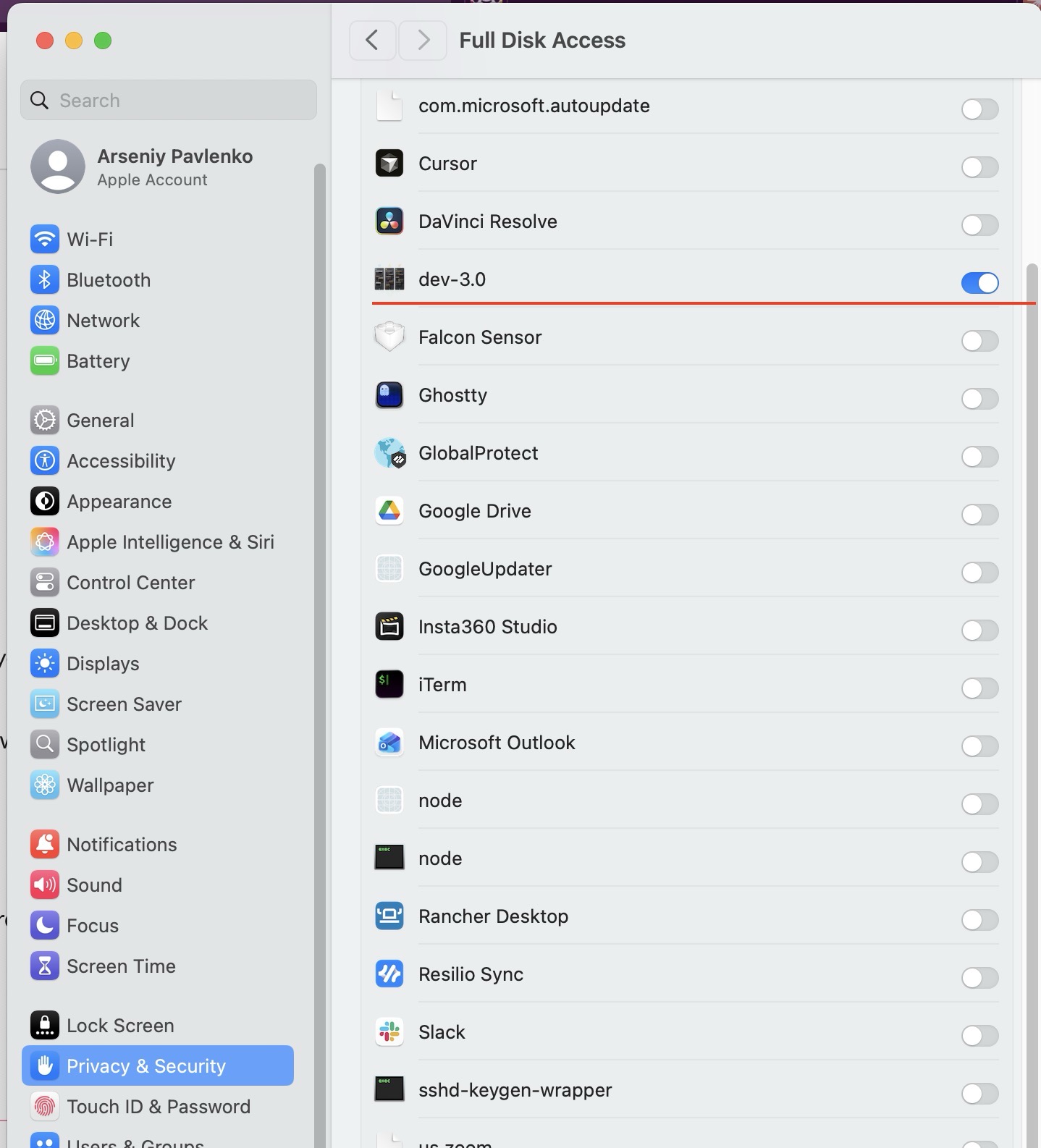
If git fetch works in Terminal.app but hangs inside a dev-3.0 task, grant Full Disk Access to dev-3.0 and restart it:
dev-3.0 and enable its toggle
dev-3.0 ships a hand-tuned 16-color ANSI palette for both the dark and light UI themes, plus a readability filter that remaps unreadable foreground/background colors emitted by agents on the fly.
Every built-in Claude Code /theme option is supported: Auto, regular Light/Dark, both colorblind-friendly variants, and both ANSI-only variants. Fixed diff colors adapt in both directions when the Claude Code theme and dev-3.0 theme use opposite polarities, so even a Light Claude theme remains readable in dark dev-3.0 and vice versa.
For the most native-looking pairing, use Auto or match the polarity:
| dev-3.0 UI | Claude Code /theme |
Codex [tui] theme |
|---|---|---|
| Dark | Dark mode, Dark mode (colorblind-friendly), or Dark mode (ANSI colors only) | dracula (recommended) |
| Light | Light mode, Light mode (colorblind-friendly), or Light mode (ANSI colors only) | github (recommended) |
If you'd rather have Claude Code render entirely through dev-3.0's tuned 16-color palette, run /theme and pick:
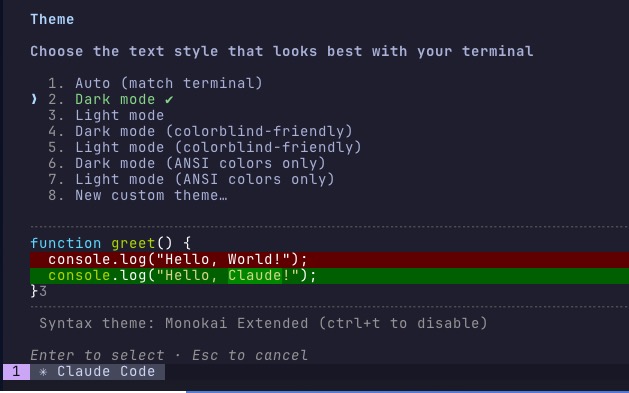
This makes Claude Code emit only the 16 base ANSI colors, which dev-3.0 resolves through its tuned palette.
Codex has no "ANSI colors only" mode. Set the recommended matching theme in ~/.codex/config.toml:
[tui]
# Recommended when dev-3.0 uses the dark UI
theme = "dracula"
[tui]
# Recommended when dev-3.0 uses the light UI
theme = "github"
Apache 2.0 — © 2026 Arseny Pavlenko
more like this
Comprehensive analytics dashboard for AI coding agents — Cursor, Windsurf, Claude Code, VS Code Copilot, Zed, Antigravi…
Skill Claude Code de veille tech francophone. Agrège les flux RSS (Journal du Hacker, Human Coders News…) et produit un…
A to-do list that runs your Claude Code agents — capture anywhere, dispatch in parallel, review from your phone.
本地优先的 macOS AI Agent 信号灯:状态栏 + 桌面悬浮信号灯,自动监控 Codex / Claude Code。Local menu bar and floating desktop status lights for A…
search projects, people, and tags