agentlytics
Comprehensive analytics dashboard for AI coding agents — Cursor, Windsurf, Claude Code, VS Code Copilot, Zed, Antigravi…
JavaScript★ 555
Standalone MCP server for cross-pane AI agent communication via tmux. Lets Claude Code, Gemini CLI, Codex, and Kimi CLI…
 howardpen9
git clone https://github.com/howardpen9/tmux-bridge-mcp.githowardpen9/tmux-bridge-mcpEnglish | 简体中文
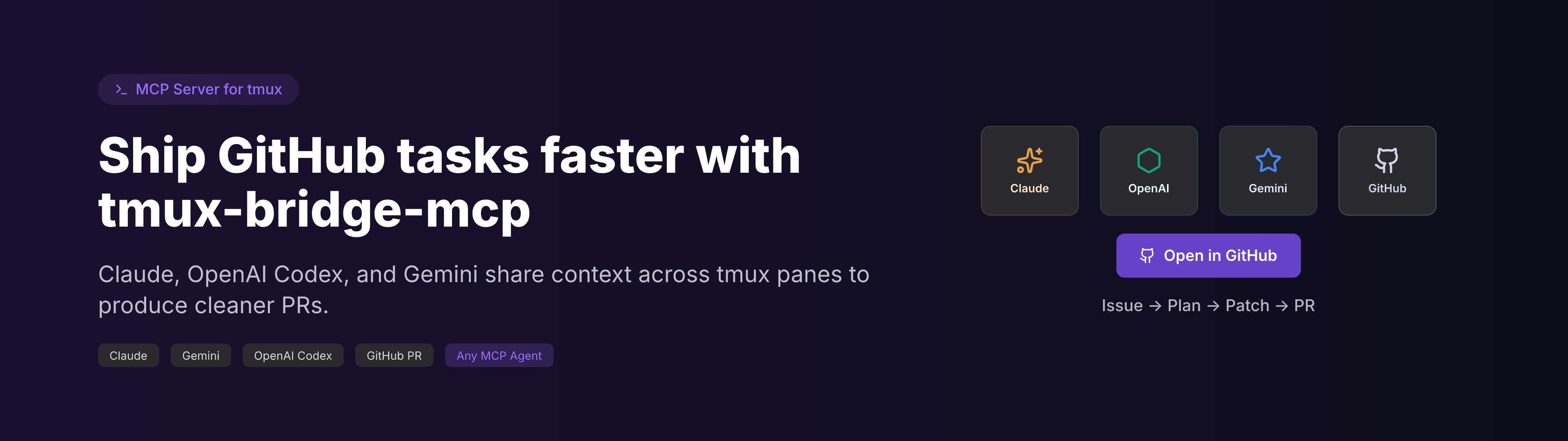
A standalone MCP server that lets AI agents (Claude Code, Gemini CLI, Codex, Kimi CLI) communicate with each other through tmux panes. It talks directly to tmux -- no external dependencies beyond tmux itself.
tmux is a terminal multiplexer -- it lets you split one terminal window into multiple panes, each running its own process independently. Think of it as "tabs on steroids" for your terminal.
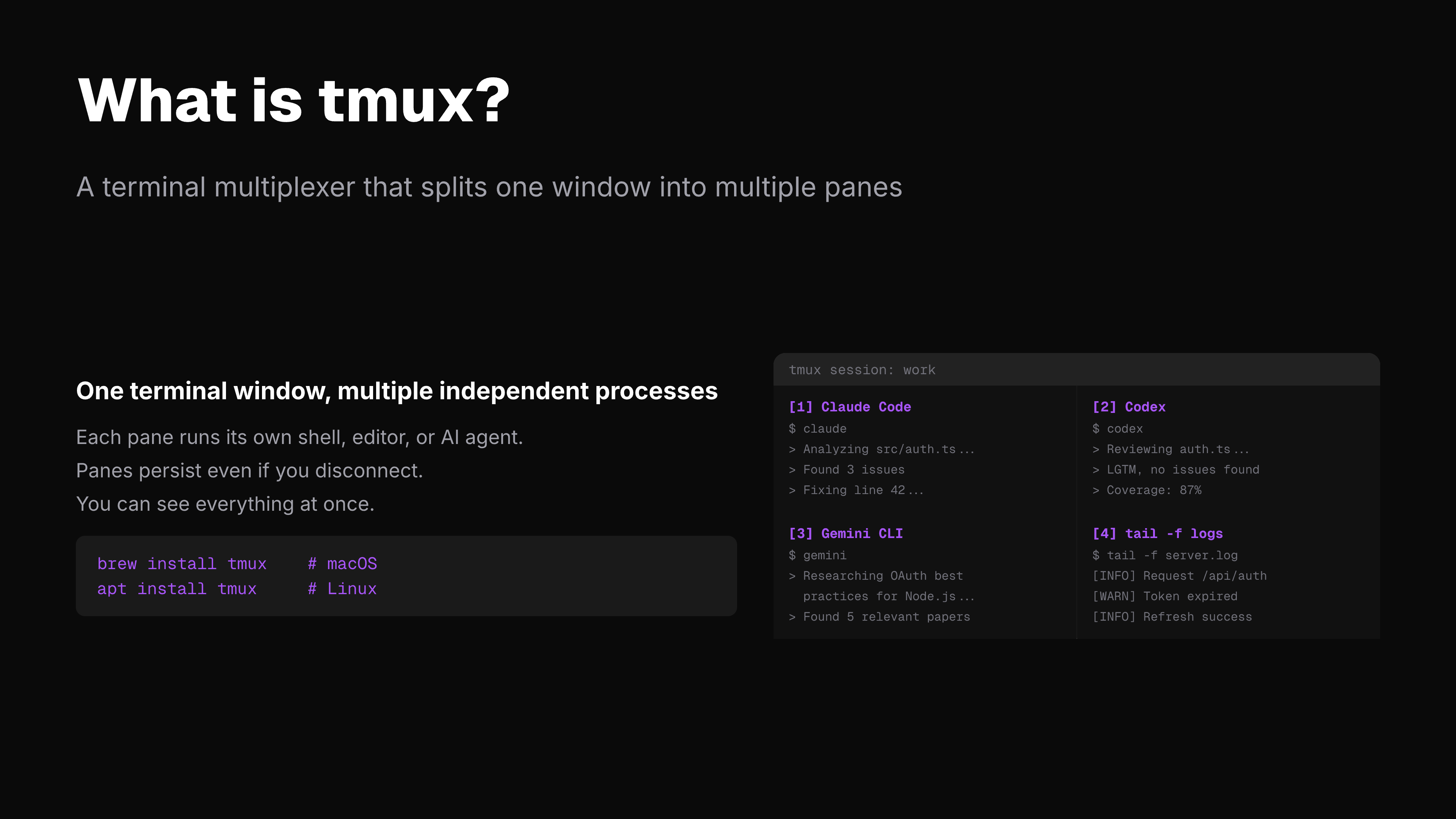
+-------------------------------+
|  Pane 1       |  Pane 2       |
|  Claude Code  |  Codex        |
|  writing code |  reviewing    |
|               |               |
+---------------+---------------+
|  Pane 3       |  Pane 4       |
|  Gemini CLI   |  tail -f logs |
|  researching  |  monitoring   |
+-------------------------------+
Each pane is a full terminal. You can have Claude Code running in one, Codex in another, Gemini in a third -- all visible at the same time, all on the same machine.
The problem: these panes can't talk to each other. An agent in Pane 1 has no idea what's happening in Pane 2.
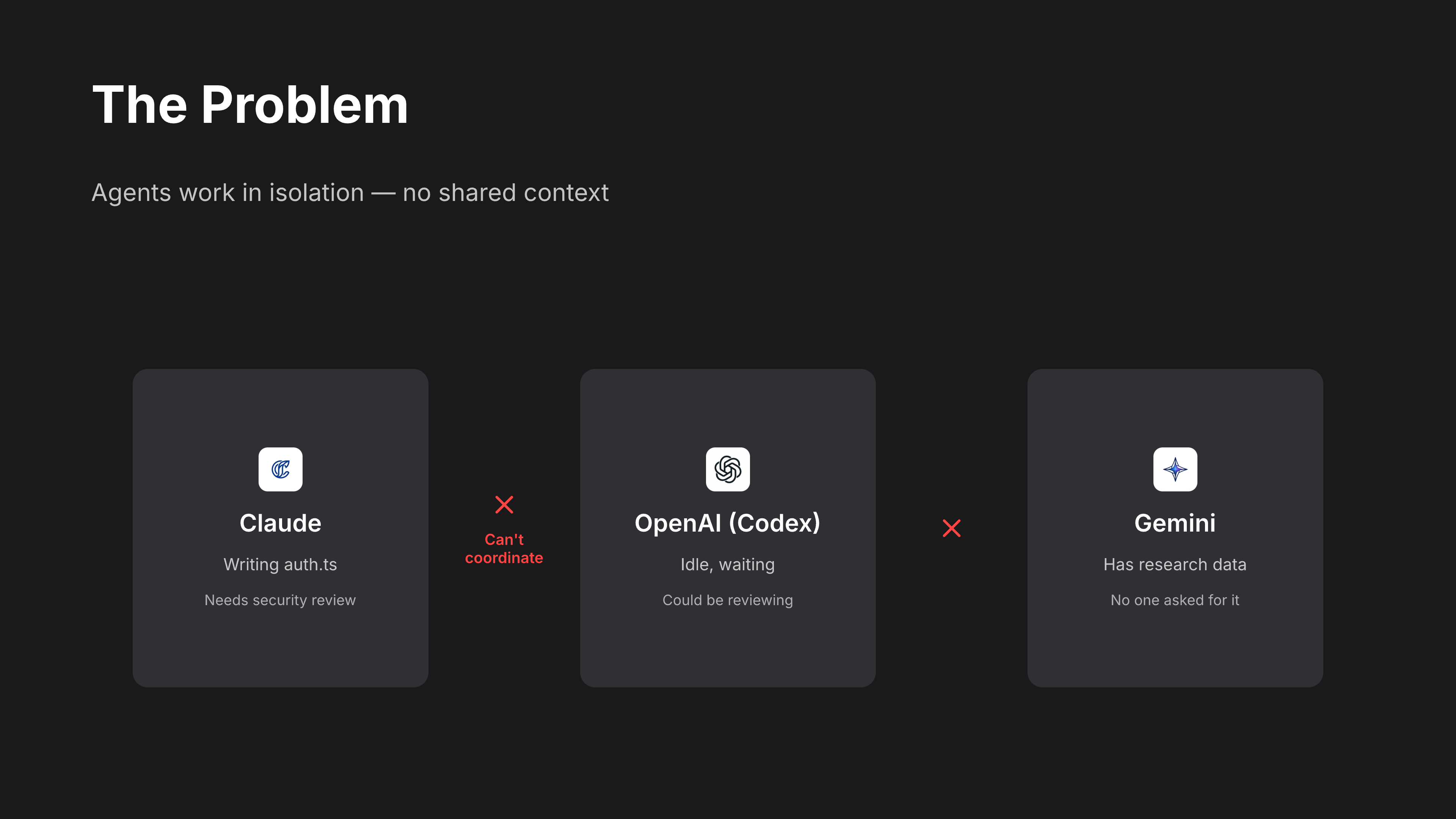
tmux-bridge fixes this. It gives every agent the ability to read, type, and send messages into any other pane.
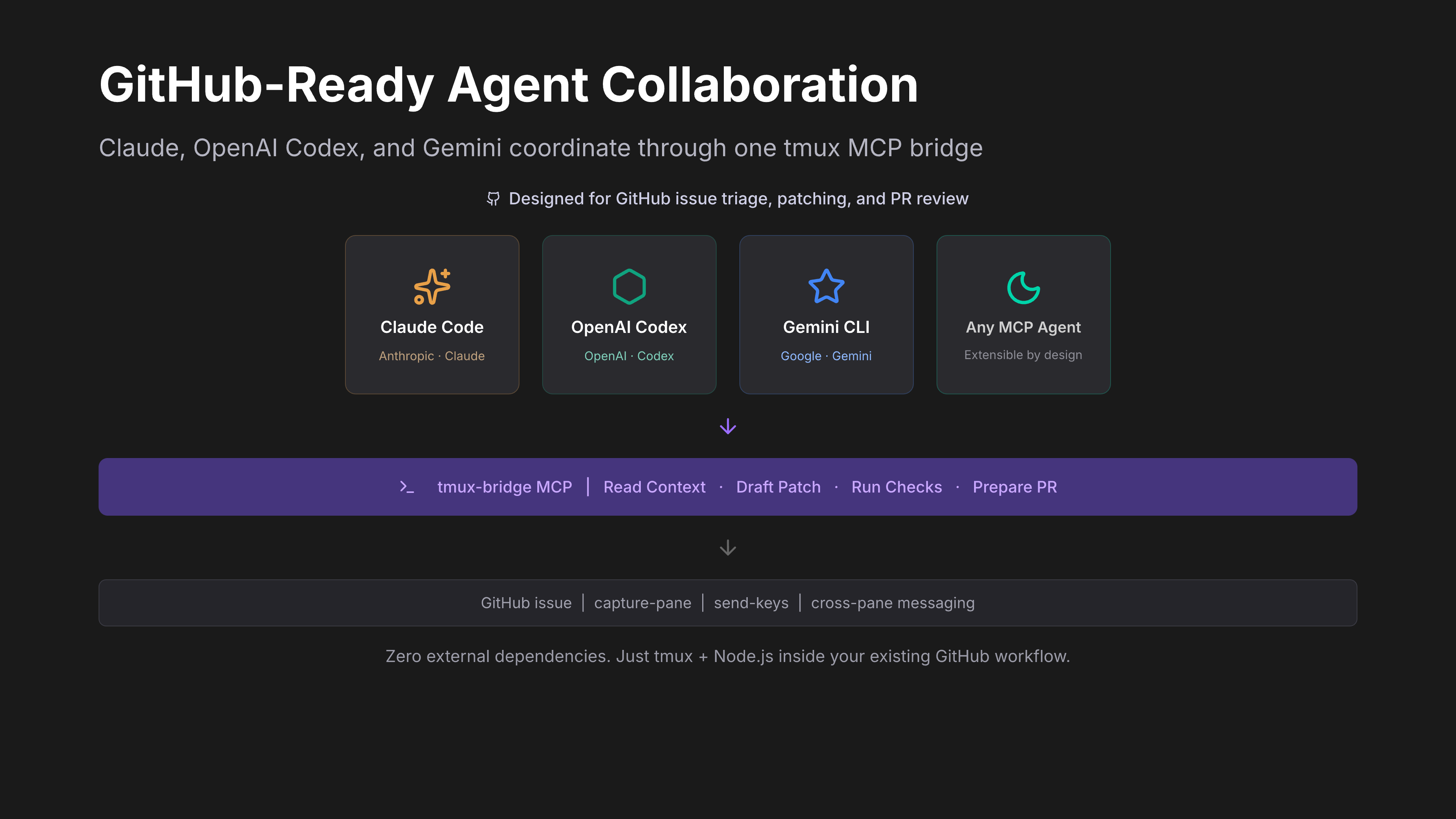
Once installed, your AI agents can:
| Action | How | Example |
|---|---|---|
| See what another agent is doing | tmux_read |
Read the last 20 lines of Codex's pane |
| Send a task to another agent | tmux_message + tmux_keys |
Tell Claude to review a file |
| Coordinate multi-agent workflows | Chain tool calls | Gemini researches -> Claude implements -> Codex reviews |
| Monitor processes | tmux_read on a shell pane |
Watch build logs, test output, server status |
| Label panes by role | tmux_name |
Name panes "claude", "codex", "gemini" for easy targeting |
All of this happens through standard MCP tool calls -- your agent doesn't need to learn any new syntax. If it supports MCP, it already knows how.
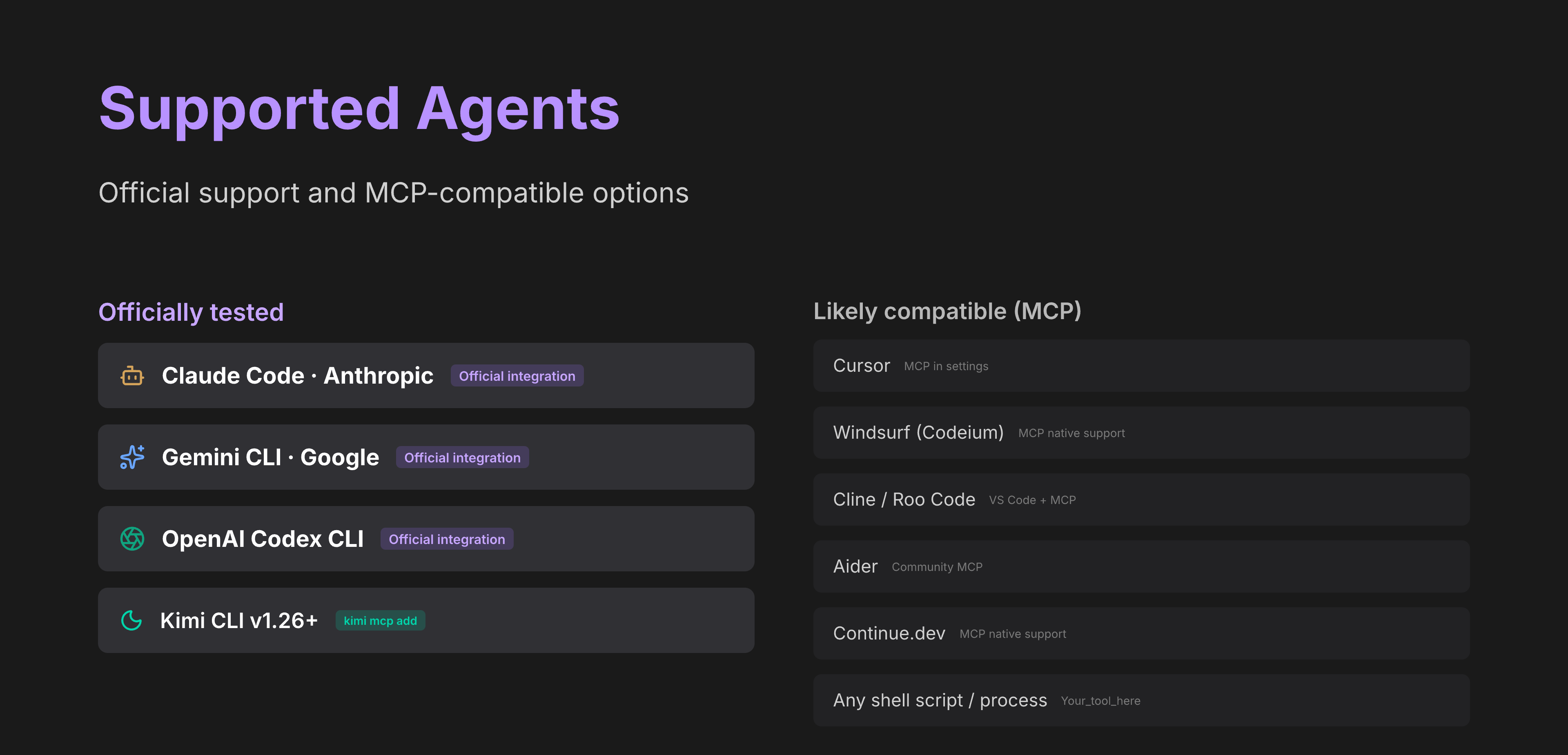
| Agent | Connection | Setup path |
|---|---|---|
| Claude Code | Native MCP (stdio) | claude mcp add -s user / ~/.claude.json |
| Codex CLI | Native MCP (stdio) | codex mcp add |
| OpenCode | Native MCP (stdio) | ~/.config/opencode/opencode.json(c) (mcp key) |
| CodeBuddy | Native MCP (stdio) | codebuddy mcp add -s user / ~/.codebuddy/.mcp.json |
| GitHub Copilot CLI | Native MCP (stdio) | copilot mcp add / ~/.copilot/mcp-config.json |
| Grok Build | Native MCP (stdio) | grok mcp add -s user / ~/.grok/config.toml |
| Gemini CLI | Native MCP (stdio) | ~/.gemini/settings.json |
| Kimi CLI v1.26+ | Native MCP (kimi mcp add) |
kimi mcp add |
| Kimi CLI older | Legacy wrapper (kimi-tmux) |
wrapper binary |
| Agent | Notes |
|---|---|
| Cursor | Supports MCP servers in settings |
| Windsurf (Codeium) | MCP server support |
| Aider | Community MCP support |
| Continue.dev | MCP server support |
| Cline | VS Code extension with MCP |
| Roo Code | Fork of Cline with MCP |
| Any shell script or process | Read pane output with tmux_read, no MCP needed |
tmux-bridge works with any agent that supports MCP over stdio. If your agent isn't listed, try adding the MCP config -- it will likely just work.
When you run multiple AI agents in separate terminals, they work in isolation. You end up copy-pasting context between them, manually relaying questions and answers, or losing track of what each agent is doing.
tmux-bridge solves this by giving every agent the ability to read, type, and send messages into any other terminal pane -- programmatically, through standard MCP tool calls.
Use cases:
tail -f pane and reacts to errors in real timeWhat you need:
| Requirement | Why |
|---|---|
| tmux | The terminal multiplexer that hosts your panes -- this is the communication channel |
| Node.js 18+ | Runs the MCP server |
| At least one MCP-compatible agent | Claude Code, Codex, OpenCode, CodeBuddy, Copilot CLI, Grok Build, Gemini CLI, or Kimi CLI v1.26+ |
If you already use tmux to run multiple agents side by side, tmux-bridge just makes them aware of each other.
You're running Claude Code in one pane, Codex in another. Claude finishes writing a function and you want Codex to review it. Here's what actually happens:
You are the message bus. Every interaction flows through your clipboard. You're not writing code anymore -- you're routing context between agents. With 3+ agents running, this becomes unmanageable within minutes.
| Approach | What it asks you to do | tmux-bridge difference |
|---|---|---|
| LangChain / CrewAI / AutoGen | Rewrite your workflow inside their framework. Your agents must be Python objects in their orchestration layer. | You keep using Claude Code, Codex, Gemini CLI as-is. No framework, no SDK, no rewrite. |
| Google A2A Protocol | Wait for agents to adopt a new protocol spec. Designed for distributed, networked agents. | Works today with any MCP agent. No protocol adoption needed. |
| Custom WebSocket / HTTP glue | Build and maintain your own IPC layer. Handle serialization, discovery, error handling. | Zero infrastructure. tmux is the transport -- it's already running. |
| Shared files / pipes | Roll your own convention. Each agent needs custom tooling to read/write. | Standard MCP tools. Any agent that speaks MCP gets cross-pane superpowers instantly. |
The key insight: you don't need a multi-agent framework. You need your existing agents to see each other. tmux-bridge adds exactly that -- a thin MCP layer over tmux -- and nothing more.
Prerequisites: tmux 3.2+ and Node.js 18+ must be installed.
One command to configure all your agents:
npx tmux-bridge-mcp setup
This auto-detects Claude Code, Codex, OpenCode, CodeBuddy, Copilot CLI, Grok Build, Gemini CLI, and Kimi CLI on your machine, then writes the correct MCP config for each one. Done in seconds.
Verify it works:
npx tmux-bridge-mcp --help
You should see the version and available commands. Restart your AI agent to activate the new tools.
See it in action:
npx tmux-bridge-mcp demo
Opens a 3-pane tmux session and runs a live cross-pane communication demo.
1. Install tmux
brew install tmux    # macOS
apt install tmux     # Linux
2. Add to your agent's MCP config
{
  "mcpServers": {
    "tmux-bridge": {
      "command": "npx",
      "args": ["-y", "tmux-bridge-mcp"]
    }
  }
}
Restart your agent. It now has 9 MCP tools for cross-pane communication.
# If installed globally
npm update -g tmux-bridge-mcp

# If using npx (auto-updates, but to force latest)
npx tmux-bridge-mcp@latest

# Check your current version
npx tmux-bridge-mcp --version
After updating, restart your agents to pick up the new version. If you use npx in your MCP config, it caches the package — run npx --yes tmux-bridge-mcp@latest once to pull the latest, then your agents will use it on next startup.
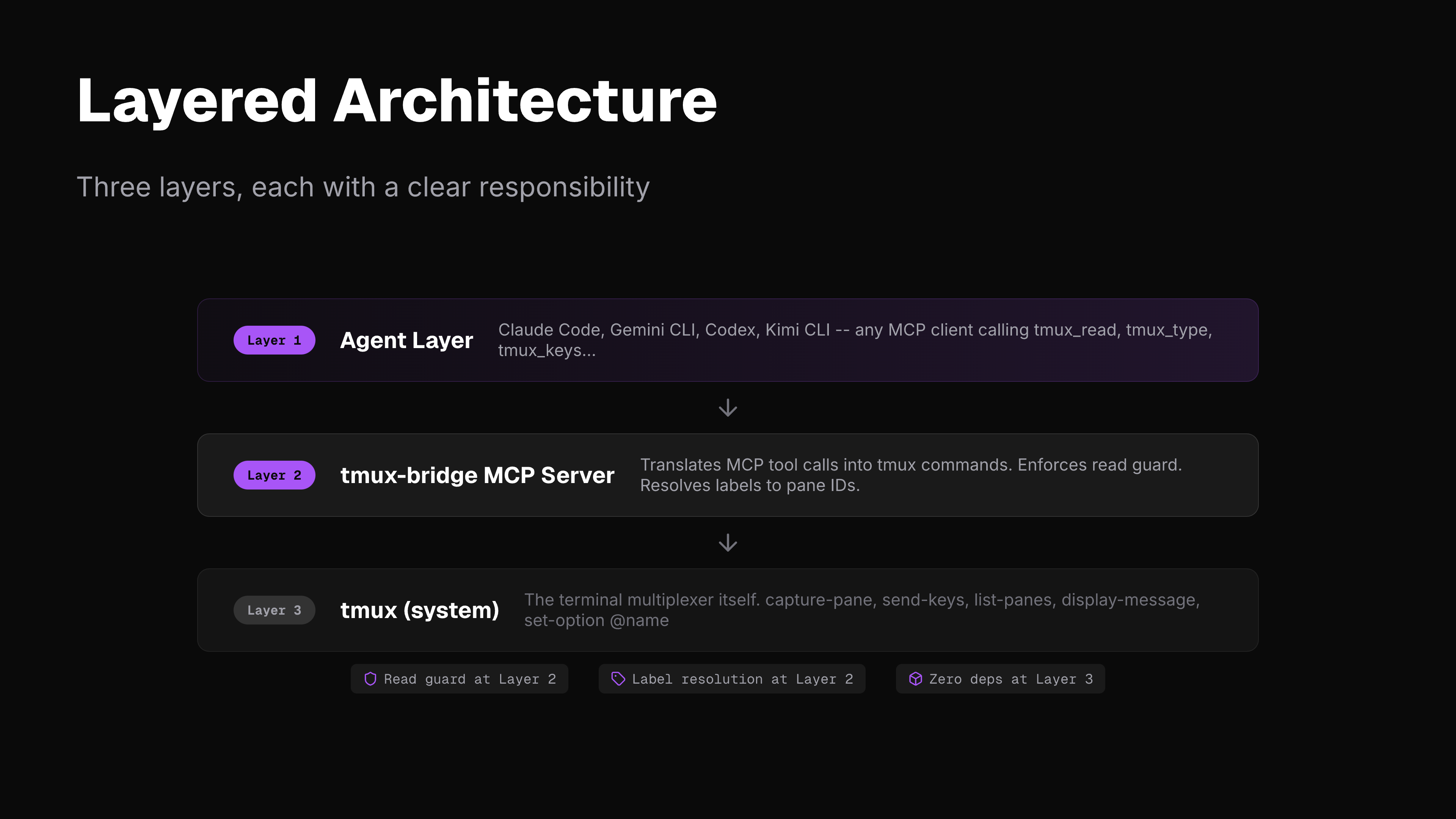
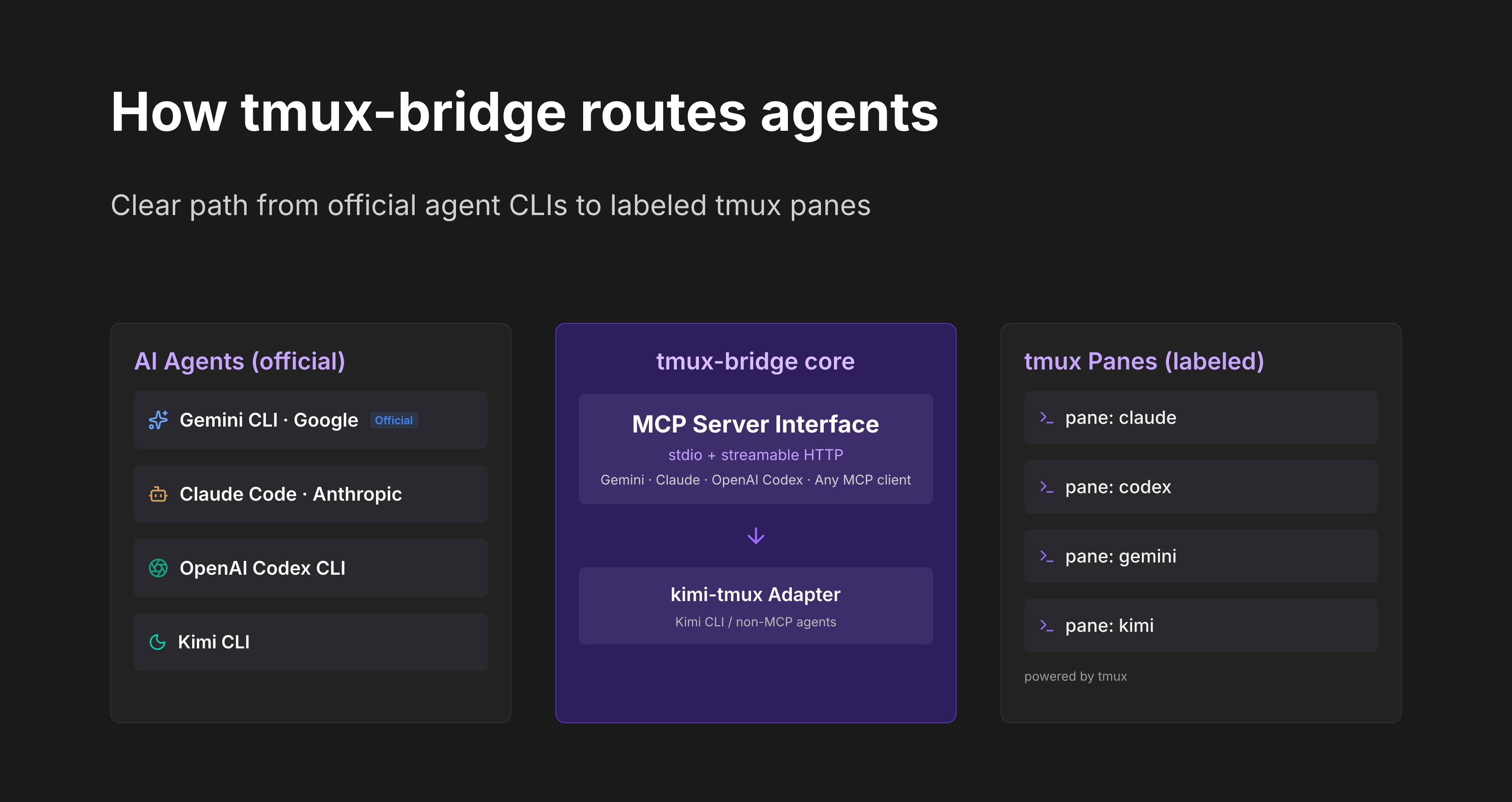
tmux-bridge runs as an MCP server over stdio. It calls tmux directly (capture-pane, send-keys, list-panes, etc.) -- no intermediate CLI layer.
MCP path (Gemini, Claude Code, Codex, any MCP client):
+--------------+  MCP/stdio  +---------------+  tmux API  +--------------+
|  MCP Agent   |<----------->|  tmux-bridge  |<---------->|  tmux panes  |
+--------------+             |  MCP server   |            +--------------+
                             +---------------+

CLI path (Kimi):
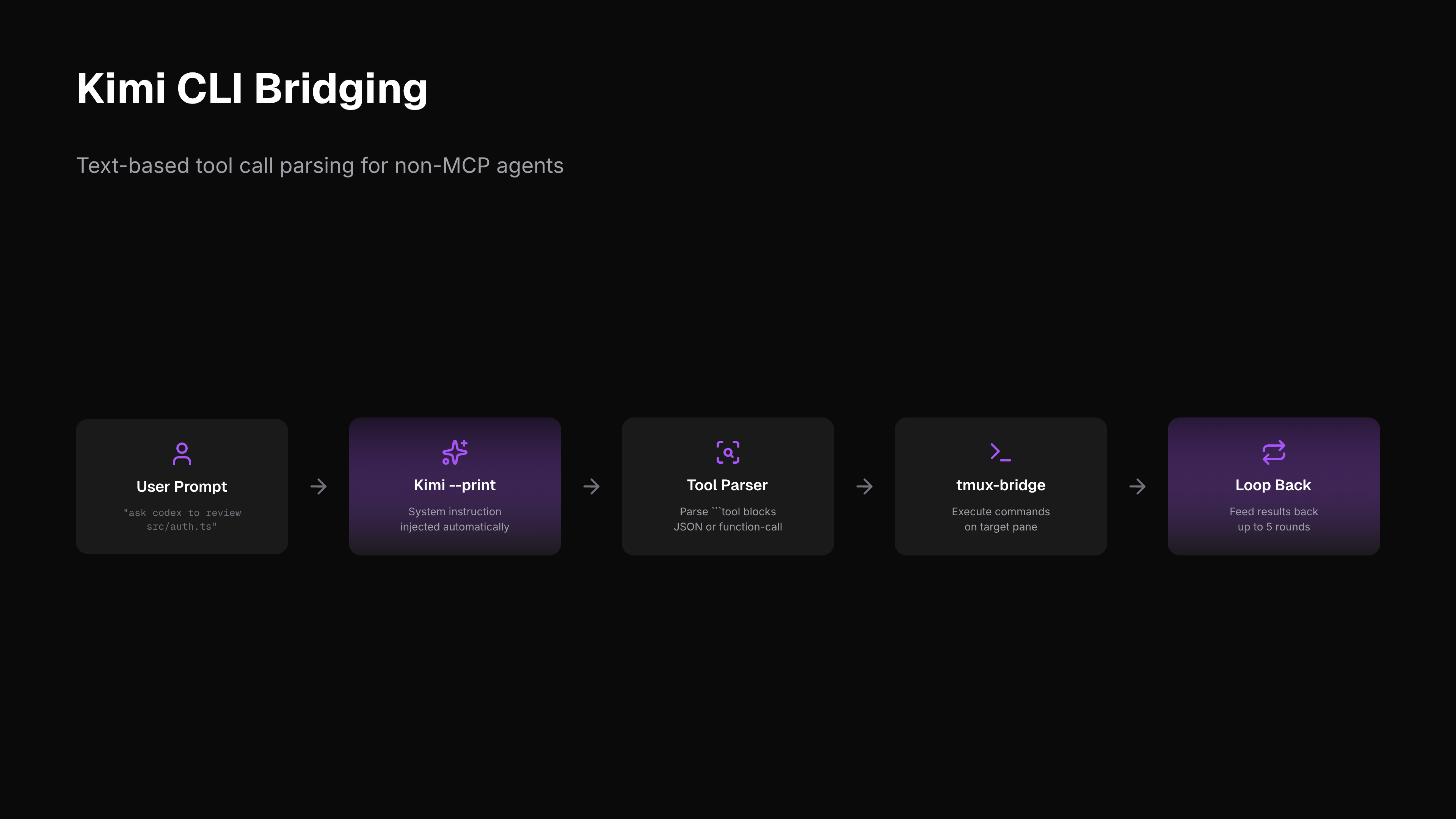
+--------------+  --print    +---------------+  tmux API  +--------------+
|  Kimi CLI    |<----------->|  kimi-tmux    |<---------->|  tmux panes  |
+--------------+  tool parse |  adapter      |            +--------------+
                             +---------------+
All cross-pane interactions follow the read-act-read workflow:
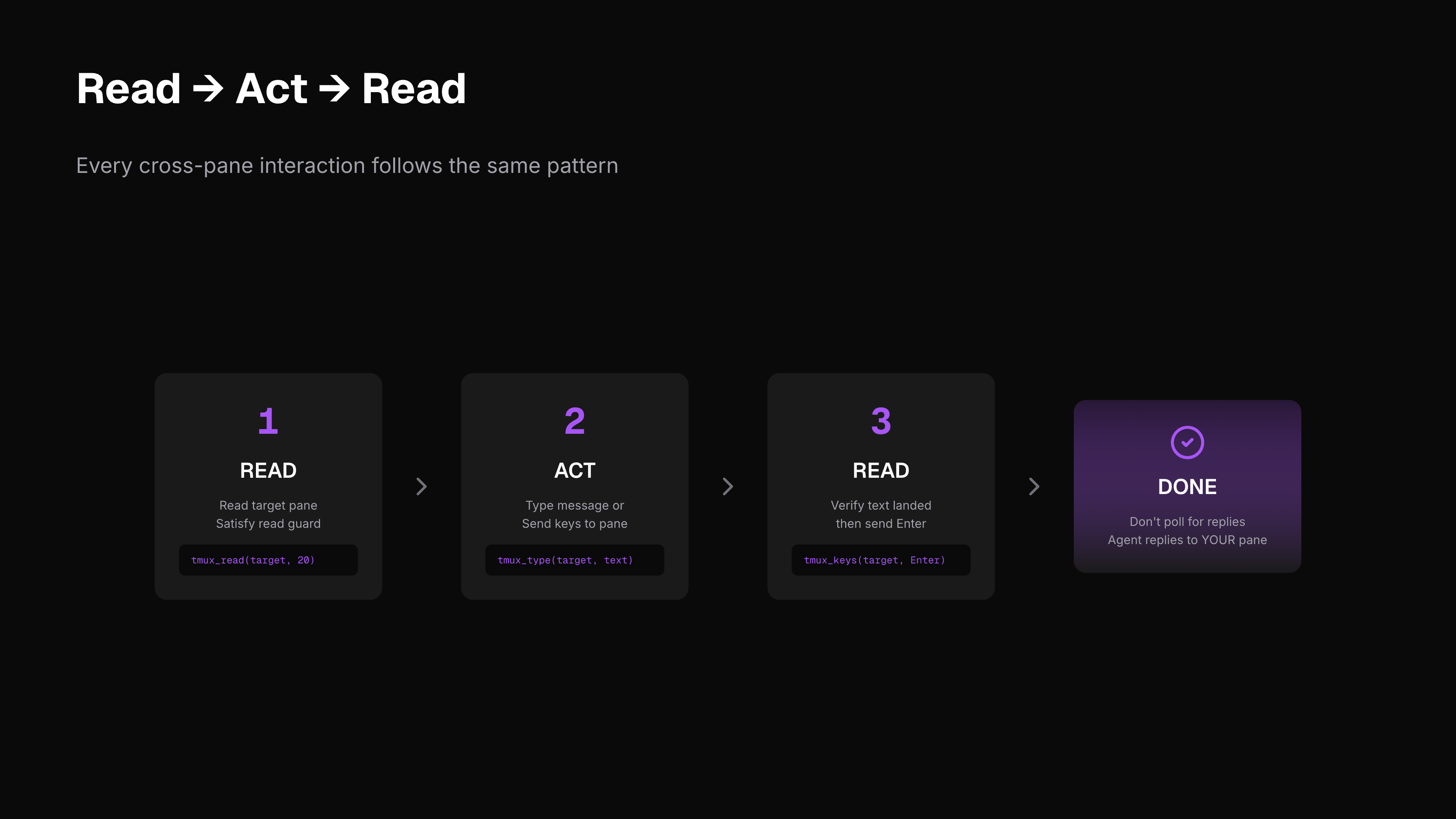
| Step | Action | Purpose |
|---|---|---|
| 1 | tmux_read |
Read target pane (satisfies read guard) |
| 2 | tmux_message / tmux_type |
Type your message or command |
| 3 | tmux_read |
Verify text landed correctly |
| 4 | tmux_keys |
Press Enter to submit |
| -- | STOP | Don't poll. The other agent replies directly into your pane. |
The read guard is enforced at the MCP layer: tmux_type, tmux_message, and tmux_keys will fail unless you call tmux_read on the target pane first.
Add to ~/.gemini/settings.json:
{
  "mcpServers": {
    "tmux-bridge": {
      "command": "npx",
      "args": ["tmux-bridge-mcp"]
    }
  }
}
Add to your project's .mcp.json or global MCP config:
{
  "mcpServers": {
    "tmux-bridge": {
      "command": "npx",
      "args": ["tmux-bridge-mcp"]
    }
  }
}
Add to your MCP config following the Codex MCP setup docs:
{
  "mcpServers": {
    "tmux-bridge": {
      "command": "npx",
      "args": ["tmux-bridge-mcp"]
    }
  }
}
opencode mcp add is interactive. tmux-bridge-mcp setup writes directly to
~/.config/opencode/opencode.json (or .jsonc):
{
  "mcp": {
    "tmux-bridge": {
      "type": "local",
      "command": ["npx", "-y", "tmux-bridge-mcp"],
      "enabled": true
    }
  }
}
codebuddy mcp add -s user tmux-bridge -- npx -y tmux-bridge-mcp
Fallback config path: ~/.codebuddy/.mcp.json (standard mcpServers JSON).
copilot mcp add tmux-bridge -- npx -y tmux-bridge-mcp
Fallback config path: ~/.copilot/mcp-config.json:
{
  "mcpServers": {
    "tmux-bridge": {
      "type": "local",
      "command": "npx",
      "args": ["-y", "tmux-bridge-mcp"],
      "tools": ["*"]
    }
  }
}
grok mcp add -s user tmux-bridge -- npx -y tmux-bridge-mcp
Fallback TOML in ~/.grok/config.toml:
[mcp_servers.tmux-bridge]
command = "npx"
args = [
    "-y",
    "tmux-bridge-mcp",
]
enabled = true
# Check your Kimi version
kimi --version
# v1.26+ → use native MCP (recommended)
# older  → use kimi-tmux wrapper
Native MCP (recommended, v1.26+):
kimi mcp add tmux-bridge -- npx tmux-bridge-mcp
Once added, Kimi uses all tmux-bridge tools directly -- no adapter needed.
Legacy wrapper (older versions):
For Kimi CLI versions without native MCP, kimi-tmux bridges the gap by injecting the system instruction as a prompt, running Kimi in --print mode, parsing tool-call blocks from output, and executing them via tmux.
kimi-tmux "list all tmux panes"
kimi-tmux "ask the agent in codex pane to review src/auth.ts"
kimi-tmux "read what claude is working on"
kimi-tmux --rounds 3 "send a message to gemini and wait for the result"
| Tool | Description |
|---|---|
tmux_list |
List all panes with target ID, process, label, and working directory |
tmux_read |
Read last N lines from a pane (satisfies read guard) |
tmux_type |
Type text into a pane without pressing Enter (requires prior read) |
tmux_message |
Send message with auto-prepended sender info (requires prior read) |
tmux_keys |
Send special keys -- Enter, Escape, C-c, etc. (requires prior read) |
tmux_name |
Label a pane for easy targeting (e.g., "claude", "gemini") |
tmux_resolve |
Look up pane ID by label |
tmux_id |
Print current pane's tmux ID |
tmux_doctor |
Diagnose tmux connectivity issues |
Targets can be a pane ID (%0), session:window.pane (main:0.1), or a label (claude).
tmux_list()
tmux_read(target="claude", lines=20)
tmux_message(target="claude", text="Please review src/auth.ts for security issues")
tmux_read(target="claude", lines=5)
tmux_keys(target="claude", keys=["Enter"])
kimi-tmux "tell the claude pane to run the test suite"
kimi-tmux "ask gemini to summarize the test results in claude's pane"
+-----------------------------------------------------------+
| tmux session                                              |
|                                                           |
| +------------+ +------------+ +----------+ +-----------+  |
| | Claude Code | |   Codex    | | Gemini   | |   Kimi    | |
| |  (MCP)     | |  (MCP)     | |  (MCP)   | |(kimi-tmux)| |
| |            | |            | |          | |           |  |
| | label:     | | label:     | | label:   | | label:    |  |
| | claude     | | codex      | | gemini   | | kimi      |  |
| +-----+------+ +-----+------+ +----+-----+ +-----+-----+ |
|       +---------------+-----------+--------------+        |
|           tmux-bridge (direct tmux IPC, no deps)          |
+-----------------------------------------------------------+
| Variable | Description | Default |
|---|---|---|
TMUX_BRIDGE_SOCKET |
Override tmux server socket path | Auto-detected from $TMUX |
KIMI_PATH |
Path to kimi binary (kimi-tmux only) |
kimi (in PATH) |
tmux-bridge is designed for local development on a single machine. It assumes all connected MCP agents are trusted:
tmux_read before tmux_type/tmux_keys) is a sequencing aid to prevent blind typing. It is not a security boundary.tmux_name are not authenticated — any agent can label or relabel any pane.Do not use tmux-bridge in multi-tenant environments or expose the tmux socket over a network. It is built for the common case: one developer running multiple AI agents side by side on their own machine.
For agents that support custom system prompts, use system-instruction/smux-skill.md. It teaches the read-act-read workflow and documents all available MCP tools.
| Project | Approach | Focus |
|---|---|---|
| smux | tmux skill + bash CLI | Agent-agnostic tmux setup |
| agent-bridge | WebSocket daemon + MCP plugin | Claude Code <-> Codex |
| tmux-bridge-mcp (this) | Standalone MCP server + direct tmux | Any agent, zero deps beyond tmux |
| Dimension | smux | tmux-bridge-mcp (this) |
|---|---|---|
| 🔌 How agents connect | Agent runs bash commands (tmux-bridge read/type/keys) |
Agent uses MCP tool calls (tmux_read/tmux_type/tmux_keys) |
| 🚀 Agent onboarding | Install skill or inject system prompt to teach bash commands | Add MCP config JSON -- agent auto-discovers 9 tools |
| 📦 Prerequisites | curl | bash installs tmux + tmux.conf + CLI script |
Just tmux + Node.js, npx to run |
| ⚙️ tmux configuration | Ships full tmux.conf (keybindings, mouse, status bar) | Doesn't touch tmux.conf -- no config conflicts |
| 🛡️ Read guard | Bash CLI layer (/tmp file lock) |
MCP server layer (/tmp file lock, same concept) |
| 💻 Language | Bash (~300 LOC) | TypeScript (~600 LOC) |
| 📥 Install | curl | bash, writes to ~/.smux/ |
npm install -g or npx |
| 🤝 Agent compatibility | Any agent that can run bash (needs skill/prompt) | Any agent with MCP support (standard protocol) |
👉 When to use smux: You want a complete tmux setup (keybindings, mouse support, status bar) and your agents support the skills system or you're comfortable injecting system prompts.
👉 When to use tmux-bridge-mcp: You want a drop-in MCP server that works with any MCP-compatible agent out of the box, without touching your tmux configuration.
/tmb) vs Claude Code Native (subagent + /codex + /gemini)| Dimension | tmux-bridge | Claude Code Native |
|---|---|---|
| Context isolation | Each pane has its own full conversation context, persists across interactions | subagent spawns fresh each time, gone when it finishes |
| Persistence | Pane stays alive, accumulates conversation history | Fire-and-forget, must re-provide context next time |
| Parallelism | Truly independent processes, no interference | Agent tool can parallelize, but shares billing/rate limits |
| Model diversity | Each pane can run a different CLI (Codex, Gemini, Kimi) | /codex /gemini can do this too -- not a real differentiator |
| Communication overhead | Goes through tmux read/send, has latency, messages may get truncated | Native tool calls, structured returns, high reliability |
| Result integration | You must read pane output, parse, and synthesize manually | subagent returns structured results directly, ready to use |
| Operational complexity | Extra layer of tmux management (labels, pane IDs) | One tool call, done |
| Cost | Each pane consumes its own token budget independently | subagent shares the same session's token pool |
Verdict
tmux-bridge's real advantage comes down to one thing: persistent context. If you need an agent that remembers the last 30 turns of conversation and keeps following up on the same task, a tmux pane can do that -- a subagent cannot.
But for most tasks, native is better:
Practical guidance:
/codex / /geminiMIT
more like this
Comprehensive analytics dashboard for AI coding agents — Cursor, Windsurf, Claude Code, VS Code Copilot, Zed, Antigravi…
Skill Claude Code de veille tech francophone. Agrège les flux RSS (Journal du Hacker, Human Coders News…) et produit un…
A to-do list that runs your Claude Code agents — capture anywhere, dispatch in parallel, review from your phone.
本地优先的 macOS AI Agent 信号灯:状态栏 + 桌面悬浮信号灯,自动监控 Codex / Claude Code。Local menu bar and floating desktop status lights for A…
search projects, people, and tags