TachiSnap
TachiSnap — Pixel Snapper for animation pixel artists. Rust + WebAssembly client-side tool for cleaning up AI-generated…
HTML★ 50
An energy-based formulation for soft-bodied virtual creatures
 juniorrojas
git clone https://github.com/juniorrojas/algovivo.gitjuniorrojas/algovivo

An energy-based formulation for soft-bodied virtual creatures.
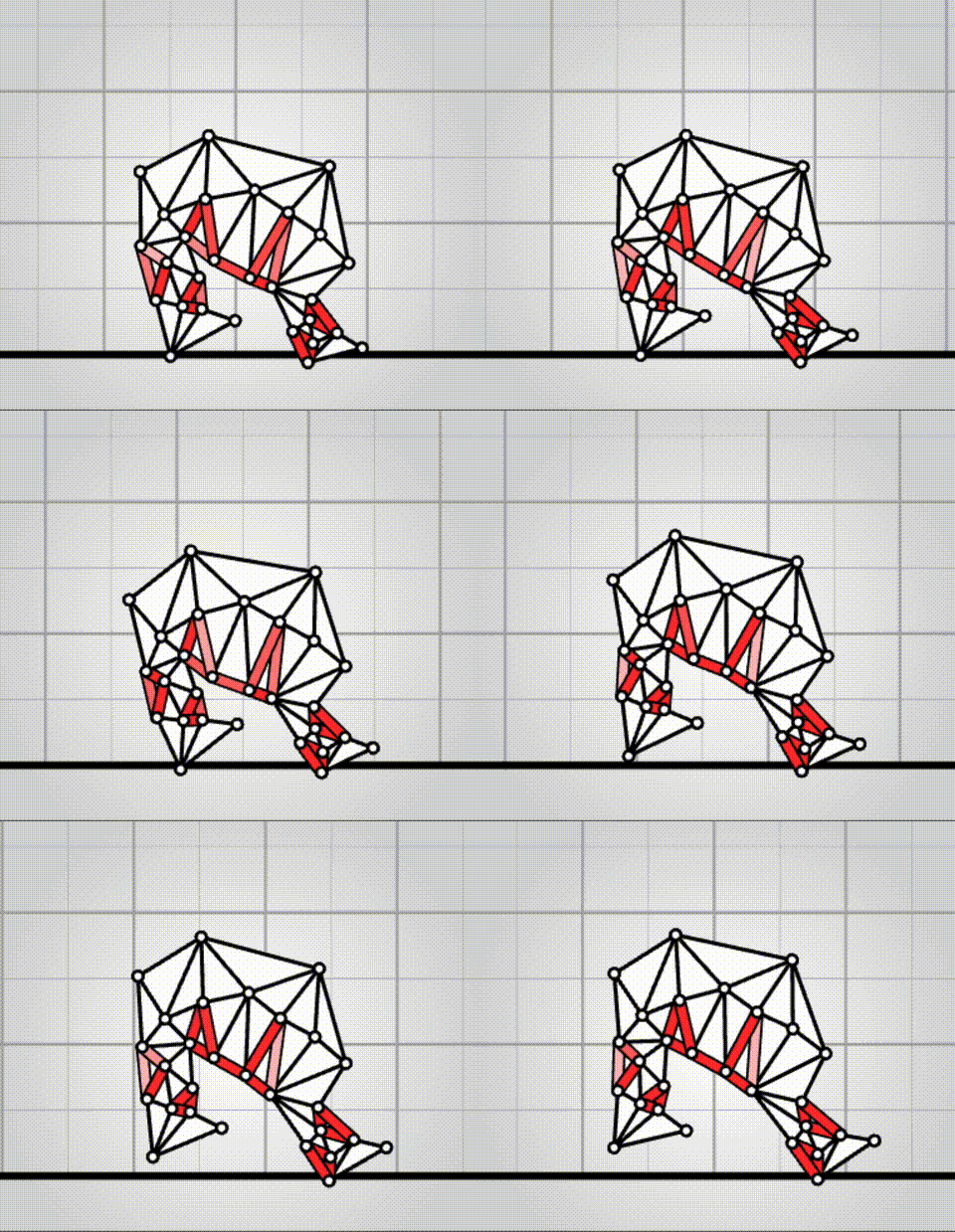
Instead of implementing simulations using explicit position update rules and manually derived force functions, we can implement simulations using gradient-based optimization on differentiable energy functions and compute forces and other derivatives using automatic differentiation. Automatic differentiation can be used for potential energy minimization and numerical integration.
This repository implements six energy functions: neo-Hookean triangles, controllable muscles, gravity, terrain collision, friction, and inertia (for backward Euler integration). The energy functions are implemented in C++ (with some parts automatically generated from Python) and differentiated with Enzyme. Additional functionality, including the optimization loop, is implemented in C++, compiled to WebAssembly, and wrapped as a JavaScript library.
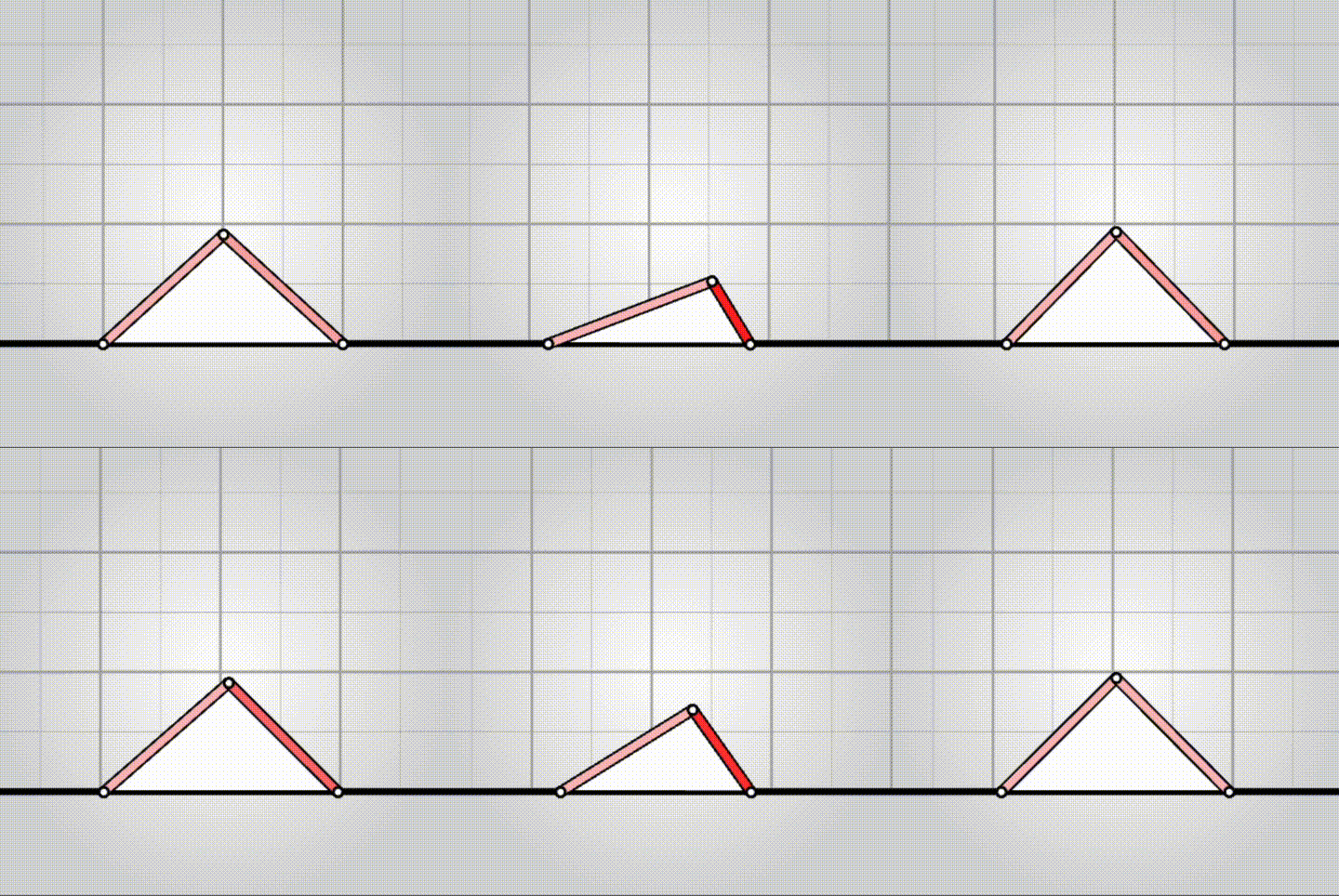
You can create a simple simulation with one triangle and two muscles, where one muscle is controlled by a periodic signal, with the following HTML code.
<!DOCTYPE html>
<html>
<head>
  <meta charset="UTF-8">
</head>
<body>
  <script type="module">
    import * as algovivo from "https://cdn.jsdelivr.net/gh/juniorrojas/algovivo@d457bbc/build/algovivo.min.js";

    async function loadWasm() {
      const response = await fetch("https://cdn.jsdelivr.net/gh/juniorrojas/algovivo@d457bbc/build/algovivo.wasm");
      const wasm = await WebAssembly.instantiateStreaming(response);
      return wasm.instance;
    }

    async function main() {
      const system = new algovivo.System({
        wasmInstance: await loadWasm()
      });
      system.set({
        pos: [
          [0, 0],
          [2, 0],
          [1, 1]
        ],
        triangles: [
          [0, 1, 2]
        ],
        muscles: [
          [0, 2],
          [1, 2]
        ]
      });

      const viewport = new algovivo.SystemViewport({ system });
      document.body.appendChild(viewport.domElement);
      viewport.render();

      let t = 0;
      setInterval(() => {
        system.a.set([
          1,
          0.2 + 0.8 * (Math.cos(t * 0.1) * 0.5 + 0.5)
        ]);
        t++;

        system.step();
        viewport.render();
      }, 1000 / 30);
    }

    main();
  </script>
</body>
</html>
The code above imports the ES6 module algovivo.min.js and loads the compiled WASM algovivo.wasm from jsDelivr. To serve these files from your own server, you can download them from the build branch.
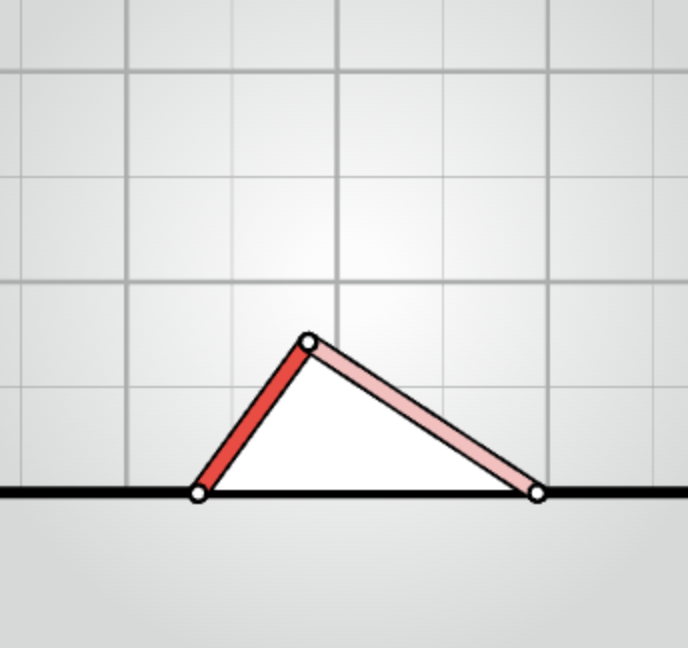
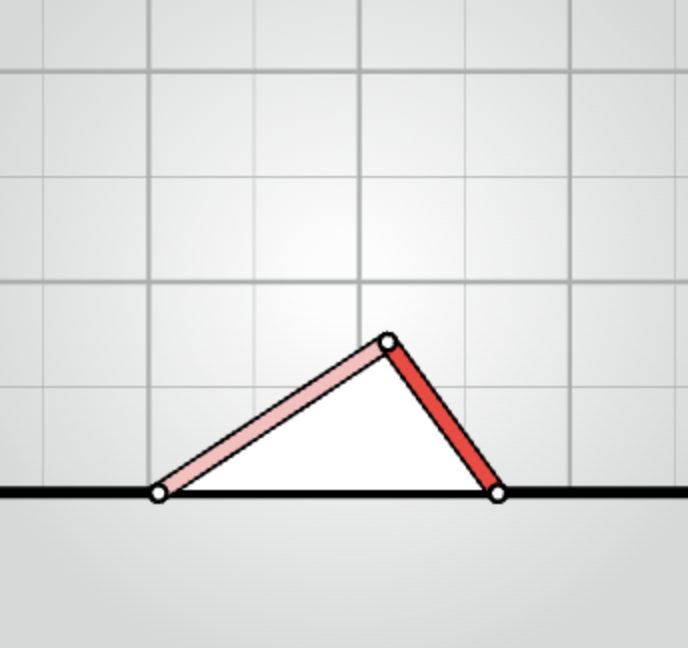
Muscle commands can be specified with system.a.set([...]). The array length must match the number of muscles. A value of 1 means that the muscle is relaxed and wants to keep its original rest length. Values less than 1 indicate that the muscle wants to contract to some fraction of its original rest length.
system.a.set([0.3, 1]) |
system.a.set([1, 0.3]) |
system.a.set([0.3, 0.3]) |
|---|---|---|
 |
 |
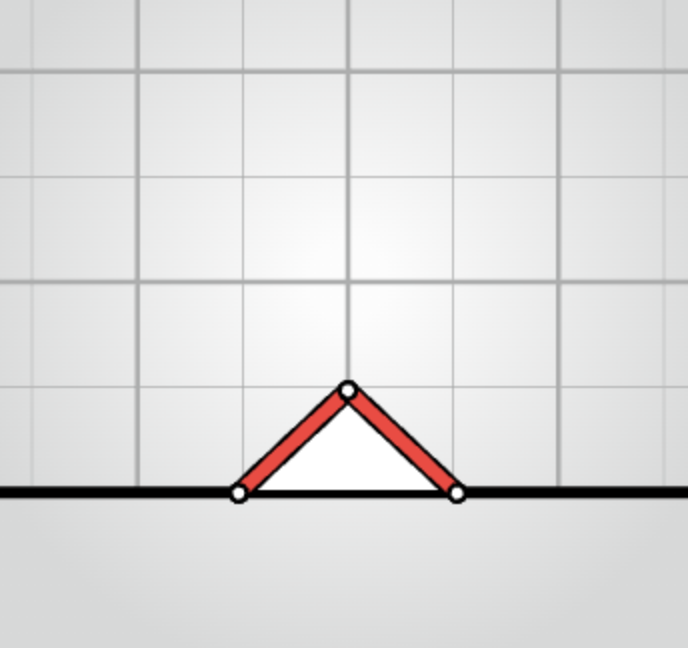 |
This is achieved using an action-dependent potential energy function for each muscle.
$$ E(x, a) = \frac{k}{2} \left(\frac{l(x)}{a\ l_0} - 1\right)^2 $$
More details about this and other energy functions used in the simulation can be found here.
Instead of manually scripting muscle commands, a neural controller can map proprioceptive signals to muscle control signals to produce locomotion. The example below loads a mesh and a pretrained controller included in this repository. The controller used here is an MLP that takes as input vertex positions and velocities projected onto a local frame, as shown here.
<!DOCTYPE html>
<html>
<head>
  <meta charset="UTF-8">
</head>
<body>
  <script type="module">
    import * as algovivo from "https://cdn.jsdelivr.net/gh/juniorrojas/algovivo@d457bbc/build/algovivo.min.js";

    async function loadWasm() {
      const response = await fetch("https://cdn.jsdelivr.net/gh/juniorrojas/algovivo@d457bbc/build/algovivo.wasm");
      const wasm = await WebAssembly.instantiateStreaming(response);
      return wasm.instance;
    }

    async function main() {
      const meshData = await (await fetch("https://cdn.jsdelivr.net/gh/juniorrojas/algovivo@a5e8c73/demo/public/data/biped/mesh.json")).json();

      const policyData = await (await fetch("https://cdn.jsdelivr.net/gh/juniorrojas/algovivo@a5e8c73/demo/public/data/biped/policy.json")).json();

      const system = new algovivo.System({
        wasmInstance: await loadWasm()
      });
      system.set(meshData);

      const policy = new algovivo.nn.MLPPolicy({ system, active: true });
      policy.loadData(policyData);

      const viewport = new algovivo.SystemViewport({
        system,
        sortedVertexIds: meshData.sorted_vertex_ids,
        vertexDepths: meshData.depth
      });
      document.body.appendChild(viewport.domElement);
      viewport.render();

      setInterval(() => {
        policy.step();
        system.step();
        viewport.render();
      }, 1000 / 30);
    }

    main();
  </script>
</body>
</html>
npm ci
npm run build
python codegen/codegen_csrc.py && \
docker run \
  --user $(id -u):$(id -g) \
  -v $(pwd):/workspace \
  -w /workspace \
  ghcr.io/juniorrojas/algovivo/llvm18-enzyme:latest \
  ./build.sh
See CITATION.bib.
more like this
TachiSnap — Pixel Snapper for animation pixel artists. Rust + WebAssembly client-side tool for cleaning up AI-generated…
.Net 10 (.Net 8+) webassembly starter project using raylib-cs nuget 7.0.2 and raylib 5.5
Pytorch Implementation of SimGAN: Hybrid Simulator Identification for Domain Adaptation via Adversarial Reinforcement L…
search projects, people, and tags