meine
meine 🌒 - A CLI file manager and system utility built with Textual. It combines intuitive command parsing with rich t…
Python★ 50
Terminal UI for visualizing NASA's Deep Space Network in real-time
 litescript
git clone https://github.com/litescript/ls-horizons.gitlitescript/ls-horizonsA terminal UI for visualizing NASA's Deep Space Network in real-time.
Note: This project is under active development. Features may change and bugs are expected.

Real-time status of all three DSN complexes with active spacecraft table showing antennas, bands, data rates, distances, and struggle indicators.

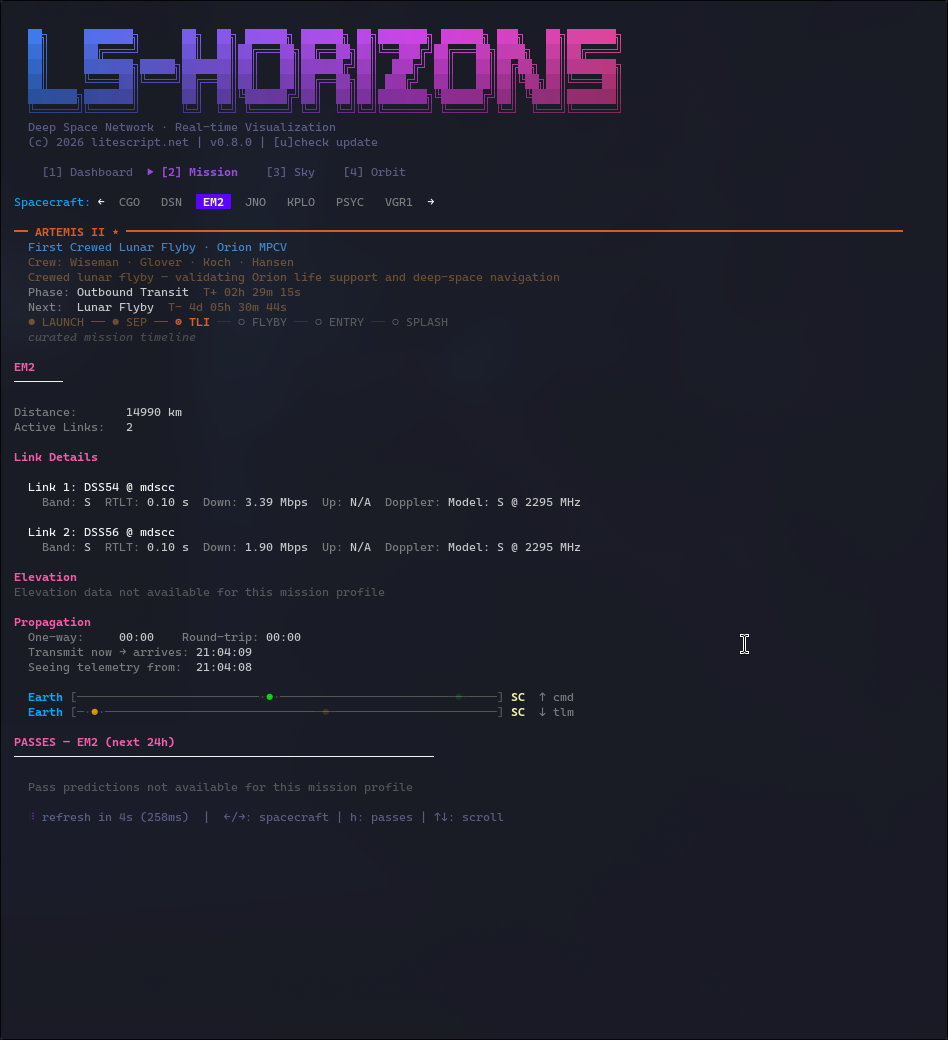
Deep dive into individual spacecraft with link details, pass schedules, elevation sparkline, and signal propagation visualizer showing light-time delay with animated pulse. Press Enter from Dashboard to jump directly here. Curated missions (like Voyager 1) show a spotlight panel with phase, MET, and timeline rail — clearly labeled as schedule-derived data.
Animated celestial view with real star positions, spacecraft locations, and trajectory path arcs. Smooth camera transitions when cycling between spacecraft.

Solar system visualization showing planets at real positions (via JPL Horizons) and active spacecraft with their trajectories. Toggle star background with t.

go install github.com/litescript/ls-horizons/cmd/ls-horizons@latest
Make sure your Go bin directory is on your PATH:
export PATH="$(go env GOPATH)/bin:$PATH"
git clone https://github.com/litescript/ls-horizons.git
cd ls-horizons
go build -o ls-horizons ./cmd/ls-horizons
Pre-built binaries are available in os-builds/. These are statically linked with no dependencies. Note that they may lag behind the latest source.
Linux (x64):
./os-builds/linux-amd64/ls-horizons
macOS ARM (Apple Silicon):
./os-builds/mac-arm/ls-horizons
Windows (x64):
.\os-builds\windows-amd64\ls-horizons.exe
Windows users: Use Windows Terminal for best results. It's included by default on Windows 11, or install free from the Microsoft Store on Windows 10. The legacy cmd.exe and PowerShell windows have limited color support and may not render correctly. Windows Terminal defaults to a dark background; the legacy blue PowerShell background will look odd with this app.
# Launch with default 5-second refresh
ls-horizons

# Custom refresh interval
ls-horizons --refresh 30s

# Use specific ephemeris source
ls-horizons --ephem horizons   # JPL Horizons (default)
ls-horizons --ephem dsn        # DSN-derived only
ls-horizons --ephem auto       # Horizons with fallback
Keybindings:
| Key | Action |
|---|---|
1 or d |
Dashboard view |
2 or m |
Mission detail view |
3 or s |
Sky view |
4 or o |
Orbit view |
Tab |
Cycle through views |
Enter |
Open Mission view for selected spacecraft (Dashboard) |
j/k or ↑/↓ |
Navigate lists |
[/] or ←/→ |
Cycle spacecraft (Mission/Sky/Orbit) |
h |
Toggle pass panel (Mission view) |
l |
Toggle labels (Sky view) |
c |
Cycle complex filter (Sky view) |
p |
Toggle trajectory path (Sky view) |
t |
Toggle star background (Orbit view) |
u |
Check for updates |
q |
Quit |
# Print summary table once
ls-horizons --summary

# Summary with ASCII mini sky view
ls-horizons --summary --mini-sky

# Watch mode: refresh every 30 seconds
ls-horizons --summary --watch 30s

# Single-line "now playing" mode
ls-horizons --now

# Show card for specific spacecraft
ls-horizons --sc VGR1

# Show only changes between fetches
ls-horizons --diff --watch 30s

# Beep on important events (TTY only)
ls-horizons --summary --watch 30s --beep

# Show event log
ls-horizons --events

# Export JSON snapshot to file
ls-horizons --snapshot-path snapshot.json

# Export JSON to stdout (for piping)
ls-horizons --snapshot-path -
| Flag | Default | Description |
|---|---|---|
--refresh |
5s |
Data refresh interval (1s - 5m) |
--ephem |
auto |
Ephemeris source: horizons, dsn, or auto |
--summary |
false |
Print text summary instead of TUI |
--mini-sky |
false |
Show ASCII mini sky view |
--now |
false |
Single-line now-playing mode |
--sc |
"" |
Show card for specific spacecraft |
--diff |
false |
Show only changes between fetches |
--beep |
false |
Beep on important events (TTY only) |
--events |
false |
Show event log |
--watch |
0 |
Repeat output at interval |
--snapshot-path |
"" |
Export JSON to file (- for stdout) |
--log-level |
info |
Log level (debug, info, warn, error) |
-l, --log-file |
"" |
Write logs to file (e.g., ~/ls-horizons.log) |
Live telemetry data from NASA's publicly available DSN feed:
https://eyes.nasa.gov/dsn/data/dsn.xml
The DSN consists of three antenna complexes positioned roughly 120° apart around Earth:
This positioning ensures continuous coverage for deep space missions as Earth rotates.
Spacecraft trajectory data from NASA/JPL's Horizons system:
https://ssd.jpl.nasa.gov/api/horizons.api
Used for computing accurate sky positions, trajectory path arcs, and range/light-time estimates when DSN data is unavailable. Supports 45+ spacecraft with NAIF SPICE ID mappings including Voyager 1/2, JWST, Mars rovers, Juno, New Horizons, and more.
Star positions sourced from the Yale Bright Star Catalog and IAU star names. The sky view renders 150+ stars down to magnitude ~4.5, with brightness-based rendering (brighter stars get larger glyphs).
cmd/ls-horizons/        Entry point and CLI flags
internal/
├── astro/              Astronomical calculations
│   ├── coords.go       RA/Dec ↔ Az/El transforms, GMST/LST
│   ├── frames.go       Coordinate frame conversions (ecliptic, etc.)
│   ├── visibility.go   Ground station visibility calculations
│   ├── sun.go          Sun position calculations
│   └── stars.go        Star catalog with 150+ bright stars
├── dsn/
│   ├── models.go       Data structures (Station, Antenna, Link, etc.)
│   ├── parser.go       XML feed parsing
│   ├── fetcher.go      HTTP client with retry logic
│   ├── derive.go       Distance, velocity, struggle index
│   ├── passplan.go     Pass planning with elevation thresholds
│   ├── elevtrace.go    Elevation trace computation for sparklines
│   ├── spacecraft.go   Spacecraft catalog with mission metadata
│   ├── spacecraft_view.go  Multi-antenna tracking abstraction
│   ├── solarsystem.go  Solar system cache with planet positions
│   ├── observer.go     DSN complex observer locations
│   └── export.go       JSON and text export
├── ephem/              Ephemeris providers
│   ├── provider.go     EphemerisProvider interface
│   ├── horizons.go     JPL Horizons API client (ephemeris + RA/Dec)
│   ├── dsn_provider.go DSN-derived fallback
│   └── targets.go      NAIF SPICE ID mappings (45+ spacecraft)
├── state/
│   └── state.go        Thread-safe state with pass plan and elevation trace caching
├── missions/           Mission spotlight layer
│   ├── models.go       MissionProfile, SpotlightState, DataProvenance
│   ├── catalog.go      Curated profiles (Voyager 1)
│   ├── aliases.go      Spacecraft name/code resolution
│   ├── runtime.go      Live phase/MET/countdown computation
│   └── viewmodel.go    Display formatting helpers
├── ui/
│   ├── ui.go           Bubble Tea main model with request queue
│   ├── dashboard.go    Dashboard view with Enter→Mission flow and spotlight badges
│   ├── mission_detail.go  Mission view with pass panel, elevation sparkline, and spotlight
│   ├── sky_view.go     Sky projection with braille arc rendering
│   └── solarsystem_view.go  Orbit view with ecliptic projection and mission HUD
├── logging/
│   └── logging.go      Structured logging
└── version/
    └── version.go      Version and update checking
A play on the Unix ls command — this tool lets you "list" what's happening at the horizons of our solar system. Also a nod to NASA's New Horizons mission to Pluto and beyond.
--ephem flagContributions welcome! Please:
go test ./... and go vet ./...MIT License — see LICENSE for details.
more like this
meine 🌒 - A CLI file manager and system utility built with Textual. It combines intuitive command parsing with rich t…
search projects, people, and tags