docktail
Expose Docker containers as Tailscale Services using label-based configuration.
 marvinvr
🍸 DockTail
Unleash your containers as Tailscale Services.
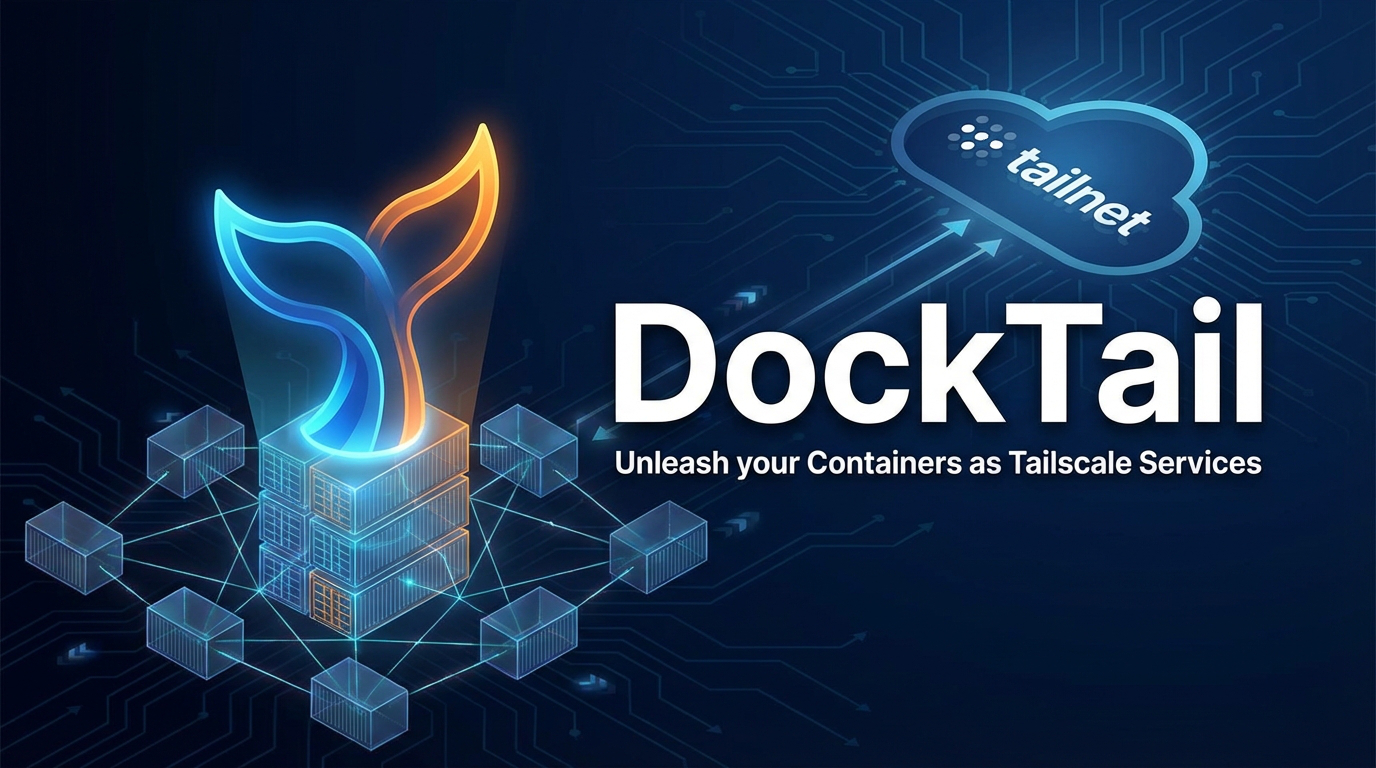

DockTail watches Docker containers, reads docktail.* labels, and exposes matching containers as Tailscale Services. App containers do not need published Docker ports by default; DockTail proxies directly to their Docker network IPs.
Why DockTail?
DockTail uses native Tailscale Services, not per-container Tailscale devices.
| DockTail | TSDProxy | ScaleTail | tsbridge | Plain Services | |
|---|---|---|---|---|---|
| Native Tailscale Services | ✅ | ❌ | ❌ | ❌ | ✅ |
| Configured via Docker labels | ✅ | ✅ | ❌ | ✅ | ❌ |
| Apps do not consume separate Tailscale device slots | ✅ | ❌ | ❌ | ❌ | ✅ |
| No app port publishing | ✅ | ⚠️¹ | ⚠️² | ⚠️¹ | ⚠️³ |
| Automatic Docker reconciliation | ✅ | ✅ | ❌ | ✅ | ❌ |
| Low manual setup after install | ✅ | ✅ | ⚠️⁴ | ✅ | ❌ |
- ¹ Depends on proxy and Docker network setup.
- ² Depends on the sidecar template and app network setup.
- ³ You configure how the service host reaches the backend yourself.
- ⁴ ScaleTail is template-based, so each app usually starts from its own Compose recipe.
Features
- Automatic Docker container discovery through labels.
- Automatic Tailscale service creation with OAuth or API key credentials.
- HTTP, HTTPS, TCP, and TLS-terminated TCP support.
- Tailscale HTTPS with automatic certificates.
- Tailscale Funnel for public internet access.
- Multiple Tailscale services from one container.
- Automatic reconciliation when containers restart or IPs change.
- Optional cleanup of unused Tailscale service definitions (opt-in, safe with multiple instances).
- Stateless Docker container runtime.
- Optional DockTail Cloud reporting — multi-host monitoring, opt-in via one env var.
Quick Start
services:
  docktail:
    image: ghcr.io/marvinvr/docktail:latest
    restart: unless-stopped
    volumes:
      - /var/run/docker.sock:/var/run/docker.sock:ro
      - /var/run/tailscale:/var/run/tailscale
    environment:
      # Optional but recommended. Enables automatic service creation.
      - TAILSCALE_OAUTH_CLIENT_ID=${TAILSCALE_OAUTH_CLIENT_ID}
      - TAILSCALE_OAUTH_CLIENT_SECRET=${TAILSCALE_OAUTH_CLIENT_SECRET}

  myapp:
    image: nginx:latest
    # No ports needed. DockTail proxies directly to the container IP.
    labels:
      - "docktail.service.enable=true"
      - "docktail.service.name=myapp"
      - "docktail.service.port=80"
docker compose up -d
curl http://myapp.your-tailnet.ts.net
This assumes the Docker host is connected to Tailscale and allowed to advertise services. See the full docs for host setup, sidecar setup, OAuth permissions, ACLs, labels, Funnel, and examples.
For Docker secrets or other mounted secret files, set FILE__TAILSCALE_OAUTH_CLIENT_ID / FILE__TAILSCALE_OAUTH_CLIENT_SECRET or TAILSCALE_OAUTH_CLIENT_ID_FILE / TAILSCALE_OAUTH_CLIENT_SECRET_FILE to the mounted file paths instead of putting the values directly in the environment.
Common Examples
Expose an app with Tailscale HTTPS:
labels:
  - "docktail.service.enable=true"
  - "docktail.service.name=api"
  - "docktail.service.port=3000"
  - "docktail.service.service-port=443"
Expose a database over TCP:
labels:
  - "docktail.service.enable=true"
  - "docktail.service.name=db"
  - "docktail.service.port=5432"
  - "docktail.service.protocol=tcp"
  - "docktail.service.service-port=5432"
Expose a service publicly with Tailscale Funnel:
labels:
  - "docktail.funnel.enable=true"
  - "docktail.funnel.port=3000"
  - "docktail.funnel.funnel-port=8443"
Mount an HTTP(S) Funnel at a path:
labels:
  - "docktail.funnel.enable=true"
  - "docktail.funnel.port=3000"
  - "docktail.funnel.path=/webhook"
DockTail Cloud (optional)
Once you run DockTail on more than one machine, "is it still up?" gets tedious. DockTail Cloud is a hosted dashboard for that — and because it already has the Docker and Tailscale context, it tells you which kind of broken you're looking at:
● down · exit 137 · likely OOM        →  the container failed
● local up · tailnet not served       →  the app is fine, the exposure isn't
● host offline · heartbeat missing    →  the whole box went away
It rides along with the agent you already run — no second binary. Set one environment variable and the same container starts reporting:
environment:
  - DOCKTAIL_CLOUD_KEY=${DOCKTAIL_CLOUD_KEY}   # from cloud.docktail.org
Without the key the module is completely inert: no connection is opened and DockTail behaves exactly as before. The link is outbound-only and metadata-only — the protocol has no exec, deploy, or shell message types, which you can verify in cloud/.
One host is free, no time limit. Explore DockTail Cloud · open the dashboard · agent setup
Documentation
-
Human docs: https://docktail.org/docs/
-
Markdown docs: https://docktail.org/docs.md
-
LLM guide: https://docktail.org/llms.txt
-
Full LLM docs: https://docktail.org/llms-full.txt
-
DockTail Cloud overview: https://docktail.org/cloud/
-
Optional Cloud agent setup:
docs/06-cloud.md
The canonical documentation source lives in docs/. Website docs are generated from those Markdown files.
Build From Source
go build -o docktail .
docker build -t docktail:latest .
Links
- Tailscale Services Documentation
- Tailscale Funnel Documentation
- Tailscale Service Configuration Reference
- Docker SDK for Go
Star History
License
AGPL v3
By @marvinvr
more like this
YiMao
YiMao · 云海求片助手 — 双核心 Telegram 影视求片机器人。订阅模式:TMDB 智能搜索一键订阅 / 趣味求片模式:AI 生成五层地狱闯关,通关解锁优先求片。深度集成 MoviePilot + Emby/Jellyfin。…