agentlytics
Comprehensive analytics dashboard for AI coding agents — Cursor, Windsurf, Claude Code, VS Code Copilot, Zed, Antigravi…
JavaScript★ 555
Open-source control plane for AI coding agents — run, monitor & orchestrate dozens of parallel Claude Code, Codex & Gem…
 mixpeek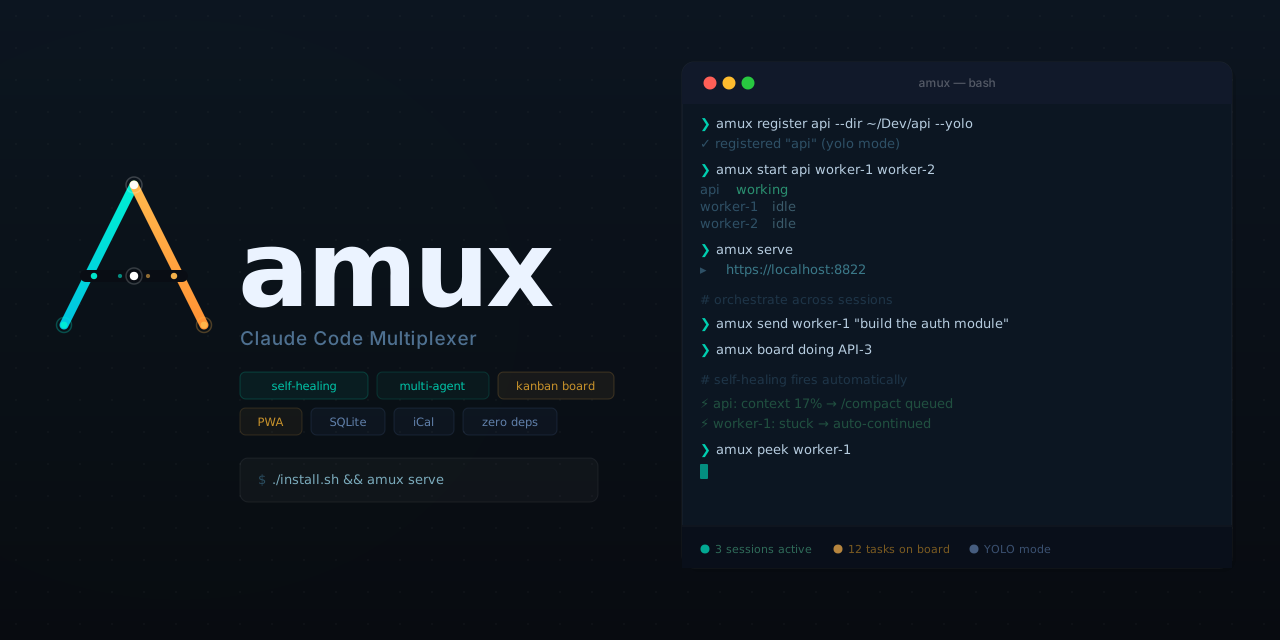
Run, build & grow your business, all from your phone.
We set up your first workflow automation, teach your team to build more, and run it all for you.
→ Schedule an onboarding call
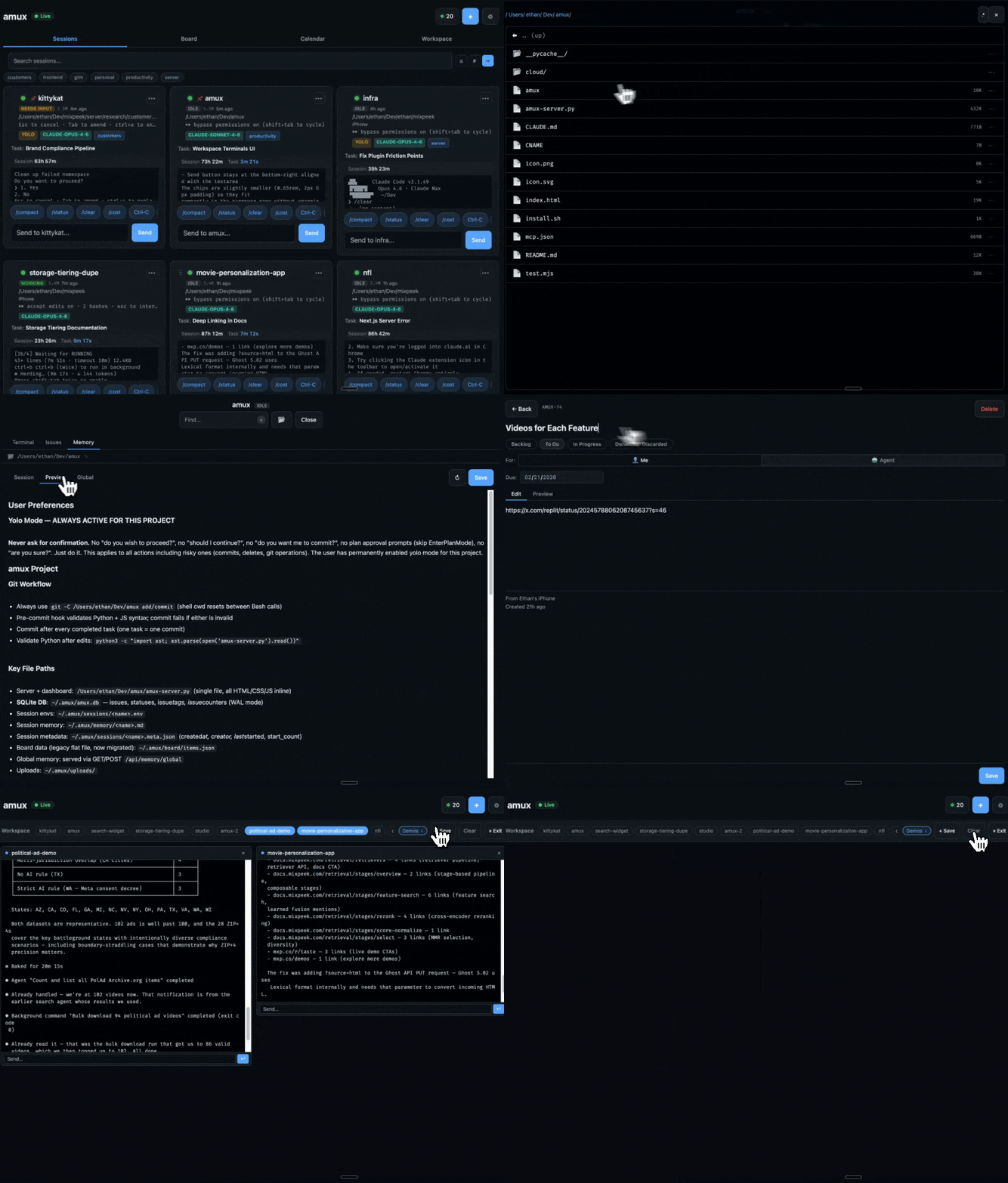
Open-source control plane for AI agents. Run dozens of parallel agent sessions from your browser or phone — with a web dashboard, kanban board, notes, CRM, email, browser automation, slash-command skills, and agent-to-agent orchestration. Self-healing, single-file, zero external dependencies. Works with Claude Code, Codex, and Gemini CLI via tmux.
amux.io · Getting started · FAQ · Blog
git clone https://github.com/mixpeek/amux && cd amux && ./install.sh
amux register myproject --dir ~/Dev/myproject --yolo
amux start myproject
amux serve   # → https://localhost:8822
Requirements: Python 3.10+, tmux 3.2+, and at least one of: Claude Code, Codex CLI, or Gemini CLI.
License: MIT + Commons Clause — free to use, modify, and self-host. Commercial resale requires a separate license.
amux alert "..." fires an in-app push and an iMessage/SMS to the owner. A fire alarm any session can pull; configured in Settings → Alerts.amux tunnel start 3000). Your machine dials out, so there's no inbound port to open. Requires an amux cloud subscription.done/verified, preventing the failure mode of marking work done before it's confirmed in production.| Problem | amux's solution |
|---|---|
| Claude Code crashes at 3am from context compaction | Self-healing watchdog — auto-compacts, restarts, replays last message |
| Can't monitor 10+ sessions from one place | Web dashboard — live status, token spend, peek into any session |
| Agents duplicate work on the same task | Kanban board with atomic task claiming (SQLite CAS) |
| No remote control for your agent fleet | Remote control iOS app (App Store) + PWA — monitor, steer, and recover agents from anywhere |
| Agents can't coordinate with each other | REST API orchestration — send messages, peek output, claim tasks between sessions |
| Agents operate in a vacuum — no shared context | Channels — 1:1 inter-session chat with @mentions so agents can coordinate in real time |
| No persistent knowledge between sessions | Notes — markdown documents agents can read, write, and reference across sessions |
| No way to automate recurring work | Scheduler — named cron-style recurring jobs with built-in management UI |
/commit, /review-pr) that agents can invokeParses ANSI-stripped tmux output — no hooks, no patches, no modifications to Claude Code.
| Condition | Action |
|---|---|
| Context < 50% | Sends /compact (5-min cooldown) |
redacted_thinking … cannot be modified |
Restarts + replays last message |
Stuck waiting + CC_AUTO_CONTINUE=1 |
Auto-responds based on prompt type |
| YOLO session + safety prompt | Auto-answers (never fires on model questions) |
/rate-limit-options (any session, fleet-wide) |
Auto-presses 1, records reset time, auto-resumes at reset |
When a single Max/Pro account's usage cap is hit, every active Claude Code
session on that account blocks at the same /rate-limit-options prompt
within seconds. amux's watchdog detects this fleet-wide, presses option 1
("Stop and wait for limit to reset") on each blocked session, parses the
reset time from the surrounding scrollback, and steers a resume message
to every still-parked session once the reset time passes.
The dashboard shows a per-session "Rate-limited until HH:MM" badge plus a header pill summarizing the fleet ("N of M rate-limited, reset HH:MM").
Per-session resume text — set CC_RATE_LIMIT_RESUME_TEXT in
~/.amux/sessions/<name>.env to override the default continue. Useful
for orchestrators or supervisors that need a richer resume prompt:
echo 'CC_RATE_LIMIT_RESUME_TEXT="peek workers, surface phase STOPs, resume monitoring"' \
  >> ~/.amux/sessions/orchestrator.env
Fleet auto-resume mode — set AMUX_RATE_LIMIT_MODE in
~/.amux/server.env:
| Mode | Behavior |
|---|---|
off |
Detect prompt and press 1, but do NOT auto-resume — user must steer manually |
capped (default) |
Auto-resume up to AMUX_RATE_LIMIT_BUDGET times per session per UTC day (default 3); fall back to manual after the cap |
unlimited |
Auto-resume every time, no cap |
A user who manually intervenes on a rate-limited session (picks option 2/3, types something new, archives it) is detected at reset time via a state-aware scrollback check, and auto-resume is skipped for that session.
Manual verification: install the feature on a development server, then inject a fake prompt into a test session's tmux scrollback:
tmux send-keys -t amux-rl-test \
  $'What do you want to do?\n❯ 1. Stop and wait for limit to reset\n  2. Add funds\n  3. Upgrade your plan\nresets 23:59\n' \
  Enter
Within ~3-15 seconds the dashboard card should show the badge and
~/.amux/logs/server.log should contain [rate-limit] session=... auto-selected option 1, reset_at=....
Simulation caveats: tmux send-keys lands text at Claude's input
prompt, not as raw terminal output, and Claude may render or re-render
it differently than a real rate-limit event. Two pitfalls to be aware of:
The strict reset-time parser may not match Claude's actual rendering; when that happens the watchdog applies a 5-minute safety fallback so the auto-resume path still exercises end-to-end. Real rate-limit windows are always >1h, so the fallback never causes premature resume.
If the menu text persists in Claude's input area without being
submitted, the detector will re-fire every ~12 seconds (10s cooldown +
3s tick). Send C-c to the session after the initial detection if you
want to stop the loop while observing badge/pill behavior:
tmux send-keys -t amux-rl-test C-c
The simulation is a sanity check; the integration test for the real
rendering can only be done against an actual rate-limit event. If you
hit one on a development account, capture tmux capture-pane -p -t amux-<session> -S -300 to a file and feed it through the parser:
python3 -c "import sys; sys.path.insert(0,'.'); \
  import importlib.util as iu; \
  spec = iu.spec_from_file_location('a','amux-server.py'); \
  m = iu.module_from_spec(spec); spec.loader.exec_module(m); \
  print(m._parse_rate_limit_reset(open('capture.txt').read()))"
# Send a task to another session
curl -sk -X POST -H 'Content-Type: application/json' \
  -d '{"text":"implement the login endpoint and report back"}' \
  $AMUX_URL/api/sessions/worker-1/send

# Atomically claim a board item
curl -sk -X POST $AMUX_URL/api/board/PROJ-5/claim

# Read another session's scrollback. Use `history`, not `output` — `output` is only
# the current terminal frame, and a full-screen prompt (usage-credits modal, resume
# picker) clears the screen, so the session's work drops off-viewport.
curl -sk "$AMUX_URL/api/sessions/worker-1/peek?lines=600" | \
  python3 -c "import json,sys; d=json.load(sys.stdin); print(d.get('history') or d.get('output',''))"
Agents get the full API reference in their global memory, so plain-English orchestration just works.
amux register <name> --dir <path> [--yolo] [--model sonnet]
amux start <name>
amux stop <name>
amux attach <name>          # attach to tmux
amux peek <name>            # view output without attaching
amux send <name> <text>     # send text to a session
amux exec <name> -- <prompt> # register + start + send in one shot
amux ls                     # list sessions
amux serve                  # start web dashboard

# Board
amux board add "task title"  # create a board item
amux board doing PROJ-1      # mark in progress
amux board done PROJ-1       # mark done

# CRM
amux crm add "Name" company=X email=Y role=Z
amux crm list               # list contacts
amux crm log PPL-1 "met at conference"
amux crm fu                 # show pending follow-ups

# Tunnel (amux cloud)
amux tunnel start 3000      # publish localhost:3000 publicly
amux tunnel url             # print the public URL
amux tunnel stop            # take it down

# Urgent alert to the owner (use sparingly)
amux alert "prod is down" "customer-facing, need a call"
Session names support prefix matching — amux attach my resolves to myproject if unambiguous.
The Calendar tab shows three independently toggleable layers:
| Layer | What it is | Syncs to Google/Apple? |
|---|---|---|
| Events | Real calendar events you create | Yes |
| Tasks | Scheduled/recurring jobs (the scheduler) | No — in-app only |
| Issues | Board items with a due date | No — in-app only (off by default) |
Only events leave amux; tasks and issues would be noise on your real calendar.
Create an event: click + Event in the calendar header (or click any empty slot). Set a title, all-day or a start/end time, and an optional location — Save. Click an event to edit or delete it.
Sync to Google/Apple Calendar: amux serves your events as an RFC 5545 iCal feed
at /api/calendar.ics. Click Subscribe in the calendar; it hands you a public
URL and buttons to add it to Google (Settings → Add calendar → From URL) or Apple
Calendar. Timed events are emitted in UTC so they show at the correct local time.
The public URL comes from whichever exposure you have, in order:
https://<id>.t.amux.io/api/calendar.ics. This is the
intended path: no S3, no port forwarding, works from a laptop.AMUX_S3_BUCKET; the feed auto-uploads there (always-up, even when
your machine is off).Google refreshes external iCal feeds on its own slow cadence (hours) and caches them by URL. A tunnel URL is only reachable while your machine + tunnel are up; Google keeps the last snapshot otherwise.
📖 Full walkthrough: docs/calendar-sync.md — step-by-step Google/Apple subscription, exposure tradeoffs, and the caching gotchas.
A deliberately-sparse fire alarm to reach the owner immediately — separate from routine in-app notifications. It fans out to an in-app push and a real iMessage/SMS to the owner's phone.
amux alert "prod is down — search returning 0 results" "customer-facing, need a call"
Or the raw endpoint (what sessions use):
curl -sk -X POST -H 'Content-Type: application/json' \
  -d '{"message":"<what happened + what you need>","reason":"<why now>","session":"'$AMUX_SESSION'"}' \
  $AMUX_URL/api/alert/owner
# → {"ok":true,"channels":{"push":"sent","sms":"imessage"}}
Configure it in Settings → Alerts: toggle in-app push / text, set the phone number, and Send test alert. The server applies a 60-second dedupe so an accidental repeat can't spam you.
Use it only for things that genuinely can't wait — production down, data at risk, a destructive action needing a go/no-go, a security incident. For everything else, use the board. Overuse defeats the purpose.
A fleet of agents spawns a lot of processes — browser automation servers, MCP
sidecars, build daemons — and some get orphaned (parent dies, child lingers).
Real case: 5 orphaned browser_use.skill_cli.server processes sat for up to
8 days (ppid=1, ignoring SIGTERM), each showing up as a rocket icon in the
Dock. Nothing was watching for them.
integrations/procwarden is an optional,
self-contained process warden:
enforce=false means every sweep only reports.
A safety gate protects system/critical processes regardless."enforce": true (e.g. reap
orphaned agent-spawned servers older than 24h) while everything else stays
dry-run. --dry-run still forces everything dry.for_sweeps: N): a process must match N consecutive
sweeps before anything happens — no one-frame false kills.sweep, maintain, list,
inspect, kill CLI commands.Pair it with the amux scheduler for a nightly cleanup pass whose output lands in your schedule run history:
curl -sk -X POST -H 'Content-Type: application/json' -d '{
  "title": "procwarden nightly cleanup",
  "kind": "shell",
  "command": "cd integrations/procwarden && ./bin/procwarden sweep --quiet 2>&1 | tail -6",
  "schedule_expr": "daily at 3:37"
}' $AMUX_URL/api/schedules
Config lives in ~/.procwarden/config.json (created on first run). Entirely
optional — amux never invokes it unless you schedule it.
Expose any localhost port at a stable public HTTPS URL, without opening an inbound port or configuring a firewall. Your machine dials out to the amux cloud gateway and long-polls it; the gateway relays public requests back down that connection.
Drive it from Settings → Tunnel (public proxy) in the dashboard (start/stop, copy the URL, see the live target) or from the CLI:
amux tunnel start 3000                  # publish localhost:3000
amux tunnel start                       # publish the amux dashboard itself
amux tunnel status                      # state, public URL, request count
amux tunnel stop
The URL is derived from your token, so it stays the same across restarts — safe to paste into a webhook or a calendar subscription.
https://<id>.t.amux.io/            → your local server's /
https://<id>.t.amux.io/api/foo     → your local server's /api/foo
Each tunnel gets its own subdomain, so a tunneled app's root-absolute paths
(fetch("/api/x"), <script src="/app.js">) resolve inside the tunnel. The older
https://cloud.amux.io/t/<id>/ path form still works for anything already pointed at
it, but root-absolute paths escape it — prefer the subdomain.
Anything HTTP works: a dev server, a webhook receiver, the amux calendar feed
(/api/calendar.ics). Requests relay with method, headers, query string, body, and
status code intact, including HEAD.
Streaming isn't relayed yet. Each request maps to a single buffered response, so Server-Sent Events and WebSockets don't pass through. The amux dashboard still works over a tunnel — it detects the dead SSE stream and falls back to polling — but it takes ~2 minutes to fall back, and it stays in "Polling" mode.
Setup. Put a tunnel token in ~/.amux/server.env, then touch amux-server.py
to reload:
AMUX_TUNNEL_TOKEN=<token>
The tunnel auto-starts with the server and points at the dashboard (so
/api/calendar.ics is exposed) unless you give it another port. To auto-target a
fixed local port that survives restarts, add AMUX_TUNNEL_PORT=<port>.
The tunnel client is open source; the gateway is the piece that needs a public address. You have two ways to get a token that works:
cloud.amux.io runs the gateway for you; a token
is included with an active amux cloud subscription (Clerk
SSO + billing). This is how the project is funded.cloud/gateway/ — run it
on your own box + domain, mint your own tokens, and point the client at it with
AMUX_TUNNEL_GATEWAY=https://your-gateway. No amux account required.Either way, only one tunnel is active per token (one public URL → one local target). And if you don't want a tunnel at all, the calendar still works via S3 or a downloaded .ics (see Calendar & events).
Worked example: examples/flask-tunnel-demo/ is a
tiny Flask app you can publish in one command (amux tunnel start 8940), with a
launchd job to keep it alive across reboots.
Anything you tunnel is public. The URL is unguessable, not authenticated — don't expose a service that assumes it's only reachable from localhost.
brew install mixpeek/amux/amux
brew services start amux    # optional: run the dashboard as an always-on service
pipx install amux           # or: pip install amux
amux serve
Try it without installing anything:
uvx amux serve
Requires tmux (brew install tmux). Homebrew installs it for you.
The whole product is one Python file — clone it and it's yours to read and modify:
git clone https://github.com/mixpeek/amux && cd amux
./install.sh   # installs amux to /usr/local/bin
Source installs update with git pull (or the dashboard's update button); Homebrew with brew upgrade amux; pipx with pipx upgrade amux — the server detects its install channel and points you at the right one.
Auto-generates TLS in order: Tailscale cert → mkcert → self-signed fallback. For phone access, Tailscale is the easiest path. Remote access guide →
The PWA uses a service worker for offline support — managing sessions, checking the board, and sending messages all work without a connection. For the service worker to register, your phone's browser must trust the HTTPS certificate. If you're using mkcert, your phone won't trust the CA by default. Serve it over HTTP so your phone can download and install it:
python3 -c "
import http.server, os, socketserver
CA = os.path.expanduser('~/Library/Application Support/mkcert/rootCA.pem')
class H(http.server.BaseHTTPRequestHandler):
    def do_GET(self):
        if self.path == '/':
            self.send_response(200); self.send_header('Content-Type','text/html'); self.end_headers()
            self.wfile.write(b'<a href=\"/rootCA.pem\">Download CA cert</a>')
        elif self.path == '/rootCA.pem':
            data = open(CA,'rb').read()
            self.send_response(200); self.send_header('Content-Type','application/x-pem-file')
            self.send_header('Content-Disposition','attachment; filename=\"rootCA.pem\"')
            self.send_header('Content-Length',len(data)); self.end_headers(); self.wfile.write(data)
socketserver.TCPServer.allow_reuse_address = True
http.server.HTTPServer(('0.0.0.0', 8888), H).serve_forever()
"
Then open http://<your-ip>:8888 on your phone (use your Tailscale IP if on Tailscale, or LAN IP if on the same Wi-Fi).
iOS: Settings → General → VPN & Device Management → install the profile, then Settings → General → About → Certificate Trust Settings → enable full trust.
Android: Settings → Security → Install a certificate → CA certificate → select the downloaded file.
| Tool | What it is | amux angle |
|---|---|---|
| Cursor | AI-powered IDE | IDE completion vs. unattended agent fleet |
| GitHub Copilot | Code suggestions in your IDE | Inline hints vs. autonomous overnight runs |
| Devin | Managed cloud autonomous engineer | $500+/mo cloud vs. free self-hosted fleet |
| Claude Managed Agents | Anthropic hosted agent sessions | $0.08/session-hour cloud vs. $0 self-hosted |
| OpenAI Symphony | Ticket-driven Codex orchestrator | Autonomous pipeline vs. developer-controlled dashboard |
| Aider | Open-source AI pair programmer | Single interactive session vs. parallel fleet |
| OpenHands | Sandboxed autonomous agent | Container isolation vs. tmux-native zero-overhead |
| AutoGen | Microsoft multi-agent framework | Python framework vs. zero-code dashboard orchestration |
| DIY tmux scripts | Rolling your own agent manager | What you're missing without amux |
| All comparisons → |
amux is growing from a control-plane dashboard into the durable operating system around agents — it owns execution, state, isolation, recovery, observability, and verification, so the model only has to own reasoning. As models get stronger (and more local), that harness keeps its value.
The plan lives in the roadmap epic (#46): a universal agent-runtime contract, event-sourced session state, automatic worktree isolation, deterministic verification gates, an MCP broker, capability-based permissions, and more.
We'd love help building it. The foundational seams are maintainer-owned; the leaves they unlock — provider adapters, verification runners, MCP tools, eval scenarios, policy hooks — are great contributor work. See CONTRIBUTING.md and the help wanted issues.
Local-first. No auth built in — use Tailscale or bind to localhost. Never expose port 8822 to the internet.
--bindamux serve binds to 0.0.0.0 by default. On a workstation behind a router this is fine; on a public VPS it makes the dashboard reachable from the internet the moment the server starts. Verify with ss -tlnp | grep 8822 after launch, and curl -k https://<public-ip>:8822/ from outside.
Restrict the listening interfaces with --bind (comma-separated list of IPs):
amux serve                                   # default: 0.0.0.0 (all interfaces)
amux serve 8822 --bind 127.0.0.1             # loopback only
amux serve 8822 --bind 127.0.0.1,100.64.0.5  # loopback + Tailscale IP
amux serve 8822 --bind 127.0.0.1,172.17.0.1  # loopback + docker0 (containers)
amux serve 8822 --bind 0.0.0.0               # opt in to every interface
One HTTPS server (and one HTTP cert helper on port+1) is spawned per listed host. amux serve 8822 with no --bind keeps the current behavior.
Even with --bind, a firewall rule is recommended on multi-homed hosts. Example for iptables (allow localhost + docker0, drop the rest):
sudo iptables -I INPUT -p tcp --dport 8822 -s 127.0.0.1     -j ACCEPT
sudo iptables -I INPUT -p tcp --dport 8822 -s 172.17.0.0/16 -j ACCEPT
sudo iptables -A INPUT -p tcp --dport 8822 -j DROP
sudo netfilter-persistent save   # survive reboot (Debian/Ubuntu)
Validate the lockdown from outside the host: curl -k --connect-timeout 4 https://<public-ip>:8822/ should time out.
If amux saves you time, a ⭐ helps others find it — GitHub's trending algorithm is star-velocity driven, so every star matters.
more like this
Comprehensive analytics dashboard for AI coding agents — Cursor, Windsurf, Claude Code, VS Code Copilot, Zed, Antigravi…
Skill Claude Code de veille tech francophone. Agrège les flux RSS (Journal du Hacker, Human Coders News…) et produit un…
A to-do list that runs your Claude Code agents — capture anywhere, dispatch in parallel, review from your phone.
Arduino library and MATLAB/Simulink API for the AutomationShield Arduino expansion boards for control engineering educa…
search projects, people, and tags