language-translator
An Obsidian plugin to translate selected text in the desired language
TypeScript★ 53
Hybrid semantic search and AI curation for your vault. Combines BM25 keyword, on-device WebGPU embeddings, and fuzzy ti…
 notoriouslab
Find, connect, and rediscover your notes.
A local-first second brain for Obsidian — semantic search · relation graph · semantic paths · Hot/Cold rediscovery · strong Chinese/CJK · WebGPU on-device · no API keys
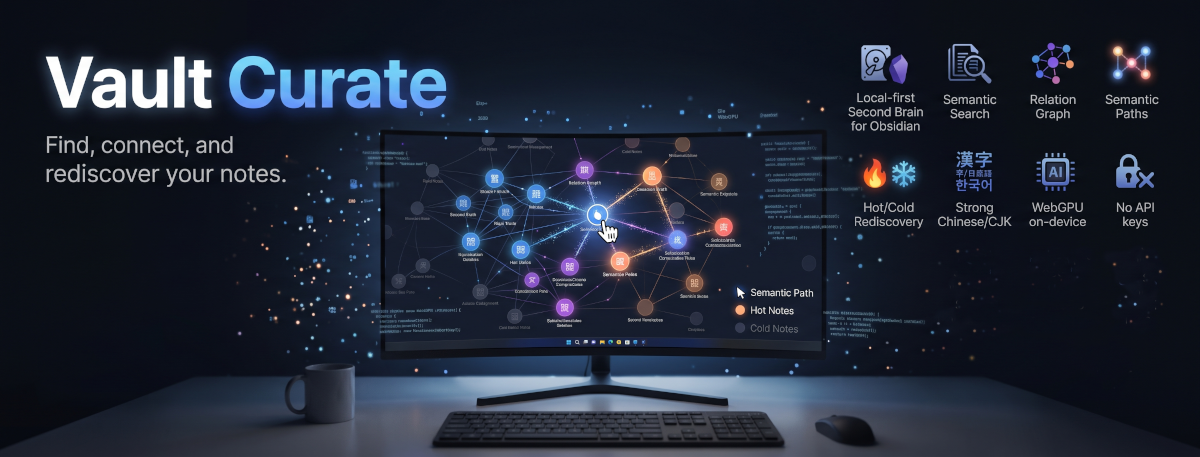
Finding a note is only the first step. The harder parts come after: seeing how notes connect — including the links you never drew — and not letting good notes sink out of sight. Obsidian's built-in search is literal (think "prayer", miss "devotional"), its graph shows only the links you made by hand, and old notes quietly fall off your radar.
Andrej Karpathy shared his vision of LLM-maintained knowledge bases — letting AI "compile" your notes into structured wikis. Compelling, but it asks you to hand over full editorial control. Vault Curate takes a different stance: AI should help you see, not think for you.
| Feature | How it works |
|---|---|
| A closed loop: find → connect → rediscover | Semantic search (keyword + meaning + fuzzy title, fused) finds the note; a relation graph and semantic paths surface related notes you never linked; Hot/Cold tiering resurfaces ones you'd forgotten. And your verdicts close the loop: a suggestion you accept becomes a real wikilink, one you reject never comes back. Each piece exists elsewhere as a single-point plugin — the loop is what makes this a second brain, not a search box. |
| Helps you see, not think for you | No background LLM calls, no auto-rewriting your notes, no chatbot answering for you. Every connection the plugin shows is a suggestion awaiting your yes or no — nothing is written, hidden, or re-ranked without your explicit action. AI curation (descriptions, grouped MOCs) is opt-in. You stay the editor of your own vault. |
| Local-first, strong on Chinese/CJK | Runs on-device via WebGPU (~110 MB model once, 5,004 chunks in about 1m23s; WASM fallback works too), no API keys. The built-in bge-small-zh-v1.5 gives Chinese names, religious terms, and colloquial phrases an edge generic multilingual models miss — switch to Ollama/OpenAI for other languages. |
Four layers form one closed loop. The first three are zero-config and work out of the box; the fourth (curation) is off by default and only runs when you explicitly turn it on.
And the loop answers to you. Everything it surfaces is a suggestion, not a decision — and both of your possible answers stick: say yes to a suggested connection and it becomes a real wikilink (never suggested again — it's a fact now); say no with a hover ✕ and that pair is gone from every suggestion surface, surviving renames, deletions, and index rebuilds. Even Hot/Cold listens the same way: editing a note is a judgment that re-heats it, merely opening one is not. The longer you use it, the more the loop reflects your map of the vault — not an algorithm's guess.
Search by meaning, not just literal characters. Three searches run at once and merge into one ranking:
| Search | Catches |
|---|---|
| Keyword | Exact phrases, keyword combinations |
| Semantic | Different wording, same meaning |
| Fuzzy title | Typos, spelling variants |
Vault Curate: Semantic search (modal) for a quick jump; the sidebar Search tab for persistent results..md → VC: Find similar notes; results land in the sidebar and drag straight to Canvas. Similarity ranks content, not templates: markdown structure is stripped before comparison and the note's description property joins the ranking, so even when dozens of notes share the same template, what surfaces is the handful actually about the same thing — not a row of identical-looking template mates. On Traditional-Chinese vaults, text is converted Traditional→Simplified under the hood before semantic matching (stored text, keyword search, and snippets stay Traditional) to sharpen ranking.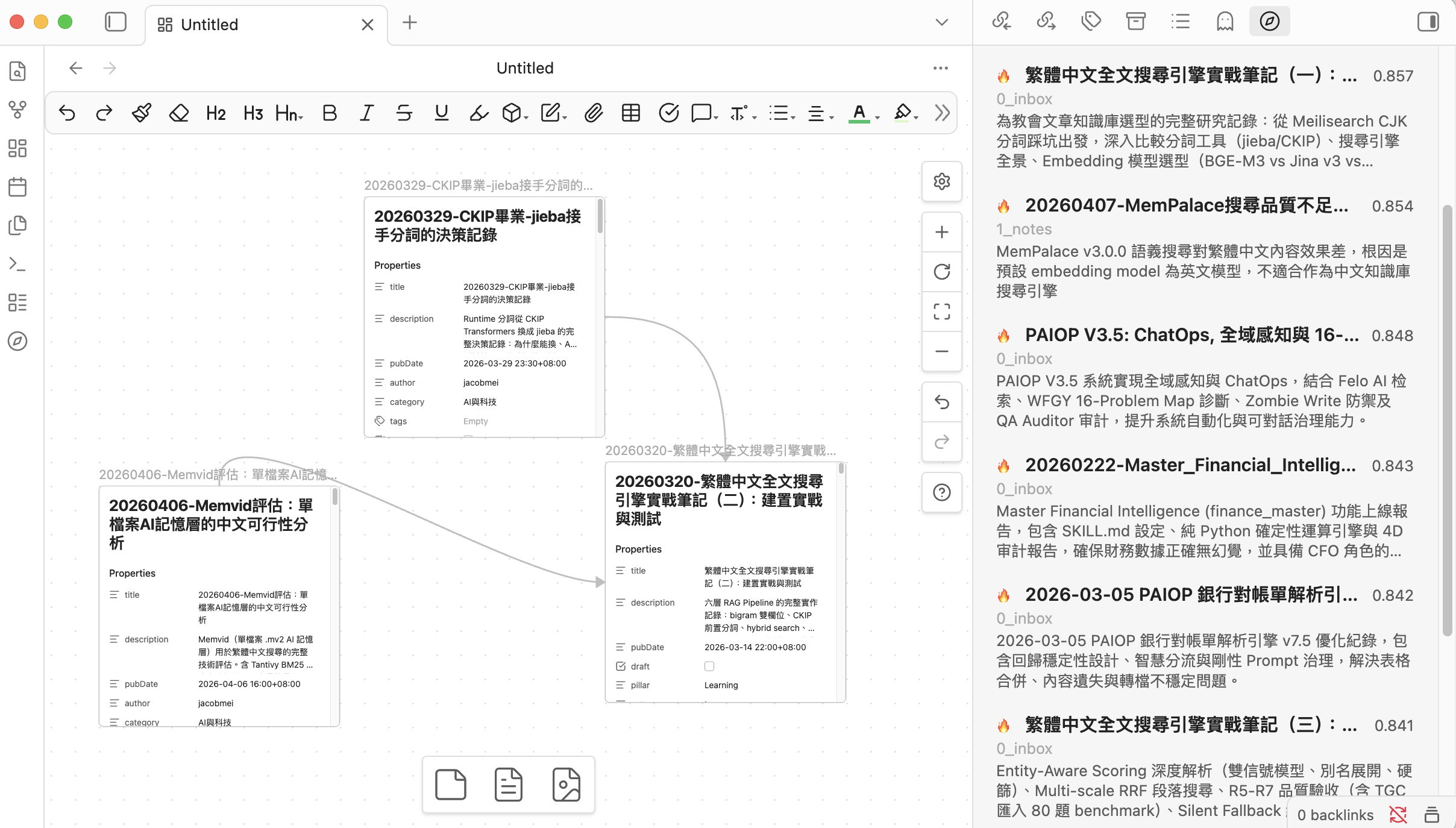
Search finds a single note; this layer shows how notes relate — including the links you never drew by hand.
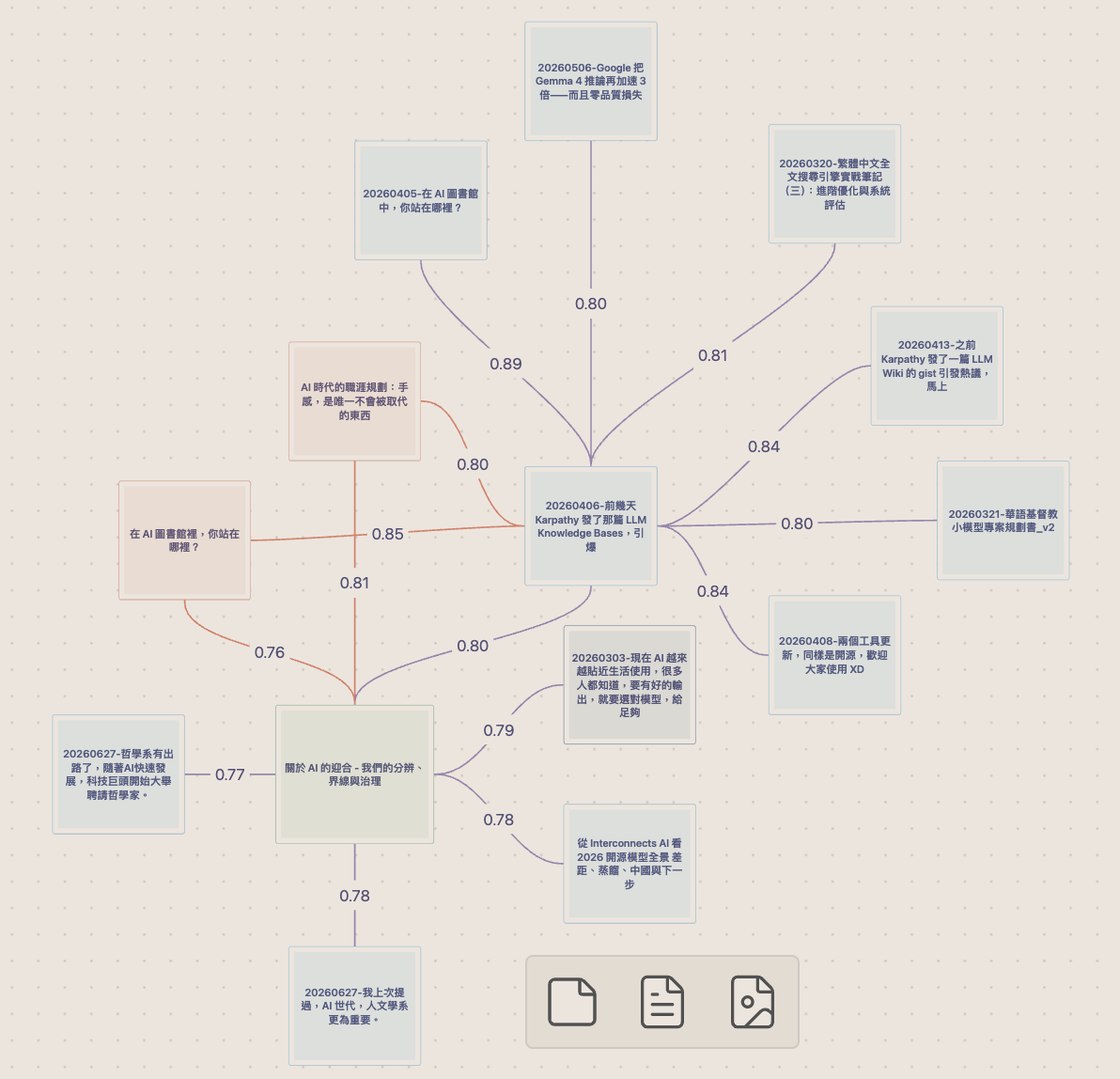
Relation graph (Canvas) — generate an editable Obsidian Canvas around any note: the note in the center, its closest semantic neighbors laid out radially, every edge labeled with its similarity score.
Entry points: the command palette, right-click VC: Generate relation graph, or the Graph button on the Discover sidebar. Each run writes a fresh timestamped .canvas into the folder set under Advanced → Relation graph folder (default Vault Curate Canvases) — your edited graphs are never overwritten.
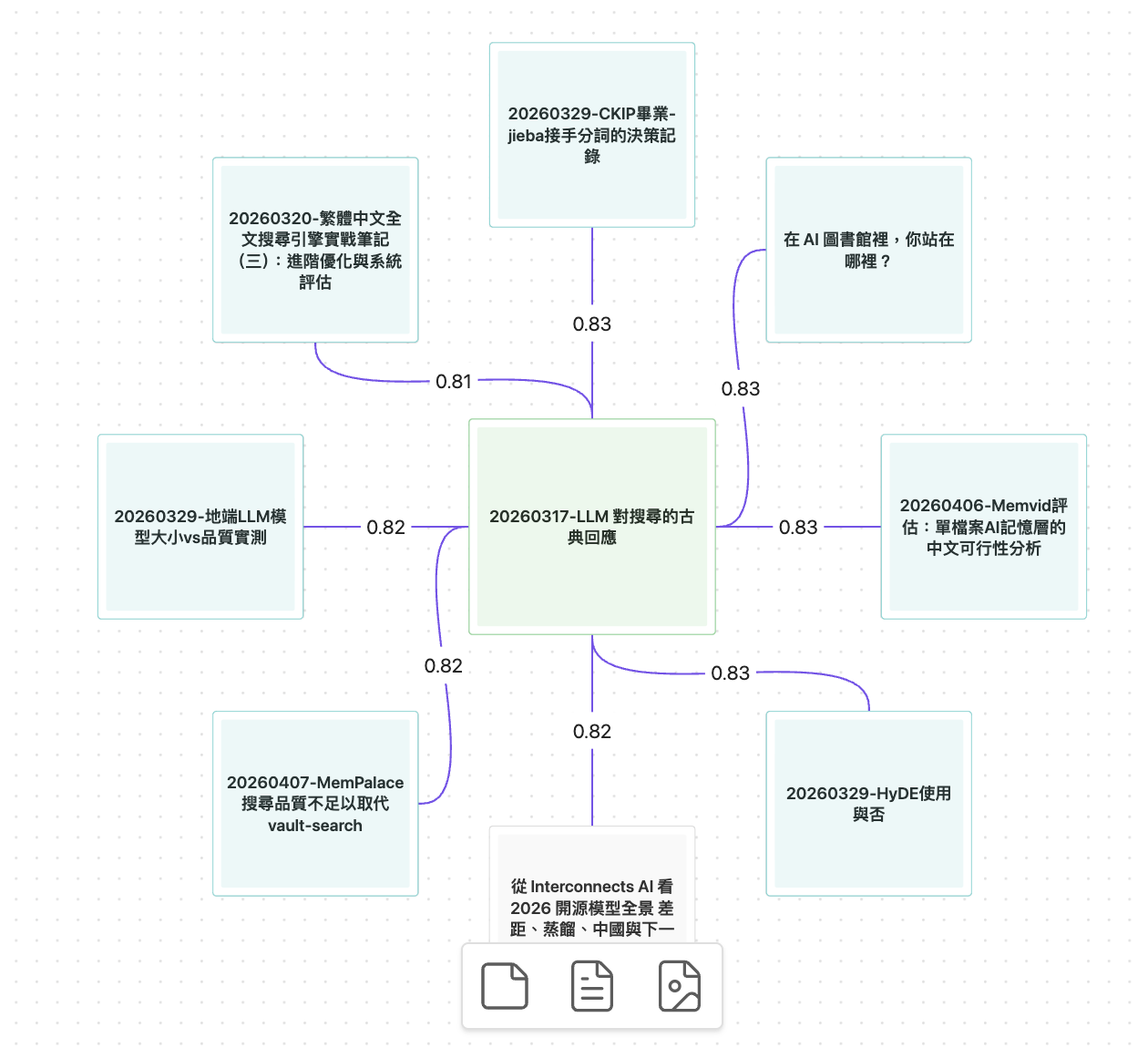
Semantic path (Canvas) — pick any two notes and get the chain of stepping-stone notes that connects them. It searches the vault-wide semantic map for a route where every step holds up: the chain is judged by its weakest hop, so one far-fetched link can't hide behind strong ones. Run Generate semantic path (Canvas) on the start note, then pick the destination in the fuzzy picker. If no chain of consistently strong links exists, you get an honest "not connected" notice with the actual numbers — information, not an error. The underlying semantic map builds once in the background (a progress notice with a Cancel button; the UI never freezes) and then follows your edits in real time — repeat queries answer instantly even while you keep writing, no matter how large your vault grows.
Expand in this graph — right-click any node inside a generated canvas → VC: Expand in this graph grows the graph in place: the clicked note's neighborhood slots into free space around it, notes already on the canvas get connecting edges instead of duplicates, and a note pointed at by two or more edges turns orange (several expansions independently converged on it, which usually means it matters). Your layout edits and manually applied colors are never touched.
Your verdict on every pair — the graph suggests, you decide, and both answers are one click:
.canvas (or run the command) → a checkbox dialog lists every purple edge grouped by source note; Cmd/Ctrl+hover any name for a native page preview. Checked pairs are written into the notes' Related section as real wikilinks — both notes by default, source-only via Advanced → Bidirectional promotion — and the edges turn gray with direction arrows on the spot. Nothing is written unchecked, and accepted pairs never come back as suggestions: they're real links now.A good note shouldn't cease to exist just because you forgot it. Notes are auto-tiered by internal links + recency: Hot (linked, or created/edited recently — any edit counts as a deliberate touch; merely opening a note does not), Cold (orphan and untouched for a while). The cutoff is tunable under Advanced → Hot window (days) and applies instantly — tiers are derived live at query time.
Discover works on notes, not query strings — it actively surfaces semantically related Cold notes you haven't touched recently:
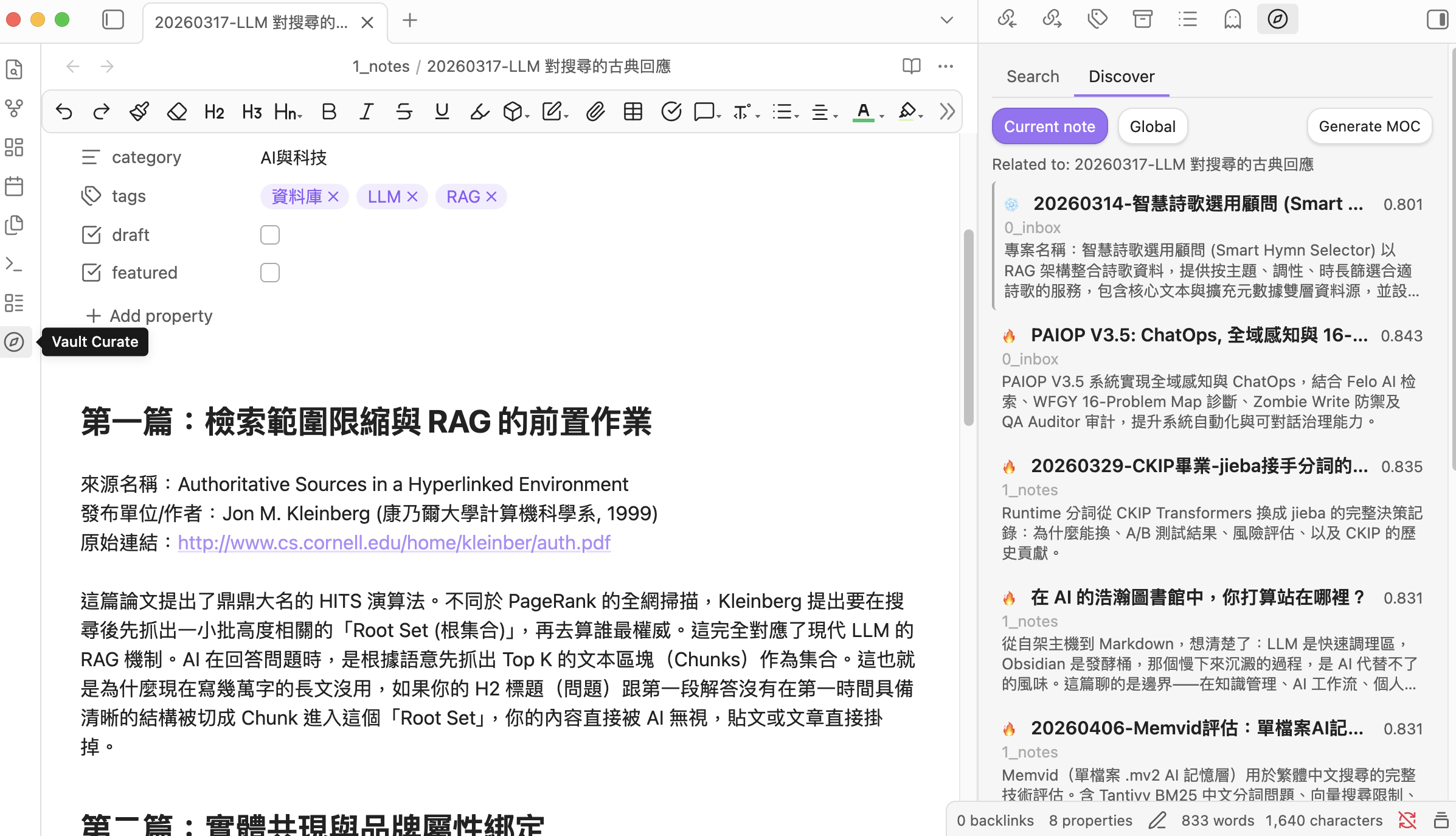
Turn it on under Settings → AI Curation → Enable AI curation to unlock three actions — all manually triggered, never running in the background:
The LLM provider is configured separately under Settings → AI Curation (local Ollama or any OpenAI-compatible endpoint).
Requirements: Obsidian desktop (v1.0.0+). The advanced paths (Ollama / OpenAI-compatible) additionally need a local Ollama instance or any OpenAI-compatible server.
From Community plugins (recommended)
Via BRAT (optional, tracks GitHub releases)
BRAT: Add a beta plugin for testing → enter notoriouslab/vault-curate, then enableBRAT: Check for updates to all beta plugins)Manual install
main.js, manifest.json, styles.css from Releases (the two .wasm runtimes are fetched automatically on first launch).obsidian/plugins/vault-curate/ in your vault, then enable in Settings → Community pluginsTip: If your vault is Git-tracked, add
.obsidian/plugins/*/data.jsonand.obsidian/plugins/*/index.sqliteto.gitignore.
The Welcome to Vault Curate modal opens automatically: under Embedding provider pick Built-in (on-device, WebGPU), then click Index my vault now. After the ~110 MB model download and WebGPU indexing finish, click the sidebar compass icon and start searching.
From the Command Palette (Cmd/Ctrl+P), type Vault Curate: to see them all.
| Command | What it does | Requires |
|---|---|---|
Semantic search (modal) |
Modal-style semantic search with quick jump | always available |
Open search panel |
Open the sidebar panel | always available |
Find similar notes |
Find semantically related notes to the active .md |
always available |
Rebuild index |
Wipe the existing index and re-index everything | always available |
Update index |
Incremental update (re-index files with newer mtime) | always available |
Discover related Cold notes |
Global discover: forgotten notes most related to your recent focus, grouped by folder | always available |
Generate relation graph (Canvas) |
Editable Canvas of the active note's semantic neighborhood | always available |
Generate semantic path (Canvas) |
Widest-path chain between the active note and a picked destination | always available |
Apply purple edges as wikilinks |
Promote a canvas's purple (unlinked) edges into real wikilinks via a checkbox dialog | a .canvas is active |
Generate description for active note |
LLM-write description + tags to the active file's frontmatter | AI curation on |
Generate descriptions for current results |
Batch description for the current sidebar results | AI curation on |
Generate MOC (topic-grouped) |
Auto-cluster results by topic, AI-name each group, output a table-of-contents note | AI curation on |
Right-click menus expose these directly on a note: VC: Find similar notes, VC: Generate relation graph, VC: Generate semantic path, VC: Expand in this graph (while a .canvas is open), and VC: Generate description (AI curation on). Right-clicking a .canvas file offers VC: Apply purple edges as wikilinks.
| Section | Settings | Default |
|---|---|---|
| Quick setup | Embedding provider (Built-in / Ollama / OpenAI-compatible); excluded folders | Built-in; empty |
| AI Curation | Enable toggle; LLM provider; LLM model | off; Ollama; qwen3:1.7b |
| Advanced | top results, min score, relation graph folder, related section heading, bidirectional promotion, hidden suggestions (count + manage/restore), Hot window (days), default search scope, chunk size + overlap, synonym list, auto-index toggle, rebuild + update buttons, index stats | see panel |
Changing the embedding provider or model triggers a confirmation modal — the index is wiped and rebuilt.
Three embedding modes, picked from Quick setup → Embedding provider:
| Mode | Where embeddings run | Where note text goes |
|---|---|---|
| Built-in | On-device WebGPU / WASM | Stays on your device |
| Ollama (local daemon) | Local Ollama daemon on 127.0.0.1 | Stays on your device |
| OpenAI-compatible API | Any endpoint you point it at — local (LM Studio, llama.cpp, …) or remote (OpenAI etc.) | Depends on the endpoint you choose; may leave your device |
The same applies to AI curation (description / MOC naming), which uses an independently-configured LLM endpoint.
No telemetry. No usage tracking. Nothing is sent to any server unless you configure a remote endpoint.
The Obsidian Developer Dashboard's automated audit may flag the following items on this plugin. They are intentional and disclosed here for transparency:
vault.getMarkdownFiles()): The indexer needs to walk the full list of markdown files in your vault to build the semantic index. The "excluded folders" setting (Settings → Advanced) lets you scope this — e.g. excluding _templates/, .trash/, or any folder you don't want indexed. No file is read until it's in the included set.new Function in bundled @huggingface/transformers): The Hugging Face Transformers library uses new Function internally to create type-safe method dispatchers during model loading. Vault Curate's own source code contains zero eval() or new Function(). We bundle the upstream library as-is to avoid divergence; the dynamic dispatch happens only inside the embedding model's tokenizer/inference setup, not on any vault content.sql.js ships an Emscripten output with a Node.js fallback path that imports node:fs / node:crypto. These branches are dead code in Obsidian's renderer process (gated by process.type !== "renderer"). As of v1.0.3, the esbuild config strips those require() strings from the released bundle so the audit no longer sees them.Vault Curate, like every Obsidian plugin, stores its settings (including any OpenAI API key) as plain text in <vault>/.obsidian/plugins/vault-curate/data.json. This is Obsidian's plugin storage mechanism, not a vault-curate-specific design choice.
If your vault syncs to a cloud service (iCloud / Dropbox / Google Drive) or pushes to a public Git repository, you should:
.obsidian/plugins/vault-curate/data.json to your sync exclusion list or .gitignoredata.json / index.jsonsrc/storage/bm25.ts) for CJK-aware full-text search (no native FTS5 dependency)@huggingface/transformers + bge-small-zh-v1.5 q8 (~110 MB, WebGPU/WASM) for on-device embeddingshdbscan-ts for topic clustering (MOC)git clone https://github.com/notoriouslab/vault-curate.git cd vault-curate npm install npm run dev # watch mode npm run build # production build npm test # vitest unit tests
more like this
An Obsidian plugin to translate selected text in the desired language
Automates the creation of JSON template files for Obsidian WebClipper.
search projects, people, and tags