gpu-life
A little simulation of particle life made using webgpu and typescript
 silvernio
TypeScript★ 101⑂ 10 forksMITupdated 2 months ago
README.mdfork it — it’s yours
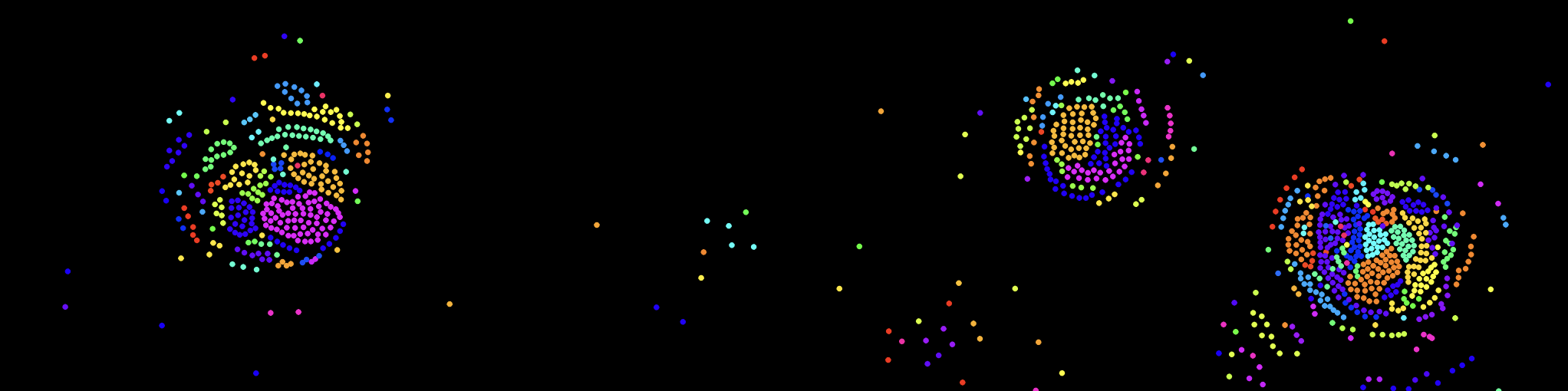
GPU Life
A little simulation of particle life made using webgpu and typescript.The algortihm for the particle movement is entirely based of particle life. It's just been moved onto a compute shader to allow for larger numbers of particles.
The movement of the particles is done using 2 ping pong buffers going through a compute shader. Then the rendering is done using a basic vertex and fragment shader each frame.
There are 3 engines that change how the particles are managed:
- NSquared - each particle checks every other particle, this is highly inefficient.
- Atomic Linked Lists - particles are put into cells, where they are added to lists, then each particle can only check other particles in nearby cells to improve performance in larger environments.
- Counting Sort - once particles are put into cells, the array that stores their cell ids are sorted directly. This approach results in faster reading of nearby particles, at the cost of a slower construction time.
- Prefix Sum - A modified version of the counting sorting algorithm written by cmhhelgeson that replaces the serial exclusive prefix sum algorithm with a parallel inclusive prefix sum adapted from B0nes164's Prefix Sum Algorithms. In simulations with tens of thousands of cells, the prefix sum algorithm will no longer act as a bottleneck for performance, with execution times reduced from ~100ms to ~0.3ms.
more like this
aperture
WebGPU-only, ECS-native 3D runtime where simulation is authoritative and rendering is a derived view.
TypeScript★ 53