 nsec
nsecNorthSec 2025 badge
Brought to you by the Team badge of NorthSec.
Overview
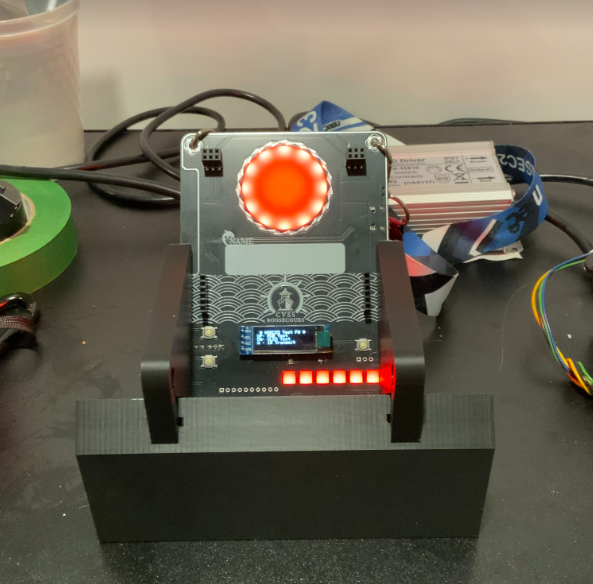
Hardware
The NorthSec 2025 badge is loosely based on the ESP32-C3 design with an ESP32-C3 microcontroller (ESP32-C3-WROOM-02-N4) which is used to drive several periphery devices:
- Eighteen NeoPixel RGB LEDs
- Five buttons
- One IR 'pairing' connector
- Two Shitty Add-On V1.69bis connector
The badge is powered through a USB-C port or through 3 AAA batteries.
If you wish to hack your badge or create a new one based on the hardware. All the information is available here.
Building the firmware
The firmware is based on the Espressif IoT Development Framework. The build system uses PlatformIO to easily manage the dependencies.
You can install it on Debian / Ubuntu in a python virtualenv with these commands:
sudo apt install python3-virtualenv

virtualenv .venv
. .venv/bin/activate

pip install platformio
The installation procedure for your OS may differ a little, please consult the PlatformIO documentation if you have any difficulties.
Once the installation is complete you can build the firmware:
# Conference firmware
pio run -e conference

# CTF firmware
pio run -e ctf
Flashing
Flash the firmware with this command:
# Conference firmware
pio run -t upload -e conference

# CTF firmware
pio run -t upload -e ctf
If multiple badges are connected, you can select which badge will be flash with
the --upload-port <port_name> option:
# Conference firmware
pio run -t upload -e conference --upload-port <port_name>
To improve the upload speed, you can skip the build validation/process with the
-t nobuild option:
# Conference firmware
pio run -t upload -t nobuild -e conference
Debugging
To read the logging statements output on the USB serial interface, it is
possible to use pio device monitor or idf.py's monitor command.
However, you can use your preferred terminal emulator by pointing it to the
/dev/ttyACM0 device. The badge is configured to output at 115200 bauds,
without parity, and with one stop bit per character.
Note that electrically resetting the board using the hardware switch will cause the pseudo-terminal device to disappear, making it hard to read the logs emitted during boot.
Pulsing the DTR signal (lowering it for 1 second) will cause the board to reset without affecting the pseudo-terminal device, allowing you to read early-boot messages. This is supported by most terminal emulators.
Credits
NorthSec CTF badge 2025 is brought to you by the teamwork of:
Special thanks to:
more like this
ML-MCU
Code for IoT Journal paper 'ML-MCU: A Framework to Train ML Classifiers on MCU-based IoT Edge Devices'