moxon-frame-generator
simple generator for 3D-printed frames for a moxon rectangle antenna
OpenSCAD★ 50
Multi-modal constructive solid geometry kernel in Rust
 timschmidt
git clone https://github.com/timschmidt/csgrs.gittimschmidt/csgrsCSGRS is the constructive-solid-geometry grammar for the Hyper geometry workspace. It provides an OpenSCAD-like vocabulary for primitives, Boolean composition, transforms, extrusion, revolution, sweep, loft, conversion, and CAD interchange without introducing another geometry kernel.
Core coordinates use hyperreal::Real. Primitive floats occur only at
explicit rendering, serialization, adapter, FFI, and WebAssembly boundaries.
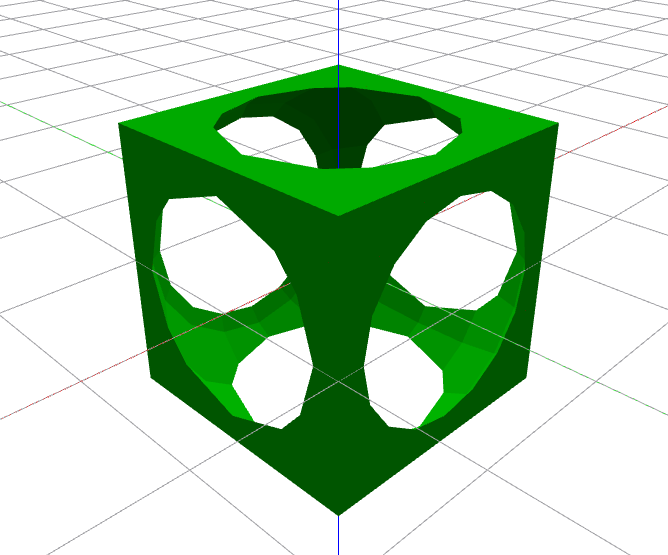
CSGRS operates directly on its dependencies' native geometry:
CurveRegion2 ── extrude / revolve / sweep ──► TriangleMesh
     │                                             │
     ├─ CurveString2 and CurvePath2 for open work  ├─ Hypermesh Booleans
     └─ Hypercurve topology and Booleans           └─ queries and interchange
hypercurve::CurveRegion2 is filled planar material, including holes.hypercurve::CurveString2 is an open or closed curve string without implied
fill.hypercurve::CurvePath2 preserves higher-order path topology.hypermesh::TriangleMesh, re-exported as csgrs::TriangleMesh, is reusable
indexed triangle geometry and the input/output type for solid modeling.csgrs::AttributedMesh<M> is an optional, feature-gated boundary sidecar
with one metadata value per triangle and optional authored normals. Modeling
operations still consume its TriangleMesh geometry.Real is CSGRS's re-export of the exact-aware Hyperreal scalar.Use Hypercurve or Hypermesh directly for kernel-level work. Use CSGRS when the task is to describe a model, cross between curve and solid representations, or exchange geometry with another format.
Install Rust with rustup, then:
cargo new drilled-cube
cd drilled-cube
cargo add csgrs
Replace src/main.rs with:
The equivalent dependency entry is:
[dependencies]
csgrs = "0.23.0"
use csgrs::{
    GeometryContext, Real, curve,
    io::stl::to_stl_binary,
    solid::{self, SolidExt},
};

fn main() -> Result<(), Box<dyn std::error::Error>> {
    let body = solid::cube(Real::from(12));
    let opening = curve::try_extrude(
        &curve::square(Real::from(4)),
        Real::from(16),
        &GeometryContext::STRICT,
    )?
    .into_value()
    .translated(Real::from(4), Real::from(4), Real::from(-2));

    let part = body.try_difference(&opening)?;
    std::fs::write("drilled_cube.stl", to_stl_binary(&part, "drilled_cube")?)?;
    Ok(())
}
Run it with cargo run. It writes drilled_cube.stl. The same program is
included as examples/basic.rs and runs with:
cargo run --example basic
The following is the useful public modeling surface. Generated API documentation contains complete signatures, feature conditions, and errors.
Functions in csgrs::curve return native Hypercurve types.
Filled constructors:
empty, rectangle, square, circle, right_triangle,
polygon, polygon_points, ellipse, and regular_ngon;arrow, trapezoid, star, teardrop, egg,
rounded_rectangle, squircle, keyhole, reuleaux, ring,
pie_slice, heart, crescent, and supershape;circle_with_keyway, circle_with_flat,
circle_with_two_flats, involute_gear, cycloidal_gear,
involute_rack, cycloidal_rack, and airfoil_naca4;bezier_region, metaballs, from_image, and
truetype_text.Open constructors return CurvePath2, CurveString2, or collections of those
types: bezier_path, bspline_path, hilbert_strings, and
hershey_strings. The Hershey catalog is compiled into Hypercurve and exposed
as curve::hershey::fonts; no font files or runtime parser are required.
Planar operations:
CurveRegionExt::{try_union, try_difference, try_intersection, try_xor};offset and offset_rounded;transformed, translated, rotated, and scaled;contains_xy, bounding_box, finite_profiles, and triangulate.finite_profiles is an explicit display/interchange projection. It is not a
replacement for the native curve topology.
These functions consume a CurveRegion2 and return a native TriangleMesh:
extrude and extrude_vector;extrude_twisted;revolve;sweep.solid::loft joins corresponding 3D sections and emits native indexed
triangles directly.
Functions in csgrs::solid return TriangleMesh:
empty, cube, cuboid, sphere, cylinder, ellipsoid,
frustum, frustum_between, polyhedron, octahedron, and icosahedron;arrow, torus, teardrop_cylinder,
spur_gear_involute, spur_gear_cycloid, and
helical_involute_gear;metaballs, metaballs_with_diagnostics, sdf,
sdf_expr, gyroid_solid, schwarz_p_solid, and schwarz_d_solid.Sampling arguments such as segments, stacks, slices, and resolution are explicit tessellation choices; CSGRS has no global tolerance setting.
solid::SolidExt supplies fluent native operations:
try_union, try_difference, try_intersection, and try_xor;transformed and translated;exact_bounds;visit_native_triangles.The corresponding free functions and additional operations are:
boolean, transform, rotate, scale,
mirror, inverse, translation, and translation_to;bounding_box, center, float, merge,
distribute_linear, distribute_grid, and distribute_arc;subdivide, renormalized, materialize_finite,
is_closed_manifold, convex_hull, and minkowski_sum;contains_point, ray_intersections,
polyline_intersections, and dihedral_angle;flatten and slice_z;exact_mass_properties;to_bevy_mesh when bevymesh is enabled;gyroid, schwarz_p, and schwarz_d.Hypermesh retains reusable bounds, topology, transform, convexity, and
Boolean facts on TriangleMesh. Cloning a mesh shares its immutable geometry
and retained facts.
Enable attributed when a renderer or interchange boundary needs aligned
face information:
use csgrs::{AttributedMesh, Real, solid};

let geometry = solid::cube(Real::from(2));
let attributed = AttributedMesh::from_uniform(geometry, "housing");
assert_eq!(
    attributed.face_metadata().len(),
    attributed.geometry().triangles.len()
);
AttributedMesh::new validates one metadata row per triangle.
with_authored_normals additionally validates one normal per position.
geometry, face_metadata, authored_normals, into_parts, and
map_metadata expose the sidecar without duplicating modeling behavior.
Feature-gated functions live under csgrs::io:
| Format | Import | Export |
|---|---|---|
| STL | stl::from_stl |
to_stl_ascii, to_stl_binary |
| OBJ | obj::from_obj |
to_obj, write_obj |
| PLY | — | to_ply, write_ply |
| AMF | — | to_amf, to_amf_with_color, write_amf |
| glTF/GLB | gltf::from_gltf |
to_gltf, write_gltf, to_gltf_scene, write_gltf_scene |
| VRML 2.0 | vrml::from_vrml |
— |
| DXF | dxf::from_dxf |
dxf::to_dxf |
| SVG | svg::import_svg |
svg::export_svg |
| Gerber | gerber::import_gerber |
gerber::export_gerber |
Triangle importers return TriangleMesh. Curve importers return distinct
filled, string, and path carriers where the source format can contain more
than one topology kind. Mesh exporters accept TriangleMesh directly, and
planar exporters accept native CurveRegion2 values.
csgrs::adapter provides opt-in primitive-scalar wrappers over native
geometry:
RawReal, F32, F64, and I128;ScalarMesh<A>;ScalarCurve<A>;GraphicsMesh, IndexedMeshBuffers, and Aabb3.Conversions happen only at ingress and egress. Float output is fallible when coordinates are not finite; integer output requires an exact, in-range integer. The adapters do not implement another geometry kernel.
The C ABI is the sibling
csgrs-ffi crate. C++, Go, Python,
and TypeScript wrappers are documented in bindings.
The wasm feature provides browser-oriented wrappers over the same core.
Default features provide the common modeling and interchange surface. For
smaller builds use default-features = false.
| Feature | Adds |
|---|---|
curve |
native curve grammar and curve-to-solid operations |
attributed |
aligned metadata/authored-normal boundary carrier |
stl-io, obj-io, ply-io, amf-io |
triangle interchange |
gltf-io, vrml-io, dxf-io |
scene and CAD interchange |
svg-io, gerber-io |
curve interchange |
offset |
regularized planar offsets |
truetype-text, hershey-text, image-io |
text and raster curve construction |
metaballs, sdf |
sampled implicit geometry |
bevymesh |
Bevy conversion |
wasm |
WebAssembly/browser wrappers |
dispatch-trace |
computation-path evidence for tests and benchmarks |
A minimal curve-and-solid build is:
[dependencies]
csgrs = { version = "0.23.0", default-features = false, features = ["curve", "stl-io"] }
For WebAssembly:
cargo install wasm-pack
wasm-pack build --release --target bundler --out-dir pkg -- --features wasm
Real and the Hyper predicate stack.try_* errors.CurveRegion2, CurveString2, and CurvePath2 have different meanings;
CSGRS does not hide them behind a combined 2D facade.TriangleMesh is authoritative geometry. AttributedMesh stores only
aligned boundary attributes.The reproducible harness, CSV schema, dependency policy, and interpretation rules are in benchmarks/README.md. Retained measurements and optimization notes are in PERFORMANCE.md.
The serialized suite compares CSGRS, CGAL EPECK, and tight-tolerance
OpenCascade across 66 shared construction, transform, Boolean, analysis, and
I/O workloads. That includes deterministic 8,020-triangle concave-labyrinth
and 36,096-triangle level-3 Sierpiński-foam meshes. Rust comparisons add
boolmesh, manifold-rust, and tri-mesh where their representations
overlap.
Set YEAHRIGHT_BENCH=1 for benchmark runs that should download the optional
public-domain YeahRight corpus into target/benchmark-fixtures/yeahright.
The examples directory covers primitives, native curve extrusion, Booleans,
transforms, hulls, Minkowski sums, metadata, adapters, and interchange. The
Nuxt WebAssembly demo is under
examples/wasm-nuxt4.
Community integrations:
These are the authoritative mathematical and interchange references for the crate:
CSGRS began as a Rust translation of Evan Wallace's CSG.js, released under the MIT license. That lineage and copyright notice remain in LICENSE.
The crate builds on work by the Hyperreal, Hyperlattice, Hyperlimit,
Hypercurve, Hypertri, Hypermesh, Hyperphysics, and Hypersdf contributors and
the upstream format/rendering crates named in Cargo.toml.
The compiled single-stroke font catalog was created by Dr. A. V. Hershey at the U.S. National Bureau of Standards. Its source distribution format was created by James Hurt of Cognition, Inc.; the integrated Rust representation is not the U.S. NTIS distribution format.
Run the release checks before submitting changes:
cargo fmt --all -- --check
cargo test --all-features
cargo clippy --all-features --all-targets -- -D warnings
RUSTDOCFLAGS="-D warnings" cargo doc --all-features --no-deps
cargo check --all-features --benches
Discussion is available in the CSGRS Discord community. CSGRS is available under the MIT License.
more like this
simple generator for 3D-printed frames for a moxon rectangle antenna
GPX 轨迹转 3D 可打印地形模型 | Hiking trail to 3D printable terrain | Electron + Vue。 一款面向户外爱好者与 3D 打印玩家的 Web 工具。将 GPX 徒步/骑行轨迹一键转…
Install and monitor KlipperScreen on Android via DroidKlipp APK, USB ADB forwarding, and WiFi fallback
search projects, people, and tags