agentlytics
Comprehensive analytics dashboard for AI coding agents — Cursor, Windsurf, Claude Code, VS Code Copilot, Zed, Antigravi…
JavaScript★ 555
Trench — Open-Source Analytics Infrastructure. A single production-ready Docker image built on ClickHouse, Kafka, and N…
 FrigadeHQ
Documentation ·
Website ·
Slack Community ·
Demo
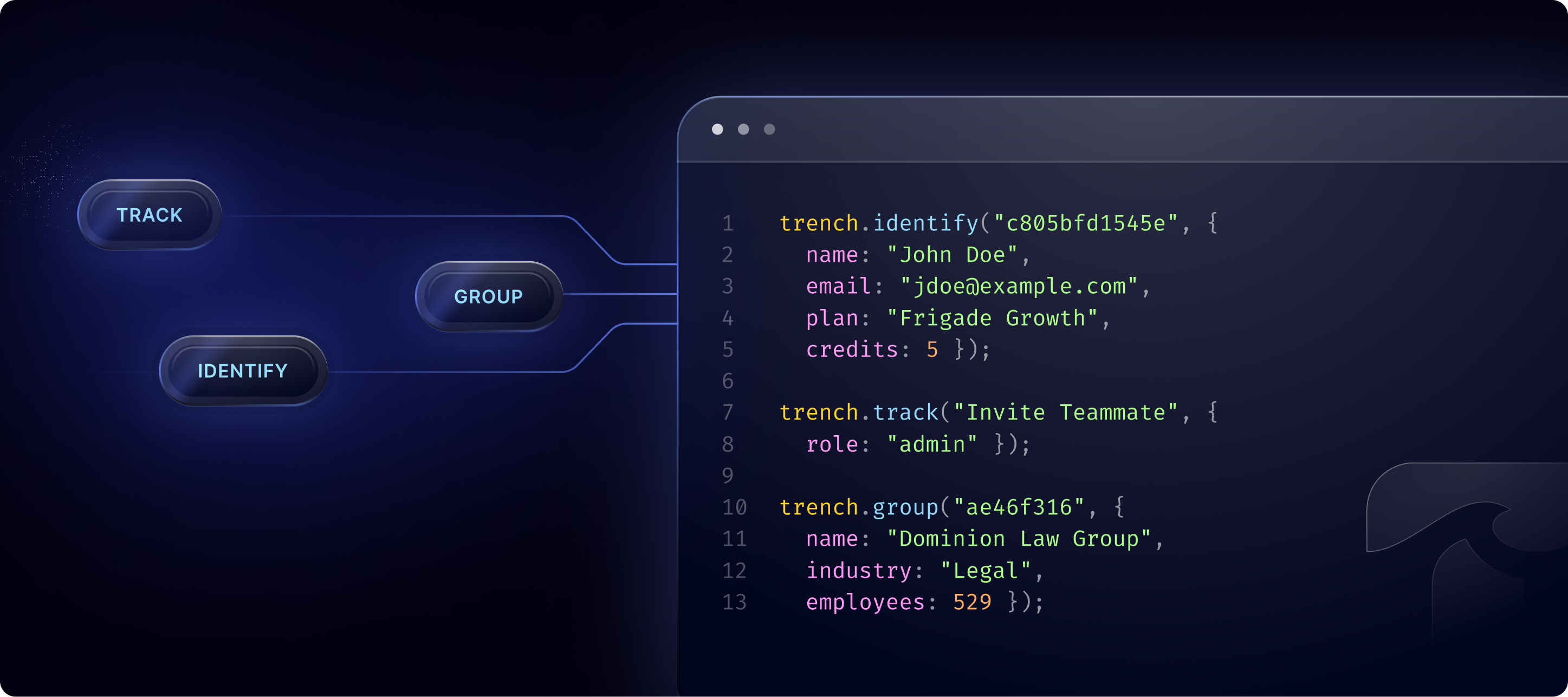
Trench is an event tracking system built on top of Apache Kafka and ClickHouse. It can handle large event volumes and provides real-time analytics. Trench is no-cookie, GDPR, and PECR compliant. Users have full control to access, rectify, or delete their data.
Our team built Trench to scale up the real-time event tracking pipeline at Frigade.
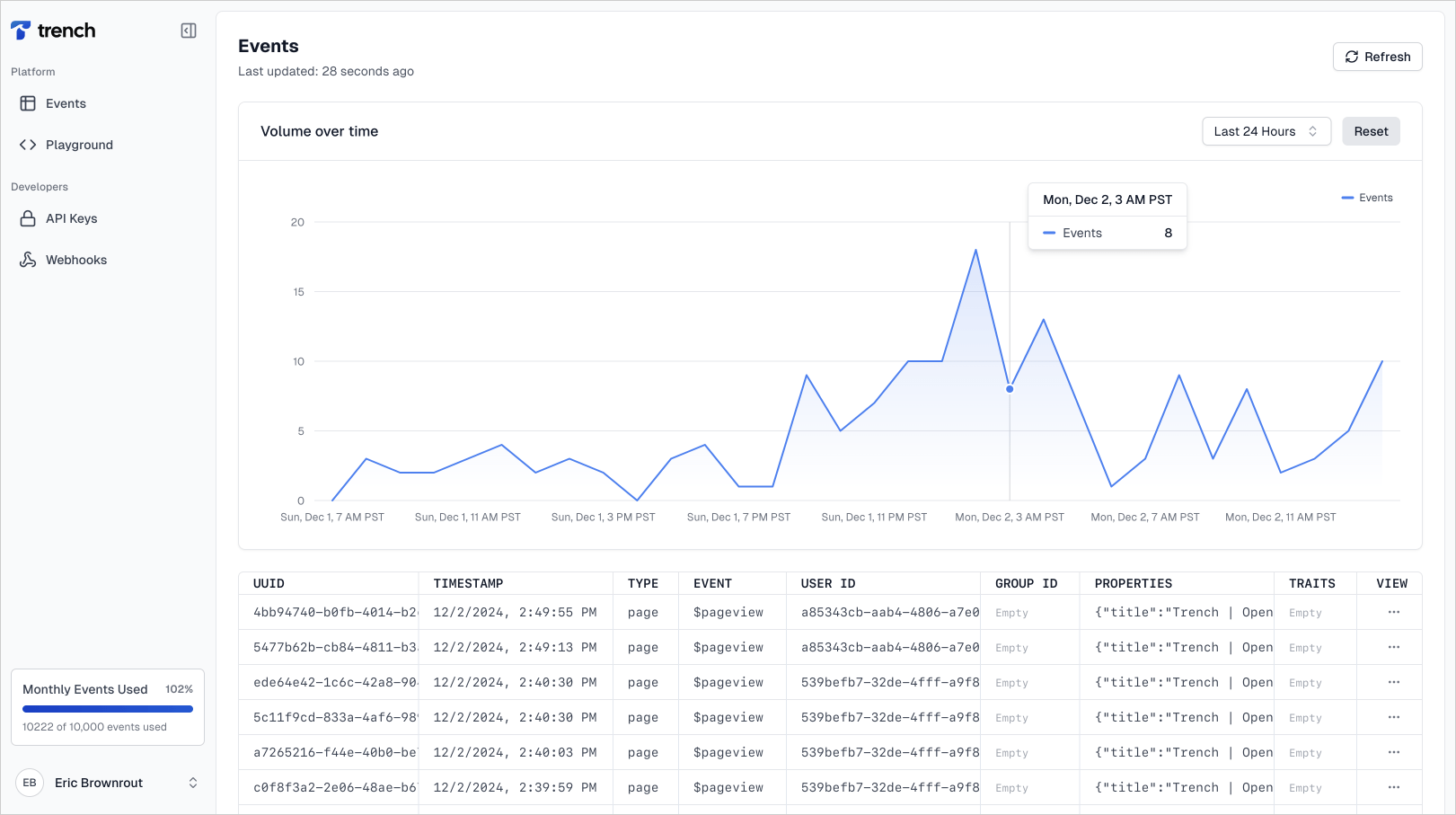
Live demo: https://demo.trench.dev
Video demo:
Watch the following demo to see how you can build a basic version of Google Analytics using Trench and Grafana.
Trench has two methods of deployment:
Follow our self-hosting instructions below and in our quickstart guide to begin using Trench Self-Hosted.
If you have questions or need assistance, you can join our Slack group for support.
Deploy Trench Dev Server: The only prerequisite for Trench is a system that has Docker and Docker Compose installed see installation guide. We recommend having at least 4GB of RAM and 4 CPU cores for optimal performance if you're running a production environment.
After installing Docker, you can start the local development server by running the following commands:
git clone https://github.com/frigadehq/trench.git
cd trench/apps/trench
cp .env.example .env
docker-compose -f docker-compose.yml -f docker-compose.dev.yml up --build --force-recreate --renew-anon-volumes
The above command will start the Trench server that includes a local ClickHouse and Kafka instance on http://localhost:4000. You can open this URL in your browser and you should see the message Trench server is running. You shouldupdate the .env file to change any of the configuration options.
Send a sample event:
You can find and update the default public and private API key in the .env file. Using your public API key, you can send a sample event to Trench as such:
curl -i -X POST \
   -H "Authorization:Bearer public-d613be4e-di03-4b02-9058-70aa4j04ff28" \
   -H "Content-Type:application/json" \
   -d \
'{
  "events": [
    {
      "userId": "550e8400-e29b-41d4-a716-446655440000",
      "type": "track",
      "event": "ConnectedAccount",
      "properties": {
        "totalAccounts": 4,
        "country": "Denmark"
      },
    }]
}' \
 'http://localhost:4000/events'
Querying events:
You can query events using the /events endpoint (see API reference for more details).
You can also query events directly from your local Trench server. For example, to query events of type ConnectedAccount, you can use the following URL:
curl -i -X GET \
   -H "Authorization: Bearer private-d613be4e-di03-4b02-9058-70aa4j04ff28" \
   'http://localhost:4000/events?event=ConnectedAccount'
This will return a JSON response with the event that was just sent:
{
  "results": [
    {
      "uuid": "25f7c712-dd86-4db0-89a8-d07d11b73e57",
      "type": "track",
      "event": "ConnectedAccount",
      "userId": "550e8400-e29b-41d4-a716-446655440000",
      "properties": {
        "totalAccounts": 4,
        "country": "Denmark"
      },
      "timestamp": "2024-10-22T19:34:56.000Z",
      "parsedAt": "2024-10-22T19:34:59.530Z"
    }
  ],
  "limit": 1000,
  "offset": 0,
  "total": 1
}
Execute raw SQL queries: Use the queries endpoint to analyze your data. Example:
curl -i -X POST \
   -H "Authorization:Bearer public-d613be4e-di03-4b02-9058-70aa4j04ff28" \
   -H "Content-Type:application/json" \
   -d \
'{
  "queries": [
    "SELECT COUNT(*) FROM events WHERE userId = '550e8400-e29b-41d4-a716-446655440000'"
  ]
}' \
 'http://localhost:4000/queries'
Sample query result:
{
  "results": [
    {
      "count": 5
    }
  ],
  "limit": 0,
  "offset": 0,
  "total": 1
}
Trench supports connecting to Kafka clusters that require SASL and/or SSL. Configure via the following environment variables (all optional):
KAFKA_SSL_ENABLED: Enable SSL/TLS when connecting to brokers. Values: true/false (default: false).KAFKA_SSL_REJECT_UNAUTHORIZED: Whether to verify broker certificates. Values: true/false (default: true). Set to false when using self-signed certs in development.KAFKA_SSL_CA: CA certificate contents (PEM). Use when brokers use a custom CA.KAFKA_SSL_CERT: Client certificate contents (PEM) if mutual TLS is required.KAFKA_SSL_KEY: Client private key (PEM) if mutual TLS is required.KAFKA_SASL_MECHANISM: One of plain, scram-sha-256, or scram-sha-512.KAFKA_SASL_USERNAME: SASL username (required when KAFKA_SASL_MECHANISM is set).KAFKA_SASL_PASSWORD: SASL password (required when KAFKA_SASL_MECHANISM is set).Notes:
docker-compose.yml uses PLAINTEXT; set the appropriate broker listeners and advertise SSL/SASL endpoints in your Kafka deployment if required.For ClickHouse to connect to authenticated Kafka clusters, you need to configure authentication in ClickHouse server configuration files.
If you don't want to selfhost, you can get started with Trench in a few minutes via:
Trench supports Kafka authentication with SASL and SSL. Here are examples of how to configure both Node.js KafkaJS client and ClickHouse for authenticated Kafka connections.
Quick Start:
docker compose -f docker-compose.sasl.yml up -d --build./scripts/generate-kafka-certs.sh, then run the compose file# Run with SASL authentication (no SSL) docker compose -f docker-compose.sasl.yml up -d --build
This setup uses:
KAFKA_SASL_MECHANISM=PLAIN, KAFKA_SASL_USERNAME=kafka_user, KAFKA_SASL_PASSWORD=kafka_passwordclickhouse-kafka-auth-config-example/clickhouse-sasl.xml for Kafka authentication# Step 1: Generate SSL certificates ./scripts/generate-kafka-certs.sh # Step 2: Set environment variables for SSL certificates export KAFKA_SSL_CA=$(cat ./certs/ca.pem) export KAFKA_SSL_CERT=$(cat ./certs/client.pem) export KAFKA_SSL_KEY=$(cat ./certs/client-key.pem) # Step 3: Run with both SSL and SASL authentication docker compose -f docker-compose.ssl-sasl.yml up -d --build
This setup uses:
clickhouse-kafka-auth-config-example/clickhouse-ssl-sasl.xml for Kafka authenticationTrench is a project built by Frigade.
MIT License
more like this
Comprehensive analytics dashboard for AI coding agents — Cursor, Windsurf, Claude Code, VS Code Copilot, Zed, Antigravi…
an efficient and user friendly OTA server equipped with a powerful WEB UI, designed to effortlessly manage both your ES…
PlexWatch is a Discord bot that provides a real-time dashboard for your Plex media server, featuring active stream moni…
search projects, people, and tags