SimGAN
Pytorch Implementation of SimGAN: Hybrid Simulator Identification for Domain Adaptation via Adversarial Reinforcement L…
Python★ 50
Official repo of VLABench, a large scale benchmark designed for fairly evaluating VLA, Embodied Agent, and VLMs.
 OpenMOSS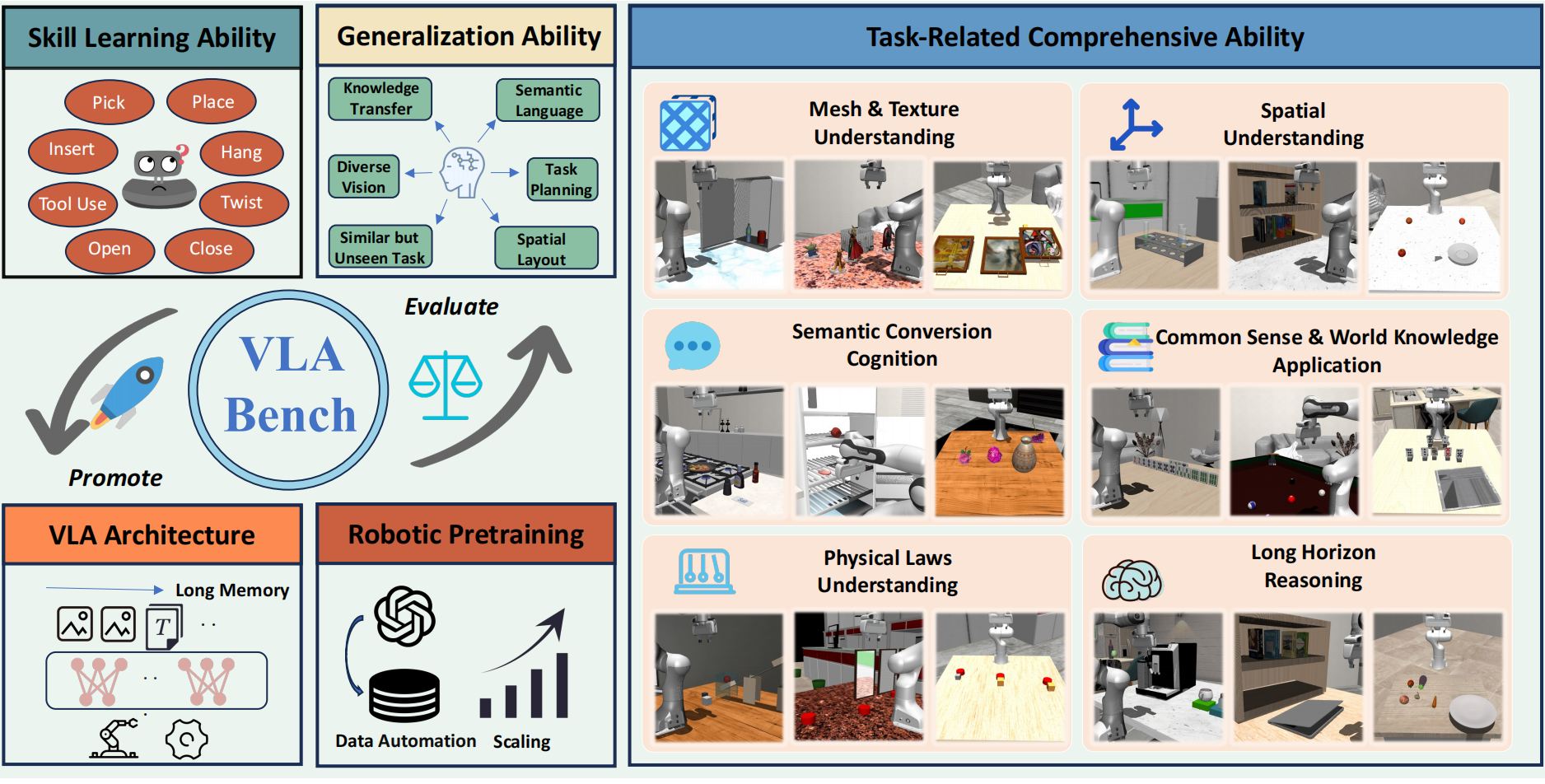
🚨 NOTICE:Please feel free to start an issue or create a PR! If I do not respond to issues in a timely manner, feel free to send me an email directly. I will do my best to build a more user-friendly community ecosystem for VLABench within this year.
conda create -n vlabench python=3.10
conda activate vlabench

git clone https://github.com/OpenMOSS/VLABench.git
cd VLABench
pip install -r requirements.txt
pip install -e .
python scripts/download_assets.py
git submodule update --init --recursive
This will update other policies repos such openpi.
The script will automatically download the necessary assets and unzip them into the correct directory.
We provide a brief tutorial in tutorials/2.auto_trajectory_generate.ipynb and the whole codes are in scripts/trajectory_generation.py. Trajectory generation can be sped up several times by using multiple processes. A naive way to use it is:
sh dataset_generation.sh
Currently, the version does not support multi-processing environment within the code. We will optimize the collection efficiency as much as possible in future updates. After running the script, each trajectory will be stored as a hdf5 file in the directory you specify.
To run the parrallel data collection on distributed machines, such as 8 GPU, please refer to
bash sh/data_generation/multi_gpu_data_generation.sh
Due to some frameworks such as Octo and Openvla using data in the RLDS format for training, we refer to the process from rlds_dataset_builder to provide an example of converting the aforementioned HDF5 dataset into RLDS format data. First, run
python scripts/convert_to_rlds.py --task [list] --save_dir /your/path/to/dataset
This will create a python file including the task rlds-builder in the directory. Then
cd /your/path/to/dataset/task

tfds build
This process consumes a long time with only single process, and we are testing multithreading mthod yet. The codes of original repo seem to have some bugs.
Following the Libero dataset process way of openpi, we offer a simple way to convert hdf5 data files into lerobot format. Run the script by
python scripts/convert_to_lerobot.py --dataset-name [your-dataset-name] --dataset-path /your/path/to/dataset --max-files 100
The processed Lerobot dataset will be stored defaultly in your HF_HOME/lerobot/dataset-name.
VLABench adopts a flexible modular framework for task construction, offering high adaptability. You can follow the process outlined in tutorial 6.
VLABench currently provides standard benchmark datasets, focusing on generalization across multiple dimensions. In the VLABench/configs/evaluation/tracks directory, we have set up multiple benchmark sets across different dimensions. These configs ensure that different models can be fairly compared under the same episodes on different machines.
| Track | Description |
|---|---|
| track_1_in_distribution | Evaluation of the policy's task learning ability, requiring it to fit in-domain episodes with a small and diverse set of data. |
| track_2_cross_categroy | Evaluation of the policy's generalization ability at the object category level & instance level, requiring visual generalization capability. |
| track_3_common_sense | Evaluation of the policy's application of common sense, requiring the use of common sense understanding for describing the target. |
| track_4_semantic_instruction | Evaluation of the policy's ability to understand complex semantics involves instructions that are rich in contextual or semantic information. |
| track_5_cross_task | Evaluation of the policy's ability to transfer skills across tasks is kept open in this setting, allowing users to choose training tasks and evaluation tasks according to their needs. |
| track_6_unseen_texture | Evaluation of the policy's visual robustness, involving episodes with different backgrounds and table textures in this setting. |
NOTICE: The evaluation can also be done by directly sampling episodes from the environment. This evaluation method is more flexible, but there is a risk of improperly initialized episodes. We recommend using the 'evaluation_tracks' method for evaluation.
We provide a standardized fine-tuning dataset, which can be downloaded from hf-dataset. In this version, the data focuses on primitive tasks. We selected 10 basic tasks and provided 500 samples for each task.
Since the current version of VLA does not perform well on primitive tasks, we plan to focus on enhancing VLA’s capabilities in this area first. In the future, we will release a more organized dataset for more composite tasks.
1. Evaluate OpenVLA
Before evaluate your finetuned OpenVLA, please compute the norm_stat on your dataset and place it to VLABench/configs/model/openvla_config.json
Run the evaluation scripts by
python scirpts/evaluate_policy.py --n-sample 20 --model openvla --model_ckpt xx --lora_ckpt xx --eval_track track_1_in_distribution --tasks task1, task2 ...
Multi-GPU Accelerated Evaluation
To speed up the evaluation process, VLABench supports multi-GPU parallel evaluation.
Example command:
bash sh/evaluation/example_multi_gpu_eval.sh
You can specify which tracks and tasks to evaluate by passing the --track and --task arguments, for example:
bash sh/evaluation/example_multi_gpu_eval.sh --track track_1_in_distribution --task select_toy
2. Evaluate Openpi
Please use git submodule update --init --recursive to ensure that you have correctly installed the repositories for the other models.
For openpi, you should create a virtual env with uv and run the server policy. Then, you can evaluate the finetuned openpi on VLABench. Please refer here for example.
Step 1. Download the evaluation episodes from HuggingFace
cd /root/of/VLABench
mkdir dataset
cd dataset

git clone https://huggingface.co/datasets/VLABench/vlm_evaluation_v1.0
Step 2. Evaluation VLMs
python scripts/evaluate_vlm.py --vlm_name Qwen2_VL --few-shot-num 1 --with-cot
Currently, the repo supports serval VLM choices:["GPT_4v", "Qwen2_VL", "InternVL2", "MiniCPM_V2_6", "GLM4v", "Llava_NeXT"], and more VLMs (diffrent family and size) will be added.
If you're evaluating GPT series, please set OPENAI_API_KEY and OPENAI_BASE_URL in your environment variables.
When you encounter an issue, you can first refer to the document. Feel free to open a new issue if needed.
@misc{zhang2024vlabench,
      title={VLABench: A Large-Scale Benchmark for Language-Conditioned Robotics Manipulation with Long-Horizon Reasoning Tasks},
      author={Shiduo Zhang and Zhe Xu and Peiju Liu and Xiaopeng Yu and Yuan Li and Qinghui Gao and Zhaoye Fei and Zhangyue Yin and Zuxuan Wu and Yu-Gang Jiang and Xipeng Qiu},
      year={2024},
      eprint={2412.18194},
      archivePrefix={arXiv},
      primaryClass={cs.RO},
      url={https://arxiv.org/abs/2412.18194},
}
more like this
Pytorch Implementation of SimGAN: Hybrid Simulator Identification for Domain Adaptation via Adversarial Reinforcement L…
search projects, people, and tags