go-recipes
🦩 Tools for Go projects
 nikolaydubina
git clone https://github.com/nikolaydubina/go-recipes.gitnikolaydubina/go-recipes🦩 Go Recipes
✨ Sponsored by NDX Technologies
Handy well-known and lesser-known tools for Go projects

Contents
- Test
- Continuous Tests Monitoring with
codecov.io - Make treemap of coverage with
go-cover-treemap - Browse coverage
- Browse coverage with
gocov-html - Browse coverage with
xgo - Browse coverage in terminal with
gocovsh - Pretty print coverage in terminal with
nikandfor/cover - Run coverage collector server with
goc - Visualize live coverage in VSCode with
goc - Detect drops in coverage with
go-test-coverage - 🎁 Comment code coverage reports in pull request with
go-coverage-report - 🎁 Debug with
Differential Coverage - 🎁 Manipulate coverage profiles with
gopherage - Shuffle tests
- Run tests sequentially
- Run tests in parallel
- Run all Fuzz tests
- 🎁 Fuzz Go binaries using LibAFL with
GoLibAFL - Detect goroutine leaks with
goleak - Detect goroutine leaks with
leaktest - Visualize test runs with
vgt - Summarize
go testwithtparse - Decorate
go testwithrichgo - Decorate
go testwithgotest - Decorate
go testwithgotestsum - Format
go testresults as documentation withgotestdox - Get slowest tests with
gotestsum - Auto-Instrument skipping slowest tests with
gotestsum - Automatically re-run failed tests with
gotestsum - Make
JUnittest report withgotestsum - Make
JUnittest report withgo-junit-report - Get packages without tests
- Perform Mutation Testing with
ooze - Perform Mutation Testing with
avito-tech/go-mutesting - 🎁 Perform Mutation Testing with
jonbaldie/go-mutesting - Perform Mutation Testing with
go-mutesting - Trace tests with
go-test-trace - Speedup tests for large codebases
- Continuous Tests Monitoring with
- Dependencies
- Upgrade dependencies
- Get Go version of current module
- Get Go versions of upstream modules
- Get directly dependent modules that can be upgraded
- Get upstream modules without Go version
- Get available module versions
- Get go module libyear, number of releases, version delta with
go-libyear - Make graph of upstream modules with
modgraphviz - Make graph of upstream packages with
import-graph - Scrape details about upstream modules and make graph with
import-graph - Scrape licenses of upstream dependencies with
go-licenses - Explore dependencies with
goda - Explore dependencies interactively with
spaghetti - Explore dependencies graph interactively with
modview - Explore dependencies graph in CLI with
depth - Explore your
GOPATHwith GUI withgoggles - Enforce Go code architecture with
go-arch-lint - Check Clean Architecture with
go-cleanarch - Use
go moddirectives - Locally patch dependency with
replace - Locally patch dependency with
go.work
- Code Visualization
- Make C4 diagram with
go-structurizr - Make graph of function calls with
callgraph - Make graph of function calls in package with
go-callvis - Make PlantUML diagram with
goplantuml - Make PlantUML diagram with
go-plantuml - Visualize the entropy of a code base with a 3D force-directed graph with
dep-tree - Make 3D chart of Go codebase with
gocity - Make histogram of Go files per package
- Explore Go code in browser powered by
go-guruwithpythia - Interactively visualize packages with
goexplorer - Make D2 graph of architecture and dependencies with
go-arch-lint graph
- Make C4 diagram with
- Code Generation
- Run
go:generatein parallel - Generate
Stringmethod for enum types - Generate enums encoding with
go-enum-encoding - Generate enums with
goenums - Generate data types from JSON Schema with
go-jsonschema - Generate constructor for a struct with
gonstructor - Generate Table Driven Tests with
gotests - Generate mocks with
mockgen - Generate interface for a struct with
ifacemaker - Generate interface for a struct with
interfacer - Generate interface for a struct with
struct2interface - Generate interface for
CSVfile withstructer - Generate decorator for interface with
gowrap - Modify struct field tags with
gomodifytags - Generate code from OpenAPI 3 specification with
oapi-codegen - Generate C-Go Bindings with
c-for-go
- Run
- Generics
- Refactor
- Errors
- Build
- Fetch private dependencies in CI
- Show compiler optimization decisions on heap and inlining
- Disable inlining
- Aggressive inlining
- 🎁 Reduce size of binary
- Profile-guided optimization
- Manually disable or enable
cgo - Include metadata in binary during compilation with
ldflags - Check if symbol or package is included in binary
- Build for Raspberry Pi, Virtual Machine, embedded or normal PC with
gokrazy - Visualise dependencies size in compiled binaries with
go-size-analyzer - Make treemap breakdown of Go executable binary with
go-binsize-treemap - Custom import path
- Custom import path with
govanityurls - Custom import path with
sally - Custom import path with
kkn.fi/vanity - Custom import path enforcement
- Manage multiple Go versions with
Goenv - Transpile C to Go with
cxgo - Transpile Go to Javascript with
gopherjs - Run compile-time function evaluation with
prep - 🎁 Containerize your builds with
brewkit
- Assembly
- Get assembly of Go code snippets online
- Get Go SSA intermediary representation with
ssaplayground - View Go assembly interactively with
lensm - View Go assembly with color annotation with
pat/disfunc - Generate Go assembly in Go with
avo - Generate AST for code snippets with
go/ast - Generate AST for code snippets with
go2ast - Visualize Go SSA function using Graphviz with
go-ssaviz - Make graph of AST with
astgraph - Convert C assembly to Go assembly with
c2goasm
- Deployment
- Execution
- Get version of binary installed with go install
- Embed Go Playground to your blog with
codapi - Embed Go Playground to your blog with
goplay - Run alternative Go Playground with
goplay.tools - Use TinyGo Playground with
tinygo - Run interactive Go kernels in Jupyter Notebook with
gophernotes - Run interactive Go interpreter with
yaegi - Run interactive Go interpreter with
gomacro - Run Go function in shell with
gorram - Run Go function in shell with
gosh - Run simple fileserver with
net/http - Create 3D visualization of concurrency traces with
gotrace - Wrap command with
os/exec - Capture output of command to file with
os/exec - Capture output of command and process it with
os/exec - Piping between processes with
os/exec -
errgroupand CommandContext withos/exec
- Monitor
- Monitor Go Runtime metrics with
opentelemetry - Monitor goroutines with
grmon - Monitor Go processes with
gops - Monitor Go runtime metrics in browser with
live-pprof - Monitor Go runtime metrics in browser with
statsviz - Auto-Instrument all functions with
go-instrument - Auto-Instrument all functions with
otelinji - Auto-Instrument functions for DataDog with
orchestrion - Continuous Profiling with
Pyroscope
- Monitor Go Runtime metrics with
- Benchmark
- Run benchmarks
- Table-driven benchmarks
- Align benchmark output
- Generate benchmark CPU and Memory profiles with
go test - Visualize callgraph of profiles with
pprof - Visualize flamegraphs of profiles with
pprof - Visualize profiles online
- 🎁 Profile and visualize (with video) Go profiles through eBPF with
go-profile - Get delta between two benchmarks with
benchstat - Get summary of benchmarks with
benchstat - Benchmark against git commit with
pat/ba - Continuous benchmarking
- Continuous benchmarking with
gobenchdata - Continuous benchmarking with
benchdiff - Continuous benchmarking with
cob - Generate live traces with
net/http/trace - Generate traces with
go test - View traces with
go tool trace - View traces with
gotraceui - View in-process traces with
trc - View wallclock traces with
fgtrace - Get on/off CPU profiles with
fgprof
- Document
- Education
- Style Guide
- Security
- Static Analysis
- Run default static analysis with
go vet - Run custom static analysis tool with
go vet - Run official static analyzers not included in
go vet - Detect most common issues with
staticcheck - Detect common style, performance, and naming issues with
revive - Detect potential Nil panics with
nilaway - Detect most common issues with
go-critic - Reference and run common linters with
golangci-lint - Detect non-exhaustive switch and map with
exhaustive - Detect structs with uninitialized fields with
go-exhaustruct - 🎁 Detect missing cascade calls with
go-lint-cascade - Detect unreachable functions with
deadcode - Detect unsafe code with
go-safer - Detect
panicwithout explaining comment withpanic-linter - Detect unnecessary type conversions with
unconvert - Detect global variables with
gochecknoglobals - Detect slices that could be preallocated with
prealloc - Detect unnecessary import aliases with
unimport - Detect unexpected import aliases with
importas - Detect inconsistent import aliases with
consistentimports - Detect naked returns with
nakedret - Detect mixing pointer and value method receivers with
smrcptr - Detect vertical function ordering with
vertfn - Detect vertical symbol ordering with
refdir - Detect tests with wrong
t.Parallel()usage withparalleltest - Detect tests with wrong
t.Parallel()usage withtparallel - Detect magic numbers with
mnd - Detect magic strings with
goconst - Detect bound checks with
pat/boundcheck - 🎁 Detect performance optimizations with
perfsprint - Calculate Cognitive Complexity with
gocognit - Calculate Cyclomatic Complexity with
gocyclo - Calculate Cyclomatic Complexity with
cyclop - Calculate age of comments with
go-commentage - Ensure
ifstatements using short assignment withifshort - Detect sub-optimal struct layout with
betteralign - Detect sub-optimal struct layout with
structlayout-optimize - Visualize struct layout with
structlayout - Rely on compiler for stricter Enums
- Analyze function callsites with
go-callsite-stats
- Run default static analysis with
- Guides
Test
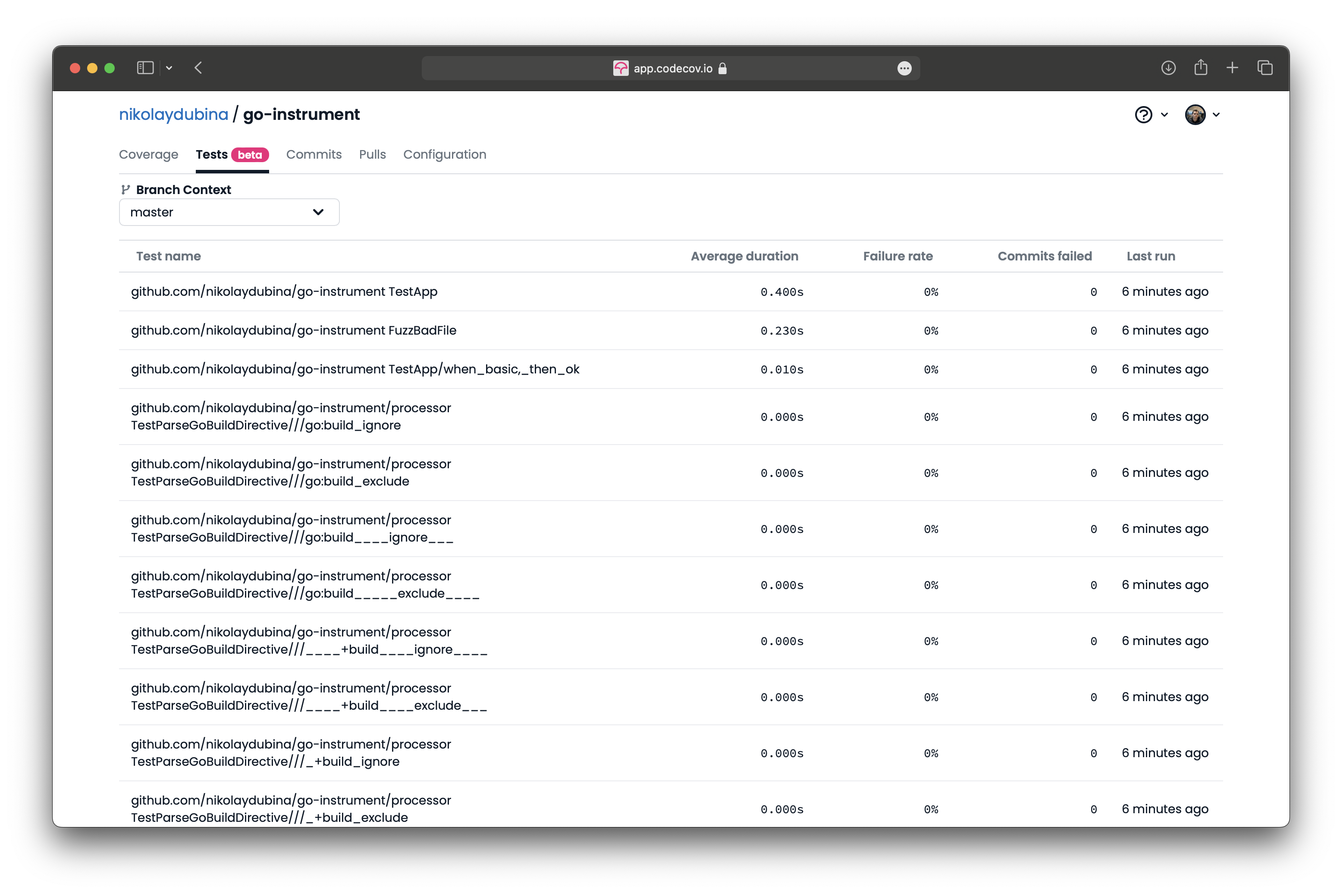
⏫ Continuous Tests Monitoring with codecov.io
Track tests duration, errors, and flakiness. Run JUnit test output converter and submit results to codecov.io via GitHub Action. — https://codecov.io
go test -coverprofile=coverage.out -cover -json ./... | gotestsum --junitfile tests.xml
Requirements
go install gotest.tools/gotestsum@latest
⏫ Make treemap of coverage with go-cover-treemap
Visualize distribution of code coverage in your project. This helps to identify code areas with high and low coverage. Useful when you have large project with lots of files and packages. This 2D "image-hash" of your project should be more representative than a single number. Also available at https://go-cover-treemap.io. — @nikolaydubina
go test -coverprofile cover.out ./...
go-cover-treemap -coverprofile cover.out > out.svg

Requirements
go install github.com/nikolaydubina/go-cover-treemap@latest
⏫ Browse coverage
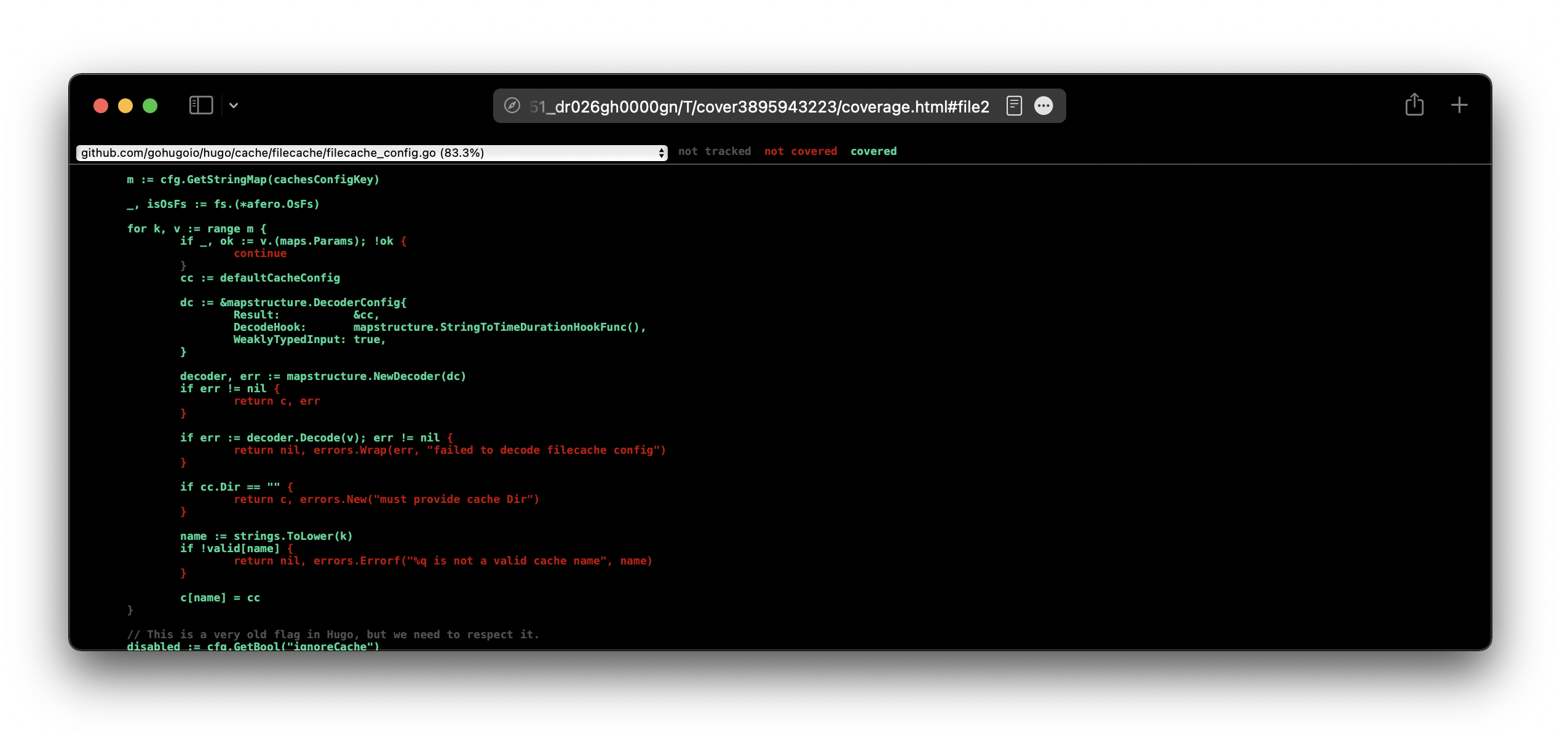
This is very helpful tool from the official Go toolchain. Similar visualization is integrated into VSCode and GoLand, but can be used separately.
go test -coverprofile cover.out ./...
go tool cover -html=cover.out
⏫ Browse coverage with gocov-html
Browse code coverage in statically generated HTML page. Multiple styles are supported. You may need to convert coverage report into gocov format. — @matm
gocov test strings | gocov-html -t golang > strings.html
gocov test encoding/csv strings | gocov-html -t kit > strings.html
gocov test strings|./gocov-html -cmax 90 > strings.html # show functions with <90% coverage

Requirements
go install github.com/axw/gocov/gocov@latest
go install github.com/matm/gocov-html/cmd/gocov-html@latest
⏫ Browse coverage with xgo
The displayed coverage is a combination of coverage and git diff. By default, only modified lines were shown. This helps to quickly locate changes that were not covered, and add tests for them incrementally. — @xhd2015
xgo tool coverage serve cover.out

Requirements
go install github.com/xhd2015/xgo/cmd/xgo@latest
⏫ Browse coverage in terminal with gocovsh
Browse code coverage similarly to HTML provided by official Go toolchain, but in terminal. Other notable features are package level statistics, coverage only for changed files. — @orlangure
go test -cover -coverprofile coverage.out
gocovsh                        # show all files from coverage report
git diff --name-only | gocovsh # only show changed files
git diff | gocovsh             # show coverage on top of current diff
gocovsh --profile profile.out  # for other coverage profile names

Requirements
go install github.com/orlangure/gocovsh@latest
⏫ Pretty print coverage in terminal with nikandfor/cover
It is similar to go tool cover -html=cover.out but in terminal. You can filter by functions, packages, minimum coverage, and more. — @nikandfor
cover

Requirements
go install github.com/nikandfor/cover@latest
⏫ Run coverage collector server with goc
This tool allows to collect coverage as soon as code is executed. — @qiniu
goc server
goc build
goc profile

Requirements
go install github.com/qiniu/goc@latest
⏫ Visualize live coverage in VSCode with goc
Official Go VSCode plugin already has coverage highlighting. In addition to that, this tool shows covered lines as soon as they are executed. This can be useful for running manual integration or system tests or debugging. — @qiniu

Requirements
go install github.com/qiniu/goc@latest
⏫ Detect drops in coverage with go-test-coverage
This tool is designed to report issues when test coverage falls below a specified threshold. Likely you would want to use it in the CI. — @vladopajic
go-test-coverage --config=./.testcoverage.yml
Requirements
go install github.com/vladopajic/go-test-coverage/v2@latest
⏫ 🎁 Comment code coverage reports in pull request with go-coverage-report
A CLI tool and GitHub Action to post Go code coverage reports as a comment on your pull requests. — @fgrosse

⏫ 🎁 Debug with Differential Coverage
This is a useful basic technique that should be more widely known (just like bisect). Read more in the blog post. — @rsc
⏫ 🎁 Manipulate coverage profiles with gopherage
Kubernetes test-infra contains a couple of useful granular tools to manipulate coverage profiles. — @kubernetes
aggregate [files...]
diff [first] [second]
filter [file]
html [coverage]
junit [profile]
merge [files...]
metadata [...fields]
Requirements
go install k8s.io/test-infra/gopherage/cmd/aggregate@latest
go install k8s.io/test-infra/gopherage/cmd/diff@latest
go install k8s.io/test-infra/gopherage/cmd/filter@latest
go install k8s.io/test-infra/gopherage/cmd/html@latest
go install k8s.io/test-infra/gopherage/cmd/junit@latest
go install k8s.io/test-infra/gopherage/cmd/metadata@latest
go install k8s.io/test-infra/gopherage/cmd/merge@latest
⏫ Shuffle tests
This is less known option that is disabled by default. However, for robust test suite it is beneficial. More test flags and full description is available at go help testflag.
go test -shuffle=on
⏫ Run tests sequentially
Use when you need to synchronize tests, for example in integration tests that share environment. Official documentation.
go test -p 1 -parallel 1 ./...
⏫ Run tests in parallel
Add t.Parallel to your tests case function bodies. As per documentation, by default -p=GOMAXPROCS and -parallel=GOMAXPROCS when you run go test. Different packages by default run in parallel, and tests within package can be enforced to run in parallel too. Make sure to copy test case data to new variable, why explained here. Official documentation.
...
for _, tc := range tests {
    tc := tc
    t.Run(tc.name, func(t *testing.T) {
        t.Parallel()
        ...
⏫ Run all Fuzz tests
The standard tool runs only a single fuzz test. Use the following to run all fuzz tests in a package.
go test -list . | grep Fuzz | xargs -P 8 -I {} go test -fuzz {} -fuzztime 5s .
⏫ 🎁 Fuzz Go binaries using LibAFL with GoLibAFL
This project provides a setup for fuzzing Go binaries using LibAFL. By leveraging Go native libFuzzer-compatible instrumentation (sancov_8bit), we enable advanced fuzzing capabilities beyond Go built-in fuzzing support. — @srlabs
⏫ Detect goroutine leaks with goleak
Instrument your test cases with verification call. Alternatively, you can add single call in TestMain. This tool was recommended by Pyroscope in blog. — Uber
func TestA(t *testing.T) {
  defer goleak.VerifyNone(t)
  ...
}
Requirements
go get -u go.uber.org/goleak
⏫ Detect goroutine leaks with leaktest
Refactored, tested variant of the goroutine leak detector found in both net/http tests and the cockroachdb source tree. You have to call this library in your tests. — @fortytw2
func TestPoolContext(t *testing.T) {
  ctx, cancel := context.WithTimeout(context.Background(), time.Second)
  defer cancel()
  defer leaktest.CheckContext(ctx, t)()

  go func() {
    for {
      time.Sleep(time.Second)
    }
  }()
}
⏫ Visualize test runs with vgt
This tool visualizes Go test results in a browser. It's helpful with understanding parallelism of tests and identifying slow tests. More information can be found in our blog post about optimizing Go tests parallelism. — @roblaszczak
go test -json ./... | vgt

Requirements
go install github.com/roblaszczak/vgt@latest
⏫ Summarize go test with tparse
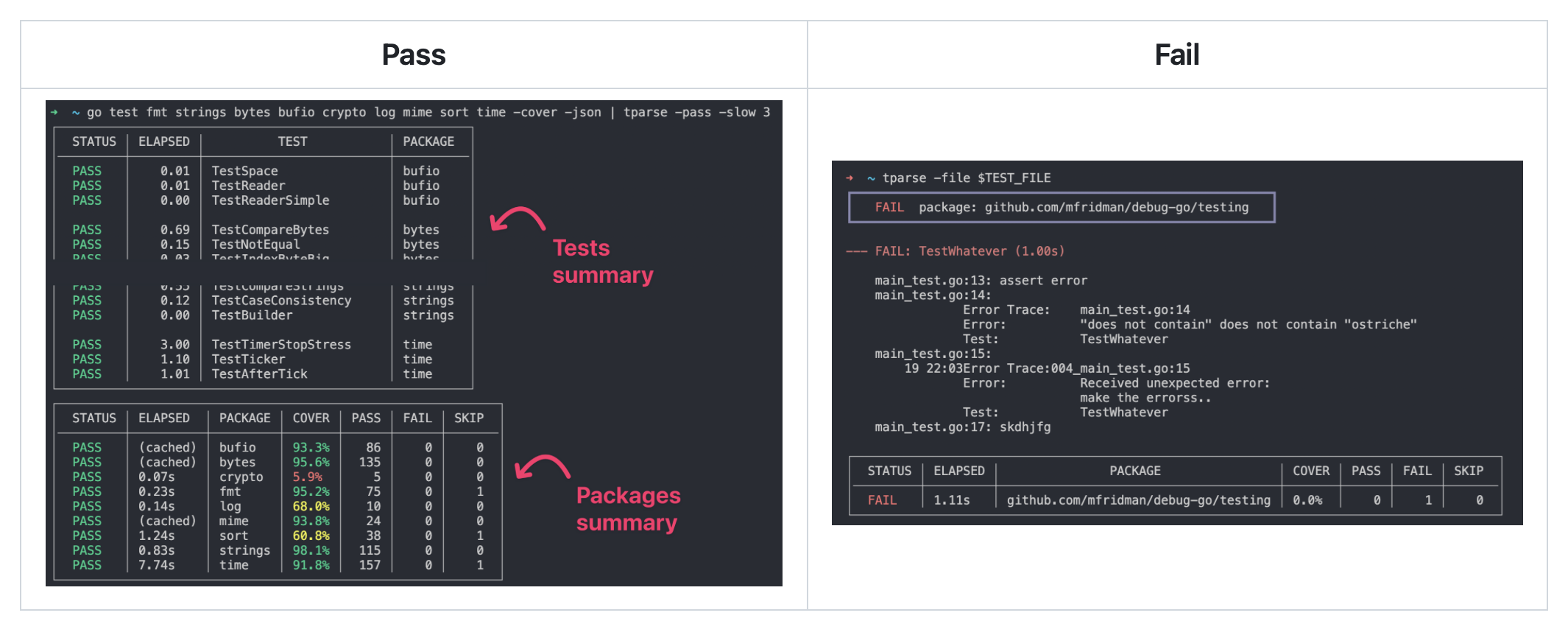
This lightweight wrapper around STDOUT of JSON of go test will nicely render colorized test status, details of failures, duration, coverage, and package summary. — @mfridman
set -o pipefail && go test ./... -json | tparse -all
Requirements
go install github.com/mfridman/tparse@latest
⏫ Decorate go test with richgo
Add colors and enrich go test output. It can be used in CI pipeline and has lots of alternative visualizations and options. — @kyoh86
richgo test ./...
Requirements
go install github.com/kyoh86/richgo@latest
⏫ Decorate go test with gotest
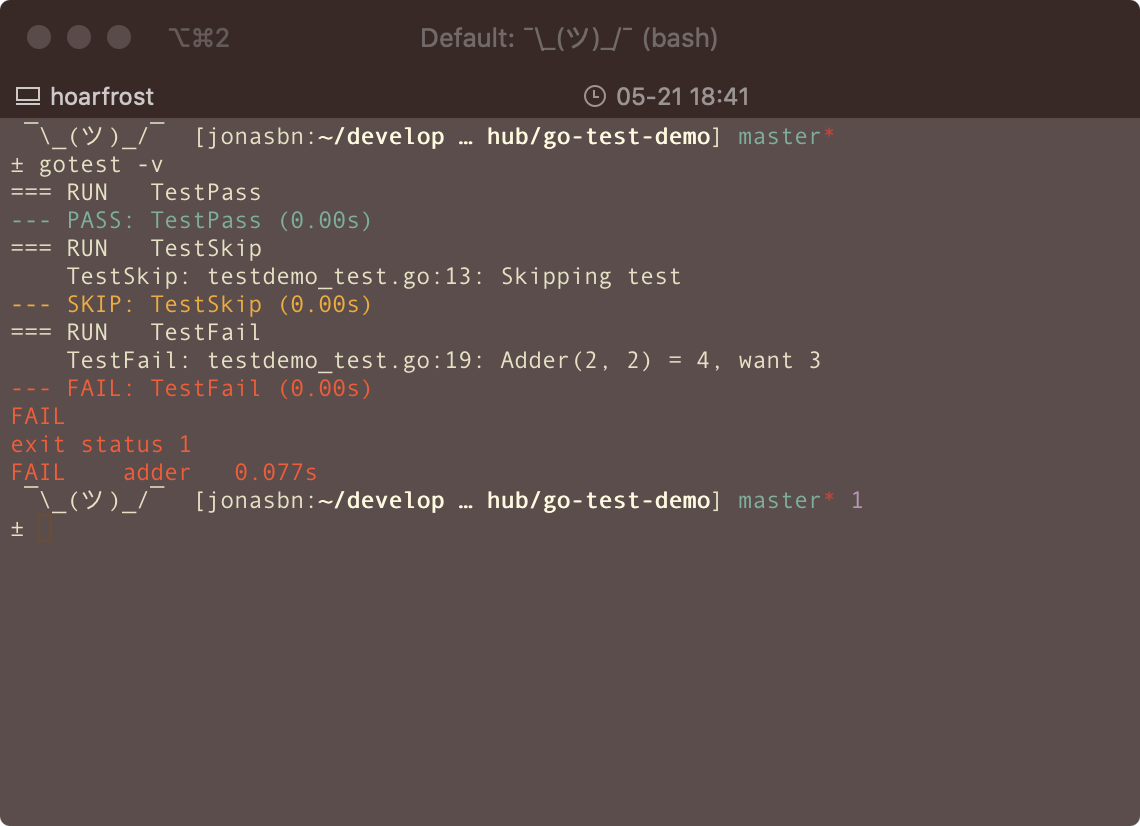
Add colors to go test output. Very lightweight wrapper around go test STDOUT. — @rakyll
gotest ./...
Requirements
go install github.com/rakyll/gotest@latest
⏫ Decorate go test with gotestsum
This wrapper around go test renders test output in easy to read format. Also supports JUnit, JSON output, skipping slow tests, running custom binary. — @dnephin
gotestsum --format dots

Requirements
go install gotest.tools/gotestsum@latest
⏫ Format go test results as documentation with gotestdox
Decorates go test results by converting CamelCaseTestNames into readable sentences. — @bitfield
gotestdox ./...

Requirements
go install github.com/bitfield/gotestdox/cmd/gotestdox@latest
⏫ Get slowest tests with gotestsum
This is subcommand of gotestsum that processes JSON output of go test to find slowest tests. — @dnephin
go test -json -short ./... | gotestsum tool slowest --threshold 500ms
Example
gotest.tools/example TestSomething 1.34s
gotest.tools/example TestSomethingElse 810ms
Requirements
go install gotest.tools/gotestsum@latest
⏫ Auto-Instrument skipping slowest tests with gotestsum
This is subcommand of gotestsum that processes JSON output of go test to find slowest tests and instruments test cases to skip them with t.Skip() statements. — @dnephin
go test -json ./... | gotestsum tool slowest --skip-stmt "testing.Short" --threshold 200ms
Example
gotest.tools/example TestSomething 1.34s
gotest.tools/example TestSomethingElse 810ms
Requirements
go install gotest.tools/gotestsum@latest
⏫ Automatically re-run failed tests with gotestsum
Other useful option of gotestsum is to re-run failed tests. For example, if you have flaky tests that are idempotent, then re-running them may be a quick fix. — @dnephin
gotestsum --rerun-fails --packages="./..."
Requirements
go install gotest.tools/gotestsum@latest
⏫ Make JUnit test report with gotestsum
JUnit is widely used format for test reporting. — @dnephin
go test -json ./... | gotestsum --junitfile unit-tests.xml
Requirements
go install gotest.tools/gotestsum@latest
⏫ Make JUnit test report with go-junit-report
JUnit is widely used format for test reporting. Go benchmark output is also supported. — @jstemmer
go test -v 2>&1 ./... | go-junit-report -set-exit-code > report.xml
Requirements
go install github.com/jstemmer/go-junit-report/v2@latest
⏫ Get packages without tests
If code coverage does not report packages without tests. For example for CI or quality control.
go list -json ./... | jq -rc 'select((.TestGoFiles | length)==0) | .ImportPath'
Example
github.com/gin-gonic/gin/ginS
github.com/gin-gonic/gin/internal/json
Requirements
https://stedolan.github.io/jq/download/
⏫ Perform Mutation Testing with ooze
Mutation testing is a technique used to assess the quality and coverage of test suites. It involves introducing controlled changes to the code base, simulating common programming mistakes. These changes are, then, put to test against the test suites. A failing test suite is a good sign. It indicates that the tests are identifying mutations in the code—it "killed the mutant". If all tests pass, we have a surviving mutant. This highlights an area with weak coverage. It is an opportunity for improvement. — @gtramontina
go test -v -tags=mutation

Requirements
go get github.com/gtramontina/ooze
⏫ Perform Mutation Testing with avito-tech/go-mutesting
This is fork of zimmski/go-mutesting. It has more mutators and latest updates. — @vasiliyyudin
go-mutesting ./...
for _, d := range opts.Mutator.DisableMutators {
  pattern := strings.HasSuffix(d, "*")

-	if (pattern && strings.HasPrefix(name, d[:len(d)-2])) || (!pattern && name == d) {
+	if (pattern && strings.HasPrefix(name, d[:len(d)-2])) || false {
    continue MUTATOR
  }
}
Requirements
go install github.com/avito-tech/go-mutesting/cmd/go-mutesting@latest
⏫ 🎁 Perform Mutation Testing with jonbaldie/go-mutesting
Fork of avito-tech/go-mutesting with a much richer mutator set, CI quality gates, covered MSI %, baseline tracking, per-test filtering, parallel execution, and LLM-ready output. — @jonbaldie
go-mutesting ./...
for _, d := range opts.Mutator.DisableMutators {
  pattern := strings.HasSuffix(d, "*")

-	if (pattern && strings.HasPrefix(name, d[:len(d)-2])) || (!pattern && name == d) {
+	if (pattern && strings.HasPrefix(name, d[:len(d)-2])) || false {
    continue MUTATOR
  }
}
Requirements
go install github.com/jonbaldie/go-mutesting/v2/cmd/go-mutesting@latest
⏫ Perform Mutation Testing with go-mutesting
Find common bugs source code that would pass tests. This is earliest tool for mutation testing in Go. More functions and permutations were added in other mutation Go tools it inspired. — @zimmski
go-mutesting ./...
for _, d := range opts.Mutator.DisableMutators {
  pattern := strings.HasSuffix(d, "*")

-	if (pattern && strings.HasPrefix(name, d[:len(d)-2])) || (!pattern && name == d) {
+	if (pattern && strings.HasPrefix(name, d[:len(d)-2])) || false {
    continue MUTATOR
  }
}
Requirements
go install github.com/zimmski/go-mutesting/cmd/go-mutesting@latest
⏫ Trace tests with go-test-trace
Collect test execution as distributed traces. This is useful for tracking test duration, failures, and flakiness. Your distributed tracing storage, search, UI, exploration, dashboards, and alarms all automatically become test status collection. If you run integration tests in your CI, then it is particularly handy to investigate your integration tests the same way as real requests, such as Go processes, databases, etc. However, if you do not have distributed traces, it is still useful for ad hoc investigations. This tool processes STDOUT of go test. No automatic instrumentation is done. — @rakyll
go-test-trace ./...
Requirements
# open telemetry collector
# traces UI (Datadog, Jaeger, Honeycomb, NewRelic)
go install github.com/rakyll/go-test-trace@latest
⏫ Speedup tests for large codebases
As of 2023-12-11, large codebases may be slow to run tests by default commands. Compiling package test binaries first and executing them later can lead to significant overall speedup.
go test -c ./pkg/mypackage -o my_pkg_test_binary.bin
./my_pkg_test_binary.bin | ... # normal test output post processing
Dependencies
⏫ Upgrade dependencies
In case VSCode or GoLand broke and you need to update dependencies manually.
go get -u ./...
⏫ Get Go version of current module
For example, setup correct Go version automatically from go.mod in CI.
go mod edit -json | jq -r .Go
Requirements
https://stedolan.github.io/jq/download/
⏫ Get Go versions of upstream modules
Use this when upgrading version of Go or finding old modules.
go list -deps -json ./... | jq -rc 'select(.Standard!=true and .Module.GoVersion!=null) | [.Module.GoVersion,.Module.Path] | join(" ")' | sort -V | uniq
Example
1.11 github.com/ugorji/go/codec
1.11 golang.org/x/crypto
1.12 github.com/golang/protobuf
Requirements
https://stedolan.github.io/jq/download/
⏫ Get directly dependent modules that can be upgraded
Keep your modules updated. Similar function is integrated in VSCode official Go plugin and GoLand.
go list -u -m $(go list -m -f '{{.Indirect}} {{.}}' all | grep '^false' | cut -d ' ' -f2) | grep '\['
Example
github.com/goccy/go-json v0.5.1 [v0.7.3]
github.com/golang/protobuf v1.3.3 [v1.5.2]
github.com/json-iterator/go v1.1.9 [v1.1.11]
⏫ Get upstream modules without Go version
Find outdated modules or imports that you need to upgrade.
go list -deps -json ./... | jq -rc 'select(.Standard!=true and .Module.GoVersion==null) | .Module.Path' | sort -u
Example
github.com/facebookgo/clock
golang.org/x/text
gopkg.in/yaml.v2
Requirements
https://stedolan.github.io/jq/download/
⏫ Get available module versions
This works even if you did not download or install module locally. This is useful to check to which version you can upgrade to, what is the latest version, and whether there are v2+ major versions recognized by Go toolchain.
go list -m -versions github.com/google/gofuzz
⏫ Get go module libyear, number of releases, version delta with go-libyear
libyear is a simple measure of software dependency freshness. It is a single number telling you how up-to-date your dependencies are. For example Rails 5.0.0 (June 2016) is 1 libyear behind 5.1.2 (June 2017). This tool can also compute number of releases, and version number delta. — @nieomylnieja
go-libyear /path/to/go.mod
Example
package                             version  date        latest   latest_date  libyear
github.com/nieomylnieja/go-libyear           2023-11-06                        2.41
github.com/pkg/errors               v0.8.1   2019-01-03  v0.9.1   2020-01-14   1.03
github.com/urfave/cli/v2            v2.20.0  2022-10-14  v2.25.7  2023-06-14   0.67
golang.org/x/mod                    v0.12.0  2023-06-21  v0.14.0  2023-10-25   0.35
golang.org/x/sync                   v0.3.0   2023-06-01  v0.5.0   2023-10-11   0.36
Requirements
go install github.com/nieomylnieja/go-libyear/cmd/go-libyear@latest
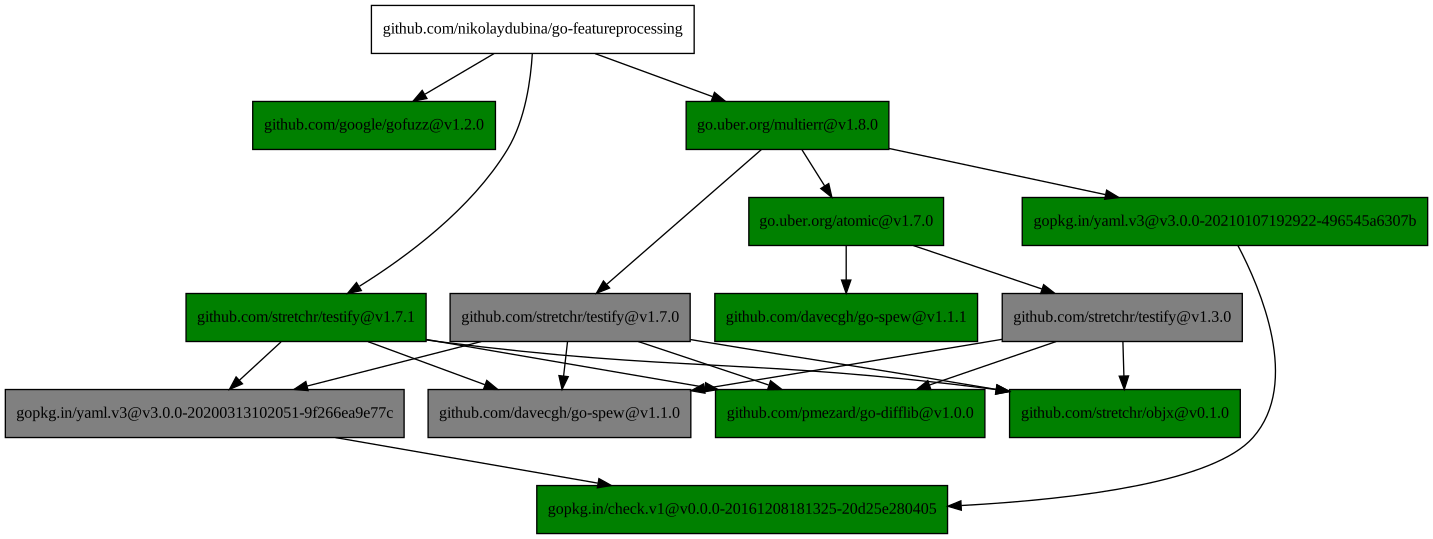
⏫ Make graph of upstream modules with modgraphviz
For each module, the node representing the greatest version (i.e., the version chosen by Go's minimal version selection algorithm) is colored green. Other nodes, which aren't in the final build list, are colored grey. — official Go team
go mod graph | modgraphviz | dot -Tsvg -o mod-graph.svg
Requirements
https://graphviz.org/download/
go install golang.org/x/exp/cmd/modgraphviz@latest
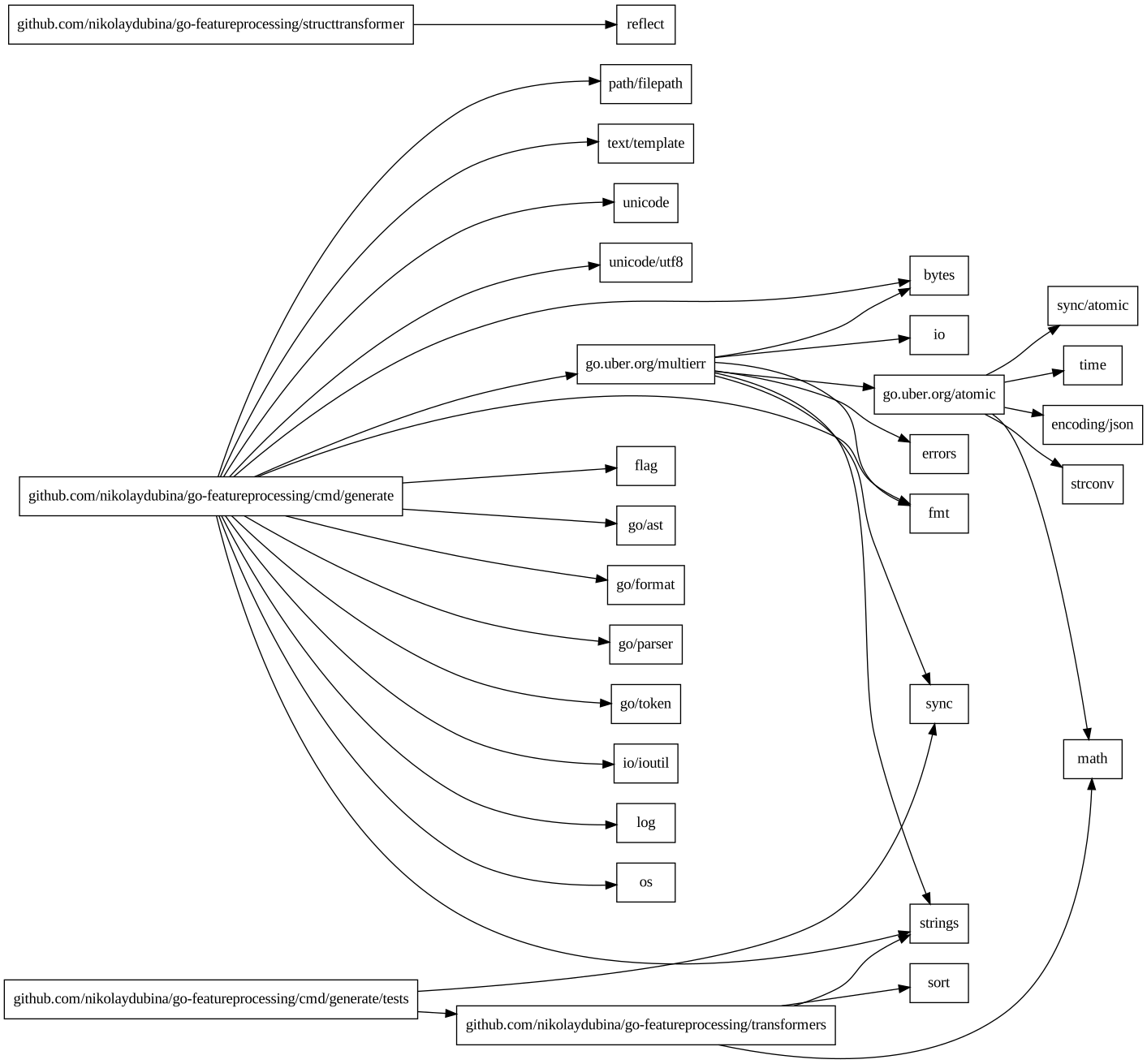
⏫ Make graph of upstream packages with import-graph
Find unexpected dependencies or visualize project. Works best for small number of packages, for large projects use grep to narrow down subgraph. Without -deps only for current module. — @nikolaydubina
go list -deps -json ./... | jq -c 'select(.Standard!=true) | {from: .ImportPath, to: .Imports[]}' | jsonl-graph | dot -Tsvg > package-graph.svg
Requirements
https://stedolan.github.io/jq/download/
https://graphviz.org/download/
go install github.com/nikolaydubina/import-graph@latest
go install github.com/nikolaydubina/jsonl-graph@latest
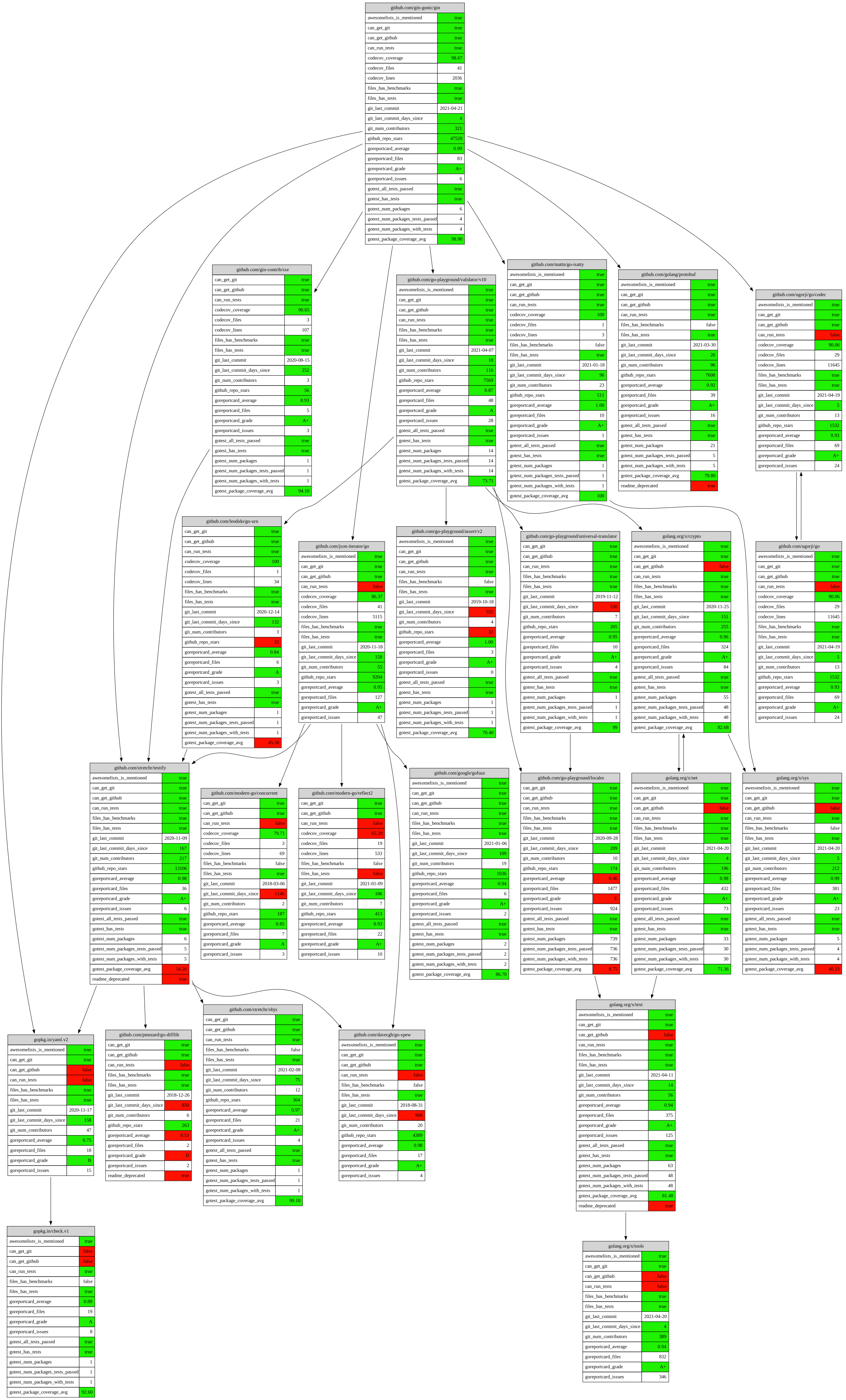
⏫ Scrape details about upstream modules and make graph with import-graph
Find low quality or unmaintained dependencies. — @nikolaydubina
go mod graph | import-graph -i=gomod | jsonl-graph -color-scheme=file://$PWD/basic.json | dot -Tsvg > output.svg
Requirements
https://graphviz.org/download/
go install github.com/nikolaydubina/import-graph@latest
go install github.com/nikolaydubina/jsonl-graph@latest
⏫ Scrape licenses of upstream dependencies with go-licenses
Collect all the licenses for checking if you can use the project, for example in proprietary or commercial environment. — Google
go-licenses csv github.com/gohugoio/hugo
Example
github.com/cli/safeexec,https://github.com/cli/safeexec/blob/master/LICENSE,BSD-2-Clause
github.com/bep/tmc,https://github.com/bep/tmc/blob/master/LICENSE,MIT
github.com/aws/aws-sdk-go,https://github.com/aws/aws-sdk-go/blob/master/LICENSE.txt,Apache-2.0
github.com/jmespath/go-jmespath,https://github.com/jmespath/go-jmespath/blob/master/LICENSE,Apache-2.0
github.com/gorilla/websocket,https://github.com/gorilla/websocket/blob/master/LICENSE,BSD-2-Clause
github.com/pelletier/go-toml/v2,https://github.com/pelletier/go-toml/blob/master/v2/LICENSE,MIT
github.com/spf13/cobra,https://github.com/spf13/cobra/blob/master/LICENSE.txt,Apache-2.0
github.com/kyokomi/emoji/v2,https://github.com/kyokomi/emoji/blob/master/v2/LICENSE,MIT
go.opencensus.io,Unknown,Apache-2.0
github.com/Azure/azure-storage-blob-go/azblob,https://github.com/Azure/azure-storage-blob-go/blob/master/azblob/LICENSE,MIT
github.com/yuin/goldmark-highlighting,https://github.com/yuin/goldmark-highlighting/blob/master/LICENSE,MIT
Requirements
go install github.com/google/go-licenses@latest
⏫ Explore dependencies with goda
This tool has extensive syntax for filtering dependencies graphs. It can work with packages and modules. — Egon Elbre
goda graph . | dot -Tsvg -o graph.svg
goda graph -cluster -short "github.com/nikolaydubina/go-cover-treemap:all" | dot -Tsvg -o graph.svg

Requirements
https://graphviz.org/download/
go install github.com/loov/goda@latest
⏫ Explore dependencies interactively with spaghetti
Useful in large refactorings, dependency breaking, physical layout changes. — Alan Donovan, official Go team

Requirements
go install github.com/adonovan/spaghetti@latest
⏫ Explore dependencies graph interactively with modview
Transform your Go project's dependency graph into a dynamic, interactive visualization with modview. This powerful tool takes the complexity out of your module graph, offering a clear and explorable view of your project's dependencies. — @bayraktugrul
modview --open

Requirements
go install github.com/bayraktugrul/modview@latest
⏫ Explore dependencies graph in CLI with depth
Use this tool to retrieve and visualize Go source code dependency trees in CLI. You can also visualize multiple packages at once, set max depth, select internal only, and show explanation. — @KyleBanks
depth github.com/KyleBanks/depth/cmd/depth
Example
github.com/KyleBanks/depth/cmd/depth
  ├ encoding/json
  ├ flag
  ├ fmt
  ├ io
  ├ log
  ├ os
  ├ strings
  └ github.com/KyleBanks/depth
    ├ fmt
    ├ go/build
    ├ path
    ├ sort
    └ strings
12 dependencies (11 internal, 1 external, 0 testing).
Requirements
go install github.com/KyleBanks/depth/cmd/depth@latest
⏫ Explore your GOPATH with GUI with goggles
Browse and search local packages. View package documentation. Displays badges for GoDoc, Goreportcard, and Travis.CI (if .travis.yml is present). — @KyleBanks
goggles

Requirements
go install github.com/KyleBanks/goggles/cmd/goggles@latest
⏫ Enforce Go code architecture with go-arch-lint
Architecture linter. Will check all project import path and compare with arch rules defined in yml file. Useful for hexagonal / onion / ddd / mvc / etc patterns. — @fe3dback
go-arch-lint

Requirements
go install github.com/fe3dback/go-arch-lint@latest
⏫ Check Clean Architecture with go-cleanarch
Clean architecture validator for go, like a The Dependency Rule and interaction between packages in your Go projects. — @roblaszczak
go-cleanarch
Requirements
go install github.com/roblaszczak/go-cleanarch@latest
⏫ Use go mod directives
Tell Go compiler which versions of upstreams to include in your build. Tell all users of your module how to deal with versions of your module.
// Deprecated: use example.com/mod/v2 instead.
module example.com/mod

go 1.16

require example.com/other/thing v1.0.2
require example.com/new/thing/v2 v2.3.4
exclude example.com/old/thing v1.2.3
replace example.com/bad/thing v1.4.5 => example.com/good/thing v1.4.5
retract [v1.9.0, v1.9.5]
⏫ Locally patch dependency with replace
This can be useful for development. First appeared on blog.
# clone your dependency to $DEP folder
# make changes
go mod edit -replace github.com/google/go-cmp=$DEP
⏫ Locally patch dependency with go.work
This is an alternative version may be more robust to accidental mistakes. First appeared on blog.
# clone your dependency to $DEP folder
# make changes
go work init
go work use . $DEP
Code Visualization
⏫ Make C4 diagram with go-structurizr
This library provides tools to generate C4 diagrams. The process is a bit involved, however you get diagram generated from real Go code automatically. Steps are outlined in blog. — @krzysztofreczek
Requirements
manually defining Go main.go script to invoke library
graphviz
manual coloring spec (DB, classes)
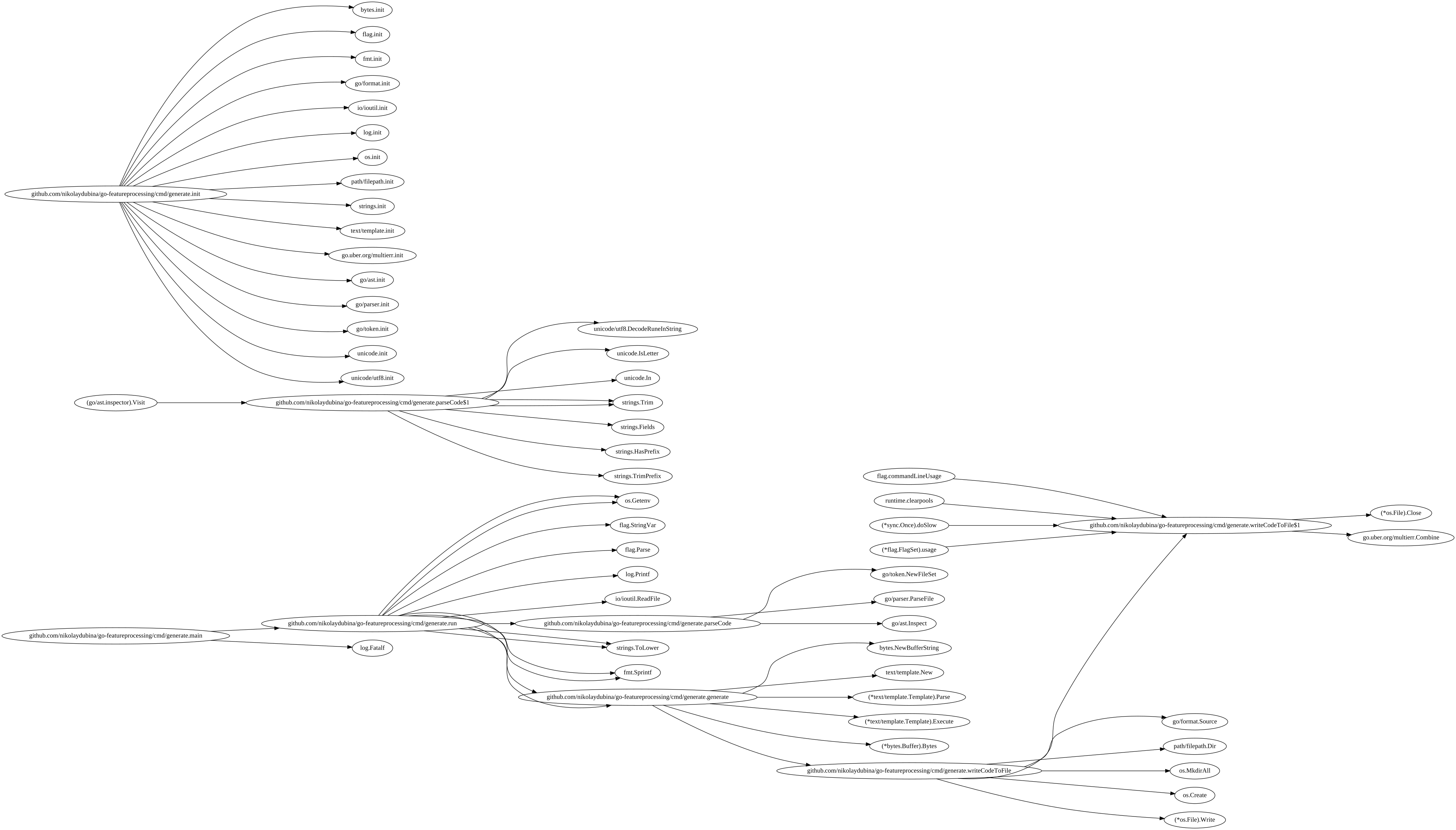
⏫ Make graph of function calls with callgraph
Visualize complex or new project quickly or to study project. Requires main.go in module. Supports Graphviz output format. Has many options for filtering and formatting. — official Go team
callgraph -format graphviz . | dot -Tsvg -o graph.svg
recommend: grep <package/class/func of interest>
recommend: grep -v Error since many packages report error
recommend: adding `rankdir=LR;` to graphviz file for denser graph
recommend: you would have to manually fix graphviz file first and last line
Requirements
go install golang.org/x/tools/cmd/callgraph@latest
⏫ Make graph of function calls in package with go-callvis
Quickly track which packages current package is calling and why. — @ofabry
go-callvis .

Requirements
go install github.com/ofabry/go-callvis
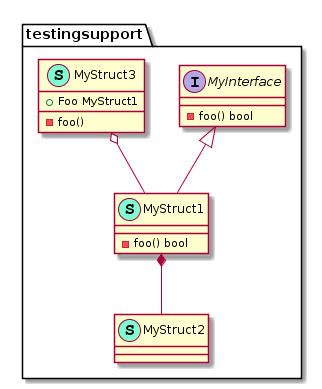
⏫ Make PlantUML diagram with goplantuml
Generates class diagrams in a widely used format with information on structs, interfaces, and their relationships. Render .puml files in, for example, planttext.com. — @jfeliu007
goplantuml -recursive path/to/gofiles path/to/gofiles2
Requirements
go get github.com/jfeliu007/goplantuml/parser
go install github.com/jfeliu007/goplantuml/cmd/goplantuml@latest
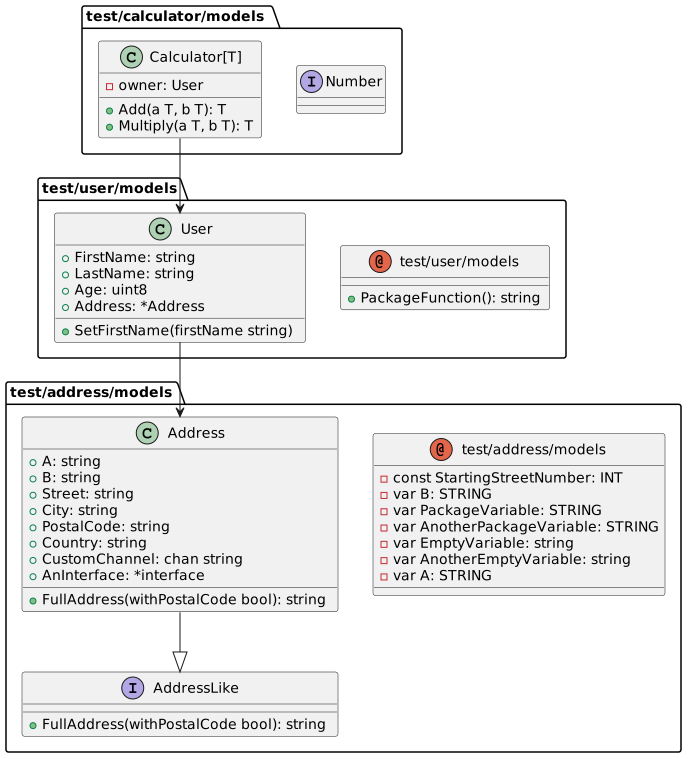
⏫ Make PlantUML diagram with go-plantuml
Automatically generates visualizations of classes and interfaces for Go packages. We recommend the recursive option. Render .puml files in, for example, planttext.com. — @bykof
go-plantuml generate -d . -r -o graph.puml
Requirements
go install github.com/bykof/go-plantuml@latest
⏫ Visualize the entropy of a code base with a 3D force-directed graph with dep-tree
This excellent interactive visualisation tool lets you explore code base as 3D graph. The more decoupled and modular a code base is, the more spread and clustered the graph will look like. — @gabotechs

⏫ Make 3D chart of Go codebase with gocity
Fresh artistic perspective on Go codebase. GoCity is an implementation of the Code City metaphor for visualizing source code - folders are districts; files are buildings; structs are buildings on the top of their files. This project has research paper "GoCity Code City for Go" at SANER'19. Also available at go-city.github.io. — @rodrigo-brito

Requirements
go install github.com/rodrigo-brito/gocity@latest
⏫ Make histogram of Go files per package
Find when package is too big or too small. Adjust histogram length to maximum value.
go list -json ./... | jq -rc '[.ImportPath, (.GoFiles | length | tostring)] | join(" ")' | perl -lane 'print (" " x (20 - $F[1]), "=" x $F[1], " ", $F[1], "\t", $F[0])'
Example
================== 18	github.com/gin-gonic/gin
     ============= 13	github.com/gin-gonic/gin/binding
                 = 1	github.com/gin-gonic/gin/internal/bytesconv
                 = 1	github.com/gin-gonic/gin/internal/json
       =========== 11	github.com/gin-gonic/gin/render
Requirements
https://stedolan.github.io/jq/download/
⏫ Explore Go code in browser powered by go-guru with pythia
Explore Go source code in browser. It provides exported symbols summary for navigation. It answers questions like: definition; callers; implementers. It is browser frontend based on go-guru, which was developed by Go core team from Google. — @fzipp
pythia net/http
Requirements
go install github.com/fzipp/pythia@latest
go install golang.org/x/tools/cmd/guru@latest
⏫ Interactively visualize packages with goexplorer
Based on go-callvis, this tool is an interactive package explorer of packages. This tool has not been updated for a long time. — @ofabry

⏫ Make D2 graph of architecture and dependencies with go-arch-lint graph
Can include vendors or not, and be of type 'flow' or 'di'. — @fe3dback
go-arch-lint graph

Requirements
go install github.com/fe3dback/go-arch-lint@latest
Code Generation
⏫ Run go:generate in parallel
Official Go team encourages to run sequentially. However, in certain situations, such as lots of mocks, parallelization helps a lot, albeit, you should consider including your generated files in git. The solution below spawns multiple processes, each per pkg.
grep -rnw "go:generate" -E -l "${1:-*.go}" . | xargs -L1 dirname | sort -u | xargs -P 8 -I{} go generate {}
⏫ Generate String method for enum types
This is an official tool for generating String for enums. It supports overrides via comments. — official Go team
package painkiller

//go:generate stringer -type=Pill -linecomment

type Pill int

const (
  Placebo Pill = iota
  Ibuprofen
  Paracetamol
  PillAspirin   // Aspirin
  Acetaminophen = Paracetamol
)

// "Acetaminophen"
var s string = Acetaminophen.String()
Requirements
go install golang.org/x/tools/cmd/stringer@latest
⏫ Generate enums encoding with go-enum-encoding
Generate encoding code for enums. This follows json struct tag notation. — @nikolaydubina
go generate ./...
type Color struct{ c uint }

//go:generate go-enum-encoding -type=Color
var (
  Undefined = Color{}  // json:"-"
  Red       = Color{1} // json:"red"
  Green     = Color{2} // json:"green"
  Blue      = Color{3} // json:"blue"
)
Requirements
go install github.com/nikolaydubina/go-enum-encoding@latest
⏫ Generate enums with goenums
Generate strict and fast enums. Generated code is much more tightly typed than just iota defined enums. You will get JSON decoder and encoder as well. This tool allows to generate extra fields and default values in enum structs. — @zarldev
goenums <file-with-iota.go>
more like this
bionic-reading.nvim
Toggle Bionic Reading for Neovim buffers using syllable based highlighting